Monday, 10 May 2010

Great Goal Or Horrible Defence?

Maxim Lapierre scored the game-winner tonight in Game Six of the Montreal-Pittsburgh series, and he did so in pretty spectacular fashion considering his agitating, checking role on the team. It wasn't a dispy-doodle, spin-o-rama, ballet-on-ice goal, but it will certainly be high on the list of Lapierre's highlight reel goals. Here's a look at it.

Now, I'm not going to discredit Lapierre's effort in scoring this goal. He worked hard, juking Goligoski off his hip. He cut to the middle into a high-traffic area, battled to maintain possession, and then fired home the goal.

My question is simple: great goal, or were we witness to some porous defence played by Alex Goligoski and Jordan Leopold? Granted, the Penguins had their fifth and sixth defencemen out on the ice, but I'm leaning heavily towards some brutal defensive play by the two Penguins on the eventual game-winning goal.

Have at it, kids. Good goal or brutal defence?

Until next time, keep your sticks on the ice!

Sunday, 9 May 2010

Happy Mom's Day!

I had every thought on penning a Mother's Day article about the sacrifices moms make in the wake of their children becoming hockey stars. But it donned on me that every single mom out there that drives her child to hockey, that brings warm cocoa and snacks to games and practices, that cheers and supports her child through wins and especially losses, that smiles and has tears well up in eyes when her child waves to her in the crowd is already the Most Valuable Parent in the world. That's not to say that dads are any less special, but today is Mom's Day, and she she deserves her chance at being an MVP.

I want to say thank you to my Mom for putting up with my obsession over the game of hockey, for supporting me when I played and when I still play, and for never once telling me she couldn't drive me to a game no matter where the game was or how insignificant the game of shinny was in her life. Mom, you certainly are an MVP. Thank you for always being there for me.

Today, I'm just going to link to some excellent Mother's Day stories from around the Interwebs because I want to spend my day with my MVP. I'll also tack ona special story that I'm following here at home just below. But I do want to spend time away from this monitor today with Mom. Is that selfish? Some may say yes, but she's my Mom and she deserves some heartfelt thanks today.

The RBC Cup, played for by the best Junior-A teams in the nation will be decided tonight in Dauphin, Manitoba as the hometown Dauphin Kings square off against BC's Vernon Vipers.

The Kings advanced to the RBC Cup Final last night by downing the La Ronge Ice Wolves of Saskatchewan by a 6-2 score. The Dauphin Kings have been perfect through the RBC Cup schedule thus far, and played the Vernon Vipers on May 1 on the opening day of the RBC Cup Tournament. Dauphin won that close game by a 6-5 score.

Earlier in the day, the Vernon Vipers advanced to the RBC Cup Final by downing the Brockville Braves of Ontario by a 2-0 score. Vernon's only loss at the tournament thus far was to Dauphin, so this match will have some intrigue as the two best teams in the tournament will meet to decide which team is hockey's best in the Junior-A ranks this season.

Game time is 2PM CST today from Credit Union Place in Dauphin, Manitoba. The game will be carried live on TSN starting at 3PM EST, so hunker down in front of the old TV with Mom, and watch the best teams from the Junior-A ranks in Canada battle it out for the right to be called "Champions". I'll have a full wrap-up this week on the RBC Cup and the championship team.

Until next time, keep your sticks on the ice!

Saturday, 8 May 2010

What A Tangled Web

Apparently, we find out if the NHL's sunbelt experiment is over on Tuesday night when city councillors for Glendale convene to determine the viability of Ice Edge Holdings' offer to keep the Phoenix Coyotes in Arizona. While it appears that the media in Winnipeg are making this a lot bigger than what it currently is, there is no doubt that there is a good chance that the councillors will vote against the options put forth by Ice Edge, leaving the team in limbo once again this summer. And the frustrating cycle of "will they stay or will they go" starts all over again for fans in Phoenix. Oi vay!

I know I said I wouldn't write about any team moving to Winnipeg again without a team actually in the process of moving, but the fever pitch is reaching ridiculous proportions, so it needs to be addressed. But I want to address the history of the problem that the Coyotes are currently facing, and how I see this playing out.

Let me be the first to say that I empathize with fans in Phoenix. Having seen the Jets leave in my lifetime, I can honestly say that I had some serious anger towards the NHL and towards Phoenix for a few years. However, after learning about the dramatic uphill battle the Jets faced as a small-market team and with the shortage of available billionaires in this city, the move was inevitable. I'm happy to say that I have no anger towards neither the NHL nor Phoenix, Glendale, and Arizona whatsoever today because I believe it was bound to happen. If it wasn't 1995, it would have been shortly afterwards.

Here's where things get murky in terms of the Phoenix-Winnipeg connection.

Ice Edge Holdings wants to bring professional hockey to Thunder Bay, Ontario, and it's very clear that an NHL team would have a hard time playing in a tiny arena in a market with a limited number of people. If Winnipeg was considered a small market, Thunder Bay would be considered a speck-of-dust market. I don't think the NHL would want to send teams to a place where there is no major media, no chance of television broadcasts, and no chance of having a team survive.

While the NHL may not be viable in Thunder Bay, an AHL franchise would be. And this is where the murky reference begins.

Ice Edge Holdings has asked for exclusive rights to deal with Glendale, essentially freezing Jerry Reinsdorf out of the negotiation process to own the team. With Reinsdorf - the NHL's preferred owner - out of the way, Ice Edge could demand whatever they like with no pressure from outside sources. In a sense, Ice Edge would be able to force Reinsdorf to the outside with no effort, giving them the ability to do whatever is needed to own the Coyotes. We'll call this EXHIBIT A.

Back in Winnipeg, Ted Wyman and Kirk Penton of the Winnipeg Sun are working leads on the Coyotes story, and decided to contact Ice Edge regarding their professional hockey dream in Thunder Bay. Keith McCullough, the chairman of Ice Edge Holdings, stated to the reporters that the group would be interested in purchasing the Manitoba Moose AHL franchise and relocating it to Thunder Bay if the True North Group was able to purchase and relocate the Coyotes back to Winnipeg. We'll call this EXHIBIT B.

Elliotte Friedman of CBC Sports reported that the asking price by the NHL for purchasing the Coyotes is $165 million. ESPN's Scott Burnside went further in reporting that a purchase agreement is already in place between the NHL and True North Sports and Entertainment in Winnipeg in the event that the Ice Edge Holdings' demands are not met. The NHL has denied that a purchase agreement is in place, but a reliable source has informed me that there have been discussions between the NHL and True North already. Whether or not this has happened, I cannot confirm, but I'll stick with my source: the NHL and Winnipeg are talking. We'll call this EXHIBIT C.

Because Ice Edge has the exclusive rights to negotiate with the city of Glendale, and because the NHL has basically demonstrated that it is not willing to start another season as the owner of the Phoenix Coyotes, the club will be sold this summer to someone. The "someone" is still a major question mark, but here's how those three exhibited pieces of evidence fit together:

  1. Ice Edge Holdings loses nothing if the city of Glendale accepts the terms of their deal, making "Exhibit A" the best option for Ice Edge Holdings, the city of Glendale, and the NHL. The Coyotes have an owner, they remain in Phoenix, and they can begin to operate as a normal NHL franchise once again.
  2. The city of Glendale rejects the offer made by Ice Edge Holdings, throwing this whole situation into second gear. Because Ice Edge retains the exclusive rights to deal with the city of Glendale, Jerry Reinsdorf cannot be considered, and Ice Edge can exhaust all of their options in exploring ways to keep the Coyotes in Glendale. The only problem? They still want pro hockey in Thunder Bay.
  3. After "exhausting" all possibilities of an ownership deal, and dragging the negotiations with the city of Glendale into early June, the Ice Edge Holdings group says "no thank you" to owning the Coyotes, putting the pressure on the NHL to secure an owner before the July 1 free agency period. With Reinsdorf out of the picture for over a month, the NHL will need someone with a lot of cash and resources to step in. This is the moment that True North has been waiting for in terms of NHL ownership. The terms in "Exhibit C" would be accepted, and the Coyotes would back the moving trucks up for a return to Manitoba's capital.
  4. The NHL would agree to sell the Coyotes to the True North group and relocate the team to Winnipeg in order to rid itself of the ownership fiasco. With the Coyotes on their way back to Winnipeg, the AHL's Manitoba Moose would be in a bit of a scheduling jam as their calendar got a whole lot more crowded. As stated in "Exhibit B", Ice Edge Holdings would come to their rescue, and relocate the AHL franchise to Thunder Bay for the start of the 2010-11 season, thereby satisfying their promise to deliver professional hockey to Thunder Bay.
  5. After a quick shuffle, the newly-relocated Winnipeg franchise would move to the Northwest Division, replacing the Colorado Avalanche who would move to the Pacific Division, thereby satisfying all divisional alignments.
I feel for the fans in Phoenix because history is definitely repeating itself in the case of this franchise. Bear to witness this set of facts:
  • A deal to save the team, keeping it in its current location, falls apart in the eleventh hour.
  • A mad scramble ensues to find an owner, regardless of whether the team stays or not.
  • The new potential owner makes unreasonable demands, such as covering the team's losses and adding other team cost-cutting measures, to the city of the team.
  • An unreasonable deadline for these demands is imposed with an "or else" tagged onto the clauses.
That's what happened 14 years ago in Winnipeg. And it's exactly what is happening in Glendale right now. Again, I empathize with the people in Phoenix because I know what you went through.

That clause that Ice Edge and Reinsdorf asked for in covering the $20-30 million loss? Happened in Winnipeg. The City of Winnipeg wrote a cheque for $20 million in the final season that the Jets were in town to cover player salaries and other expenses in order to keep the Jets in town. Sound familiar?

Just to add a little salt to the wound, the last playoff opponent that the Winnipeg Jets faced in their final season? The Detroit Red Wings, who dispatched the soon-to-be-moved franchise in six games, rather than seven.

I'm not here to start telling people that "those who do not know history are doomed to repeat it". I just want the people in Phoenix to know that this franchise has faced this entire ordeal once before, and it resulted in the team being relocated. What I am here to say, however, is to learn from Winnipeg's mistakes if you truly want to keep your team. We caved in on several fronts, and we still lost the team.

How much is the City of Glendale willing to lose before they cut their losses? And how far will they go to save their beloved NHL franchise?

Until next time, keep your sticks on the ice!

Friday, 7 May 2010

Hockey In 1935

Hockey history is probably the biggest reason why I love this game so much. Diving deep into historical pieces allows one to appreciate the old sweaters and uniforms the teams wore, the old equipment that is now saved for museums, and the stories from those times that transcended that era. Thanks to Popular Science's online archives, we are lucky enough to take a glimpse into hockey back in 1935. Honestly, I found it fascinating.

Popular Science published five pages in their February 1935 edition of the magazine explaining the nuances of hockey. In it, they had some fairly amazing facts about the game back in 1935, and how different today's game is from that forgotten era.

The first page of the article has a wonderful picture of a goal-mouth battle between the Detroit Red Wings and the Chicago Black Hawks. Author Edwin Teale declared the sport of ice hockey as being in "the position of national winter sport of American fans", and its popularity was gained through what hockey is known for: "the fastest, roughest, hardest-hitting game on the sport calendar". Teale also speaks of the difference between Canadians, who apparently don't mind the cold to watch hockey, and Americans, who prefer the indoor game.

This carries into the second page where Teale writes about how fans can remain warm while the ice remains frozen. Namely, he describes in detail how the "ice griddle" of pipes work in the concrete floor within Madison Square Garden to create an one-inch thick layer of ice for the players. What is more surprising is that the ice-making equipment cost MSG a total of $70,000 in 1935! That kind of money was unheard of back then!

As Teale described, the battle between the refrigeration plant and the radiators in the stands to keep the fans warm was tedious before the investment. During one game, the ice was so slushy that skates cut through the ice and struck the concrete floor, ruining the skates. $180 worth of skates were damaged, and, at $15 per skate, was a costly loss for a dozen pairs of skates.

Of course, goaltender Roy Worters of the New York Americans - described as "[t]he guard at the net" by Teale - is plastered all over the page in his gorgeous sweater, and you can't miss the Ottawa Senators player in the top-right corner. Beautiful stripes! Just as a note, that Senators player picture had to have been taken during the 1933-34 season as the Senators had moved to St. Louis to become the Eagles for the 1934-35.

The third page contains some very interesting information. According to the information that Teale has, 17,647 hockey players were registered in Canada in 1935. The approximate population of Canada in 1935 was 10,845,000. That means approximately three people played hockey for every two thousand people in Canada at that time. That's not bad for a developing country.

Teale goes over a few standard rules, but the "one sports writer" who described hockey as "a combination of forked lightning, old-fashioned shinny, and second-degree murder" made me chuckle. Especially when you consider the picture above of an Ottawa Senators player up-ending a Boston Bruins player.

I found it interesting that the average weight of an NHL player in 1935 was 155-pounds, and that the 210-pounds that "Ching" Johnson weighed was "an exception". Also interesting to me is that a player's career lasted five years on average, and that his legs would be the first thing to go.

What caught my attention, though, were the dollar figures that NHL franchises were worth back at the start of the NHL. In 1924, "a franchise for one of the big cities cost about $3,000. By 1929, it had increased to $75,000. And, today, it stands at a hundred times its original figure, approximately $300,000". Considering that an expansion fee today is approximately $300-400 million, it appears that owning stock in an NHL franchise will never lose you money.

After some interesting injury information, there's a portion of the article dedicated to some headgear worn in the early NHL. Ching Johnson apparently sported "an aluminum protector to hold a broken jaw in place". And two Montreal Canadiens - Armand Mondou and Johnny Gagnon - wore "queer black headgear suggesting derby hats shoved down over their ears". Mondou is the first man in NHL history to be awarded a penalty shot, and it appears that he may be the first man who didn't play between the pipes to don headgear in an NHL game.

The fourth page of the article explains how the NHL added what seems like a very dumb rule in 1934 about how all players must wear skates. For a league that was started a decade earlier, you would think that these sorts of things would have worked themselves out by then, right?

Teale discusses some of the longer games seen in the first decade of the NHL, and explains how nets were altered to prevent the pucks from rebounding back out of the net where referees might miss the goal. He also speaks highly of Warren Roach, a shopkeeper who sharpened skates across from Madison Square Garden. Roach could sharpen up to 150 pairs of skates per day, and there's a fabulous picture in the lower-right of the page that shows him at work.

The history of the game, along with some information on the Intercollegiate Quadrangular Hockey League, is discussed, and we get to see that the Hobey Baker Award given to the champion of the four IQHL teams is nearly as old as the Stanley Cup!

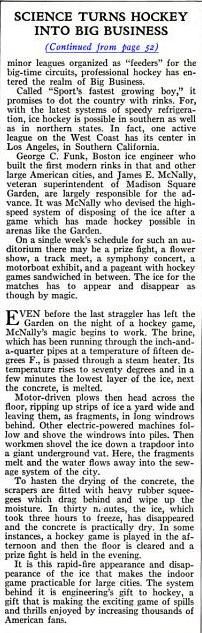
The final strip of the article discusses how the ice is removed for the many events that occur at Madison Square Garden. There is some credit given to George C. Funk as the man who was largely responsible for the modern rinks in most large American cities. James E. McNally, MSG's superintendent, is credited as the man who developed the system to remove the ice and dry the concrete below in amazing speed for additional events happening at Madison Square Garden. McNally basically invented a primitive zamboni to aid in the drying of the concrete.

This article is one of the coolest "historical" articles I've read simply due to how thorough Mr. Teale was in his examination of the game. Take the time to read through some of the info from those pages. I'll bet you'll learn something that you didn't know. And that's why I love hockey history.

Until next time, keep your sticks on the ice!

Thursday, 6 May 2010

TBC: The Rookie

It's kind of funny to be reviewing this book now, but I feel that the information contained within its covers makes a lot more sense today than it may have a few years ago. Today, Teebz's Book Club is proud to review The Rookie, written by Shawna Richer and published by McClelland & Stewart. Shawna Richer, a sportswriter for the Globe and Mail in Canada, decided that she would like to follow around the NHL's most-hyped freshman in some time during his first year in the spotlight in the NHL as a member of the Pittsburgh Penguins, chronicling his season as he embarked on an NHL career. What she found in her year-long tailing of Sidney Crosby is that the young man is remarkable in terms of the time he gives to fans, and how dedicated to and passionate about hockey he is.

Shawna Richer was the Globe and Mail's Atlantic bureau chief before embarking on her year-long crusade following Pittsburgh's new star. She was based in Halifax where she got to see and hear a lot about Sidney Crosby's exploits as he made his way towards the NHL. Richer worked as editor-in-chief for the Telegraph-Journal in New Brunswick, but is now writing for the Globe and Mail once again.

Miss Richer leaves no stone unturned in her examination of Crosby's rookie season in the NHL. She documents how the Penguins were awarded the first pick in the NHL Draft Lottery coming out of the 2005 Lockout, and how lightning would strike again as the Penguins - in dire financial straits - found another dynamic, young player to pull them out of the fire when they needed it most. Much like his idol and new owner, Mario Lemieux saved the Penguins from financial despair when he was drafted, and now Crosby would be suiting up in the same dressing room as his favorite player.

It was rather interesting to hear Crosby's perspective on his first season in the NHL. The Penguins had a rather poor season in the win-loss column, but there were definitely highlights that Miss Richer identified. From Crosby's phenomenal play that allowed him to join the 100-point club as an 18 year-old to his competition with Washington's Alexander Ovechkin for the Calder Trophy to the development of the younger Penguins to the adversity his team went through, Crosby's views on the Pittsburgh Penguins show an extraordinary young man through Miss Richer's recordings.

There was a lot of adversity in his first year. A couple of injuries slowed Crosby down. A Olympic team roster spot was put on hold when Wayne Gretzky and his management team decided to leave the youngster at home. But the biggest surprises came in January 2006. On January 18, a frustrated Zigmund Palffy - one of Pittsburgh's prized free agent signings - walking into GM Craig Patrick's office and asked a simple question: "Can we talk?"

Patrick didn't have to be clairvoyant to see what was coming. Palffy stated that he was retiring due to a shoulder injury that simply hadn't felt right all season long. Due to his personal reasons, Patrick was hardly in a position to convince the winger to stay on, and Palffy left mid-season despite playing on a line with Crosby.

The second biggest surprise came just six days later on January 24. The man who had saved the Pittsburgh Penguins on a number of occasions, both on and off the ice, had found himself as an old man in a young man's game. Mario Lemieux, standing before Pittsburgh media and his teammates, announced he was retiring from the game of hockey at the age of forty. Crosby's landlord, idol, captain, and friend was leaving the game just as Crosby was beginning. However, in Lemieux's eyes, the torch had been passed to Crosby as the rookie led the Penguins in scoring.

It's interesting to see how Crosby kept all of these events from becoming much larger than some people were making them. Through all of the disappointment, he was realistic and practical about the events unfolding around him. On not being selected for the 2006 Canadian Olympic team:

"It would have been nice, definitely. But there are so many good players in Canada, and being so young, I don't think I expected to be picked. I prepared myself. I tried to have the best first half possible and give myself an opportunity, and I was right in the mix. I'm not there, but at least I can say I gave it a good shot. Like with World Juniors, when you play so much hockey you always know there's other teams to play for. But if you focus on playing for your own team, everything else takes care of itself. I just tried to worry about helping the team here. If I can contribute and make things happen here, then that's the best way I can make a difference."
That's a pretty good sign that Crosby had been prepared for moments like this for a long time. And it's not just the maturity he shows, but the way he handles himself and speaks glowingly about others that shows he might be one of the most mature eighteen year-olds to ever play in the NHL.

The Rookie is a very interesting look at the Penguins' season and how Crosby worked through his first professional season. Shawna Richer wrote the book in a chronological manner, but her insight into Crosby's past allows for a number of excellent side stories to be told. The Rookie is probably not the best story for non-Penguins fans, but it is certainly a story worth reading by hockey fans, and I encourage everyone to put aside any "Crosby bias" to give this book a shot. I enjoyed reading it, and I feel it is worthy of the Teebz's Book Club Seal of Approval for its honest look at Crosby's first season in the NHL. Richer does editorialize occasionally, but she's on the mark with most of her comments in reflection.

Until next time, keep your sticks on the ice!