



Showing posts with label Russian Super League. Show all posts

Sunday, 25 August 2024

San Jose's Next Stopper

With the Nashville Predators trading star prospect goaltender Yaroslav Askarov earlier this weekend, one of the best options for any team to upgrade their goaltending situation is off the market. No one is saying that Askarov will be a star in the NHL, but his body of work in the AHL seems to indicate that this is a very possible outcome. In saying that, today is less about Askarov's potential and more about San Jose's collection of players who have stood in the crease. Today, we look at the shiver of Sharks who stopped pucks in San Jose that have made a difference in the outcome of the franchise! Not every netminder will be listed here, but these are the memorable goalies who wore the teal on the west coast at some point!

We can talk about Jeff Hackett and Brian Hayward in the early days of the San Jose Sharks, but there was a Latvian kid who stole the show with his athleticism and puck-stopping skills that needs to be mentioned. Drafted 196th-overall in the tenth round of the 1989 NHL Entry Draft by the Minnesota North Stars, goaltender Arturs Irbe was selected in the 1991 Dispersal Draft from the North Stars as the 18th selection of the 24 players they could take from the North Stars. At the time, Irbe was playing in the Soviet Championship League with Dynamo Riga, so it wasn't expected that he'd make the jump immediately from the Soviet Union to the NHL.

In 1991, Irbe would land in San Jose where he played 13 games as he adjusted to North American hockey, going 2-6-3 with a 4.47 GAA and an .868 save percentage. 1992-93 didn't go much better after he saw action in 36 games, posting a 7-26-0 record with a 4.11 GAA and an .886 save percentage. It seemed like Irbe wasn't the goalie that San Jose hoped they were getting when they chose him in the dispersal draft, but they stuck with the "little Latvian" into the 1993 season.

The addition of some key players and a new coach in the 1993 offseason pushed San Jose to new heights in the NHL's Pacific Division, but this was Irbe's breakout season as well. He played in 74 of the 84 games that the Sharks played, posting a 30-28-16 record on the strength of a 2.89 GAA and an .899 save percentage. The defensively-minded Sharks proved that they could hang with some of the better teams in the NHL that season, shocking everyone with a first-round upset of the Detroit Red Wings in their first-ever playoff appearance! They'd fall to the Maple Leafs in Round Two in seven games, but history was written and moments like the one below were why Artus Irbe became a San Jose Sharks goaltending legend!


After Irbe left the Sharks in 1996, the Sharks tried to find a big-name replacement by bringing in guys like Chris Terreri, Ed Belfour, Kelly Hrudey, and Mike Vernon, the Sharks found another player within their ranks who was also playing for a Russian Dynamo team. Evgeni Nabokov had been selected 219th-overall in the ninth round of the 1994 NHL Entry Draft by San Jose, and he was playing for Dynamo Moscow when the Sharks selected him. Again, there was no guarantee he was joining the Sharks anytime soon, but they'd get him over to North America a few years later.

A forgettable 1997-98 season with the AHL's Kentucky Thoroughblades where Nabokov went 10-21-2 in 33 games on the strength of a 3.92 GAA and an .872 save percentage was erased one season later when the Nabokov the Sharks saw in Russia arrived. 1998-99 would see him play 43 games with the Thoroughblades, posting a 26-14-1 record as he pushed his GAA down to 2.62 and raised his save percentage to .909. He helped Kentucky knock off the Hershey Bears in the opening round of the Calder Cup Playoffs before falling to the Philadelphia Phantoms in Round Two in seven games.

In 2000-01, Evgeni Nabokov would be in San Jose to stay as he logged 66 games that season, going 32-21-7 with a 2.19 GAA and a .915 save percentage. The Sharks would be upset in the opening round of the playoffs by the St. Louis Blues, but Nabokov was named as the Calder Trophy winner as the best rookie in the NHL. He'd continue to backstop the Sharks to new successes as the team relied on Nabokov for jaw-dropping moments like from the 2008 Stanley Cup Playoffs!


There have been a pile of other impressive netminders who have stood in the Sharks' crease since Nabokov and Irbe, but no one has had the same success as these two netminders. Yes, both Antti Niemi and Martin Jones had their moments in trying to be as good as these two iconic Sharks netminders while names like Adin Hill and Devyn Dubnyk have followed Irbe and Nabokov with lesser success, but the two Russian netminders helped to put the Sharks in the upper echelon of the NHL during their times on the west coast.

San Jose's now where Askarov can cement his legacy as well, and the Sharks could desperately use another good netminders to get them back to the heights they experienced with both Irbe and Nabokov. Again, there's no guarantee that Askarov will find the same success in San Jose that Irbe and Nabokov did, but it seems the Sharks have had success with Russian-born and Russian-trained netminders in their history. Maybe Sharks fans will be treated to saves like this?


Sharks fans will enjoy watching Askarov's athleticism on display, and he can handle the puck well which should help the Sharks in the defensive sone as well. He won't be your quiet, make-all-the-saves goalie like Irbe nor will he be as safe with the puck as Nabokov was, but that excitement will be fun to watch. I'm excited to see Askarov take the reigns in San Jose, and I suspect we'll be adding his name to the goaltending greats who wore the Sharks' teal when his time with the team is done!

Until next time, keep your sticks on the ice!

Friday, 4 September 2020

TMC: Red Penguins

I finally cleared some time on the schedule to sit down and give this documentary a thorough viewing. Being that I was and am a Pittsburgh Penguins fan, I knew of this Russian Penguins team through stories I heard, but I was never lucky enough to see the team play in any way. Thanks to the efforts of Gabe Polsky, we now get a glimpse of how this team came about and why it eventually fell apart. Teebz's Movie Club is proud to review Red Penguins, directed by Gabe Polsky. This documentary follows the idea of Howard Baldwin and a handful of investors buying into the Russian Red Army team, the two years of absolute craziness surrounding the team, and the eventual end of the Russian Penguins hockey club.

I want to say upfront that I found it weird that Polsky repeatedly made reference to Walt Disney's Michael Eisner denying any involvement with the Russian Penguins whatsoever. It's not weird that he mentioned it, but it was weird that Eisner has denied this over and over again despite there being mountains of evidence indicating that every word of it is true. While the Disney tie-in is important for the story that Polsky tells, it just struck me that Eisner's constant denials came across as petty when one considers the story of the Russian Penguins as a whole.

In any case, Red Penguins is an enjoyable look at this rather crazy period of time when Russia's communist regime had fallen, US capitalism viewed that fall of communism as an opportunity, and the overall corruption of a political system that bled into sports in a big way thanks to the ties the spots clubs had with the government for so long.

A handful of names in Red Penguins are somewhat recognizable - Howard Baldwin and Viktor Tikhonov, most notably - but the documentary really highlights the people we may never heard of in marketing whiz Steven Warshaw, Russian Penguins general manager Valery Gushin, and Russian businessman Alimzhan Tokhtakhunov who may or may not have ties to organized crime. Through these men, we hear the tales of Russian Penguins and their ups and downs when it came to on-ice and off-ice ideas and business from 1993 through to 1996.

It was Warshaw who was handed the task of making this bankrupt Russian hockey team into an entertainment mecca once more, and he went all-in to attract fans back to a mostly-empty rink. From strippers on the ice to circus bears to free beer nights to listening to a pitch involving the team in a potential Mighty Ducks 5 movie, it's hard to believe that an NHL club would partner with this Russian club that allowed Warshaw to run some of the most insane promotions ever. But he did, and the results were that the Penguins would eventually sell out their arena on a regular basis thanks to efforts by Steve Warshaw.

Where things start unraveling is when Baldwin and his partners began examining the finances for this team, and they noticed a lot of "discretionary spending" that essentially were the Russian executives skimming off the top for themselves. While the intentions of Baldwin and his partners were positive, the free democracy that Russia had instilled upon itself was collapsing inward thanks to its own corruption and greed as the mafia grew increasingly stronger while Vladimir Putin's militaristic control restored a sense of order in the country. In the end, the idealism of this American-run Russian pipeline for players to come to North America was abandoned after executives, politicians, and players began turning up dead with no explanation and no investigation.

Red Penguins would be one of those hockey movies where you'd expect to see it running late at night on some channel as filler, but the fact that it's a real story makes it more like The Blair Witch Project in that you keep watching and suspending disbelief knowing that something crazier is on the horizon. Honestly, Gabe Polsky does a good job in pulling back the curtains on this short era of insane hockey and politics that intertwined, but the 80-minute runtime feels too short when it comes to really looking into some of the bigger details revealed in the film.

If you want some crazy hockey history or have heard of this fabled Russian Penguins team, you'll want to watch Red Penguins to get a better idea of the craziness that surrounded this team. While the film is rated PG-13 for violent and/or bloody images, sexual material and/or nudity, some strong language, and drug references, this is one documentary that hockey history fans won't want to miss. I enjoyed Red Penguins for its look at the circus that surrounded this team, and I feel like I know a little more about this squad thanks to Gabe Polsky's film.

Teebz's Rating: ★★★★☆


Until next time, keep your sticks on the ice!

Saturday, 18 July 2020

This Looks Crazy

Having been around the hockey world for a while, my interest in the game started when I was young. I was all about learning about leagues and teams and players, and I could never quite figure out how a Russian team of players found their way into the IHL during the 1993-94 season. It turned out that one of the best netminders to ever don a Winnipeg Jets jersey suited up for the Russian Penguins that season as Nikolai Khabibulin was their netminder, and my curiosity in this oddball team in the IHL grew. However, the Jets left for the warmer climate of Phoenix, Arizona, I was moving into a new chapter of my life, and this curiosity waned. Looking back, I wish it hadn't.

I received an email from The 2050 Group regarding a new film that Universal Pictures is releasing on August 4 on digital platforms and via video-on-demand. Written, directed, and produced by Gabe Polsky, a new documentary all about how an NHL team joined forces with one of the most dominant Russian hockey teams to try and redefine hockey on both continents. What Polsky found and shows in this new film seems to be pure chaos in speaking with the people who were directly involved in this venture!

Here is the trailer for Red Penguins. Honestly, this looks entertaining!
I don't know about you, but any time someone mentions hockey in the same sentence as "gangsters, strippers, and live bears serving beer," you're probably in for a rather crazy experience. From the Red Penguins trailer above, it seems that everyone who was involved in this relationship between the Penguins and the Central Red Army team experienced their own ballet of emotion and feelings when it came to how this entire collaboration played out.

I'll let you know right now that I'm booked on August 4 so I can watch this film. As I said, my curiosity as a kid about this team always had me wondering about them, and I'm hopeful Gabe Polsky's look at the Russian Penguins and this joint venture by the Penguins and CSKA Moscow in Red Penguins will answer a few questions while being as wildly entertaining as the trailer is.

Expect a movie review on this site once I've had the chance to see it!

Until next time, keep your sticks on the ice!

Tuesday, 26 June 2018

Who Is That Russian Guy?

The six inductees in the Class of 2018 Hockey Hall of Fame ceremony have been revealed, and there were a few surprises. In the Players category, it's hard to argue the merit of Martin Brodeur or Martin St. Louis as they've been two of this generation's best players. Jayna Hefford will be honoured as an inductee after her incredible career as part of the women's game. Alexander Yakushev will be honoured for his international hockey career, and it's one that is far more interesting than one would think. In the Builders category, Willie O'Ree is finally getting his induction as the man who broke the colour barrier in the NHL. And the sixth and final inductee is current NHL Commissioner Gary Bettman. Let's get into this.

There isn't much that one can say about Martin Brodeur that hasn't already been published. Three Stanley Cups, four Vezina trophies, five Jennings trophies, two Olympic gold medals, two World Championship silver medals, a 2004 World Cup of Hockey gold medal, the cover player on NHL '14, and he holds the NHL's all-time career win total at 691. Pretty sure he was a shoo-in for the Hall of Fame the moment he announced his retirement.

Martin St. Louis is another player who really needs no introduction. The undrafted NCAA forward played in 1134 NHL games, scoring 1033 points. He won a Stanley Cup in 2004 with the Tampa Bay Lightning, two Art Ross Trophies including the 2012-13 Art Ross Trophy at the age of 37 to make him the oldest winner of the trophy, the Lester B. Pearson Award in 2004, and Hart Memorial Trophy in 2004, a 2004 World Cup of Hockey gold medal, an Olympic gold medalist in 2014, and two silver medals at the IIHF World Championships. Again, this resumé screams Hall of Fame, and Marty St. Louis will be headed there.

Jayna Hefford's inclusion should be the start of a long line of amazing women's player heading into the Hockey Hall of Fame. Hefford helped Canada win four-straight Olympic gold medals and one silver medal in 1998, and she will be remembered for scoring the game-winning goal in the gold medal game in the 2002 Winter Olympics. She holds seven gold medals from the IIHF Women's World Championships and another five silver medals. She helped Canada win the gold medal at the 2010 Women's Four Nations Cup. Hefford helped the Brampton Thunder win the first CWHL championship in 2007-08, was named the CWHL MVP in 2008-09, and scored a league-record 44 goals and 69 points in the '08-09 season. In total, she scored 439 goals in 418 games in the COWHL, original NWHL, and CWHL. Hefford's inclusion in the Hockey Hall of Fame should never have been debated.

Willie O'Ree changed hockey forever when he suited up with the Boston Bruins on January 18, 1958 against the Montreal Canadiens to become the NHL's first black player. In a rather amazing twist, O'Ree kept an eye injury secret that caused him to be 95% blind in his right eye from the Bruins, allowing him to break the colour barrier in professional hockey. O'Ree has been an inspiration to many kids of African-American heritage who have made it to the NHL including Joel Ward, Madison Bowey, and Wayne Simmonds. O'Ree's career was only 45 games long, but his determination and hard work that got him to the NHL will eternally be recognized with his induction into the Hall of Fame.

Gary Bettman will always be a polarizing choice, but there's no denying that he's made the league stronger, bigger than its ever been in the United States, expanded and moved teams to centers that have resulted in great league strength, and made it into a billion-dollar sports league. Yes, there's a lot that people will point to when it comes to negatives about Bettman, but there is no denying that hockey is better financially and certainly more prominent in everyday life in many non-traditional communities thanks to the vision of Gary Bettman.

So who is this Alexander Yakushev guy? Yakushev was an atypical Russian hockey player during his era in the late 1960s and early 1970s. While most players were smaller and speedy, Yakushev was a towering 6'4" scoring machine who owned the slot, but skated as well as his smaller teammates. He is often compared to Phil Esposito for his style of play, and he certainly made an impact in the 1972 Summit Series where he scored seven goals and four assists in the eight games to lead the Soviet team in scoring.

Yakushev won a a pair of Olympic gold medals in 1972 and 1976 while playing for the Soviet Union, added seven gold medals, two silver medals, and a bronze medal from the IIHF World Championships, and was named to the IIHF Hall of Fame in 2002. He was a goal-scoring machine in the Soviet Championship League with Spartak Moscow before ending his career with Austria's Kapfenberger SV.

Yakushev moved into the coaching realm once his playing days were over, starting as an assistant coach of Spartak Moscow before taking over the head coaching position in 1989-90. He would hold that position until 1993 before taking the head coach position with Austria's EK Zell am See in 1993-94, and he would jump to the Swiss League's HC Ambrì-Piotta where he was the head coach from 1994 until he was relieved of his duties on November 5, 1996. Yakushev would return to Spartak Moscow in 1997, but he also assumed the head coach duties for the Russian National Team for the next two seasons. Since then, he's dabbled in coaching and in team management in Russia, but the 71 year-old will finally be honoured for a career about which very few hockey fans know.

Your six inductees will see their new plaques added to the Hockey Hall of Fame on Monday, November 12th, 2018. I'm extremely pleased to see Willie O'Ree and Jayna Hefford added to the Hall's esteemed players and builders, and it's always nice to see a player whose career was hidden behind the curtain of Communist Russia be honoured as well. I think the Hockey Hall of Fame's Selection Committee did a pretty good job with their selections this season!

Until next time, keep your sticks on the ice!

Saturday, 24 June 2017

McKenzie's Tweet

The NHL Entry Draft is a bit of a gamble for teams looking to change their fortunes. For the most part, the players picked in the opening round will play a part in helping the franchises who picked them, but there have been general managers who have decided to "go off the board" in the opening round to try and grab a player they believe will help their clubs thanks to some advanced scouting. When the Winnipeg Jets selected the defenceman above with the 17th-overall pick in 1992, it grabbed everyone by surprise including all of the media. That's something rare, even in those days, so I had to point this pick out.

TSN's Bob McKenzie dropped this incredible tweet on the world yesterday, and it brought back all sorts of memories of watching the bumbling #3 patrol the Jets' blue line. Sergei Bautin should never have been a first-overall draft pick, and the names that Winnipeg left on the board to select the Russian rearguard is a little baffling. While the era of Mike Smith as GM in Winnipeg brought in numerous Russian players to the Manitoba capital, Sergei Bautin might be the cherry on the top of what was a rather forgettable era in Jets history.

Sergei Bautin was selected 17th-overall in 1992 in a draft that produced first-overall pick Roman Hamrlik, fifth-overall pick Darius Kasparaitis, and 14th-overall pick Sergei Gonchar. Clearly, the international flavor was nothing new for the NHL that season as 11 of the 24 first-round picks were from non-North American countries. That being said, only two players played less NHL games than Sergei Bautin did, and it's still puzzling how Bautin got that many games attached to his hockey career after seeing him play.

Bautin played two seasons with Moscow Dynamo in the Russian SuperLeague where he put up three goals, two assists, and 116 penalty minutes in 65 games of action as a 21 and 22 year-old defenceman. It wasn't like this kid was some 16 year-old phenom who got a shot to play against the men in Russia; rather, he was simply a low depth defenceman who had an affinity for spending time in the penalty box on a regular basis. Again, he scored a whopping five points when the Jets were scouting him, so I have a hard time seeing why they would draft a 22 year-old Russian who would be classified as a "project player" with their first-overall pick in 1992. He recorded no points at the 1992 Olympics and just a goal and an assist in eight games at the 1992 World Championships, so what did Winnipeg see in him?

After choosing Bautin at the draft and shocking everyone, things didn't go too poorly for the Jets and Bautin in his rookie season. Bautin scored a respectable five goals and 18 assists to go along with 96 penalty minutes in 71 games, helping the Jets make the playoffs where they would bow out to the Vancouver Canucks in six games. There were still questions about his skating and vision, though, as he often seemed out of position and a step behind most other players at his age. However, with the success the Jets had that season, these holes in his game were often forgiven because he was an NHL rookie trying to adjust to the faster North American game.

The 1993-94 season was not so forgiving to Sergei Bautin. With the NHL having undergone massive changes, the Jets found themselves in the Central Division as the NHL changed formats to introduce the Eastern and Western Conferences and playoffs featuring the top-eight teams from both conferences. The club decided to trade defenceman Phil Housley to the St. Louis Blues for Nelson Emerson and Stephane Qunital, and the revamped blue line never found its leader all season. The Jets got off to a 6-3-1 start that season, but a 2-20-2 run that lasted from January 2 until February 25 sunk the struggling club to dead last in the Western Conference from which they wouldn't recover.

After a 5-3 loss to the Penguins on February 18, 1994, the Jets pulled off a minor miracle by finding a taker for Bautin who hadn't won over any fans with his poor play during the losing streak. Somehow, GM John Paddock convinced Detroit GM Bryan Murray to take Bautin and goaltender Bob Essensa off their hands in exchange for Tim Cheveldae and Dallas Drake. While the trade wouldn't save the season for the Jets, it was a move that improved the Jets dramatically both on the ice and on paper.

Bautin, though, would find himself in a very unwelcoming situation. As per the Chicago Tribune in 1994,
But Murray was being ripped royally for the second, less publicized part of the trade, the one that sent young Dallas Drake to Winnipeg for Sergei Bautin. While Drake was playing for the Jets, Bautin had to be sent down to Adirondack because he was so out of shape.

A two-pack-a-day smoker, Bautin, a defenseman, could not bench-press his own weight - 185.

"Condition-wise, he was at the bottom of our organization," said Winnipeg GM John Paddock - after the deal was made. "He's got no quickness and no strength."
Bautin's one-game audition for Scotty Bowman went poorly, and he was dispatched to Adirondack where he wouldn't be recalled. Out of work with the Red Wings, he found a taker in the San Jose Sharks for the 1995-96 season, but he was quickly sent down to the IHL's Kansas City Blades when San Jose's coaches and management realized the defender still couldn't skate in the NHL.

With this NHL options exhausted, Sergei Bautin jumped to Sweden with Lulea IF, but continued to be plagued by penalty minutes. He averaged more than five penalty minutes per game in his first season, leading the league with 153 PIMs, playing alongside players such as Mattias Ohlund, Jarmo Myllys, and Mika Alatalo. Lulea would finish in third-place in the SEL that year and finish as the finalist where they earned a silver medal, and Bautin was invited back for a second season.

At 30 years-old, Bautin cleaned up his act by reducing his penalty minutes total by over 130 minutes, finishing with just 21 PIMs in 1997-98. Lulea would take steps back in the SEL, however, and Bautin's contract was not renewed for a third season. He would play for Ak Bars Kazan the following season, Nuremburg in the DEL in 1999-00, and Metallurg Magnitogorsk in 2000-01. In those three season, he would total four goals, 15 assists, and 221 PIMs as whatever he learned with Lulea was forgotten quickly. After his season with Magnitogorsk, Bautin's career in professional hockey was over.

Ironically, his LinkedIn profile has some inconsistencies once we hit the new millenium. According to Bautin's LinkedIn, he played with Magnitogorsk from 2002-03, some three years after his stint with Ak Bars Kazan, and his 50-or-so games with the Nuremburg Ice Tigers appear before his time with Ak Bars Kazan. He does list two years with Japan's Oji Seishi Tomakomai of the Asian Ice Hockey League as a player and assistant coach from 2000-02 which doesn't appear on some sites, but it does on others. His one year with the Russian Second Division team Krylya Sovetov Moscow is shown on some sites as well, but he used this year to transition into a coaching role with Krylya Sovetov's junior team and to enroll at the Moscow Athlete University where he obtained his Bachelor's Degree in Professional Coaching. I'm not sure about you, but that degree sounds a little questionable. Nevertheless, he has a degree.

It seems, though, that coaching has brought Sergei Bautin back to North America. His LinkedIn shows that he spent four years in Kansas City, Missouri coaching a youth team followed by a 13-months stint in Dallas, Texas coaching another youth team. For the last six years, Bautin has lived in Denver, Colorado where he's the Hockey Director at Big Bear Ice Arena's Evolution Elite Hockey Academy. Again, I'm not sure you want to be taking lessons from a guy whose off-season training was chain-smoking and vodka shots, but he is a "professional coach" as per his degree.

So who did the Jets pass over when it came to that 17th-overall pick? The list is only a few players long before Winnipeg chose again at #27, but there are three names that stand out:
  • Defenceman Jason Smith went at #18 to New Jersey.
  • Centerman Martin Straka went at #19 to Pittsburgh.
  • Winger Grant Marshall went at #23 to Toronto.
The Jets did miss out on others after taking Boris Mironov at #27. Valeri Bure went to Montreal at #33, Mike Peca went to Vancouver at #40, and Darren McCarty went to Detroit at #46. I'm not sure how Mike Smith got his GM job or how he kept his GM job for as long as he did, but his scouting staff was probably the worst staff the NHL has ever produced with the misses they absorbed in trying to draft Russians. Granted, they got a few picks right - Keith Tkachuk, Stu Barnes, Alexei Zhamnov, and Nikolai Khabibulin - but the vast majority of his picks were, at best, questionable.

And that's the story, ladies and gentlemen, of how an obscure Russian defenceman had an NHL career where his only bicep curl was to lift a cigarette or shot glass to his mouth.

Until next time, keep your sticks on the ice!

Monday, 27 June 2016

The New Class

The Hockey Hall of Fame contains some of the greatest names to ever have strapped on a pair of skates and skated at the top levels of the game. Names like Orr, Gretzky, Lemieux, Richard, Howe, Tretiak, and Kharlamov are on plaques at the Hall. These are the men that redefined the sport in their times and generated stories of their greatness that have been passed on from generation to generation. There are names upon names of the men and women who built, curated, and made the game of hockey better than what it was prior to their arrival, and the Hockey Hall of Fame will add four more names this fall after their selections today.

Eric Lindros, Sergei Makarov, Rogie Vachon, and the late Pate Quinn will all have their names beside the greatest men and women to have played, coached, managed, and built the game of hockey. While some will suggest other names who may be more worthy, there's no denying that this class brings some unique abilities to the Hall.

Some will argue that Eric Lindros getting in before players like Mark Recchi or Paul Kariya shows the shortsightedness of the Hall's committee. I have made the case several times about why Lindros shouldn't be in based on the numbers put up by others, but there's no denying that Eric Lindros' presence in the NHL changed the way hockey was played for almost a decade.

His size alone changed how GMs approached the way they built their teams. He was a massive man who scored at will a times, and it got him several accolades along the way. Lindros won the Hart Trophy and Lester B. Pearson Trophy in 1995, led the Flyers to the 1997 Stanley Cup Final before bowing out to the Detroit Red Wings, and averaged more than a point a game in the regular season and playoffs during his career. While injuries limited that career to just 760 NHL games, his international achievements can't go unnoticed either.

Lindros was part of the 1990 and 1991 gold medal-winning Canadian World Junior teams. He remains Canada's all-time points leader at the World Junior Championships with 31 points. He won a silver medal at the 1992 Albertville Winter Olympics and a gold medal at the 2002 Salt Lake City Winter Olympics. He certainly had his ups and downs in the NHL, but he always seemed to be willing to pull on the Hockey Canada logo when needed.

Sergei Makarov will join Igor Larionov in the Hall of Fame as two-thirds of the legendary KLM line from the days of Soviet hockey dominance are now enshrined. There's no end to how much he accomplished outside the NHL:
  • Gold medals in two World Junior Championships in 1977 and 1978.
  • Named as tournament MVP in 1978.
  • Gold medals at the IIHF World Championships in 1978, 1979, 1981, 1982, 1983, 1986, 1989 and 1990.
  • Gold medal at the 1981 Canada Cup.
  • Gold medals at the 1984 and 1988 Winter Olympics, and a silver medal at the 1980 Winter Olympics where the "Miracle On Ice" took place.
  • 11 championship seasons with CSKA Moscow in the Russian SuperLeague.
  • Named Soviet Player of the Year (SuperLeague MVP) three times.
  • Awarded Order of the Red Banner of Labour in 1984.
After joining the Calgary Flames for the 1989-90 season, he won the Calder Trophy at the age of 31, forcing the NHL to change its rules for eligibility for the trophy. Makarov was inducted to the IIHF Hall of Fame in 2001, so it seems only appropriate that he's added to the Hockey Hall of Fame as well!

Rogatien Vachon might be a surprising addition to the Hall of Fame, but he did some things in the NHL of which you might not be aware. He was a three-time Stanley Cup champion, and he holds a number of Los Angeles Kings goaltending records still to this day.

Among the things you may not know is that Vachon was the first goaltender to be credited with a goal - briefly. It was determined that he was the second-last player to touch the puck against the New York Islanders in the 1976-77 season, so the goal was credited to Vic Venasky after video review. During his career, Vachon never allowed a goal on a penalty shot. He was also the first Detroit Red Wings player to earn more than $1 million per season! Add in a 1976 Canada Cup championship where he was named to the tournament All-Star Team and was named Team MVP, and Vachon has made some hockey history in his career!

Finally, the late Pat Quinn is being inducted as a builder for his work as a coach, general manager, and executive in hockey. This is one of those inductions you wished had come earlier as Pat passed on in 2014. Quinn won gold medals as a coach of the men's hockey team at the 2002 Winter Olympics, 2008 IIHF World U18 Championships, the 2009 World Junior Championship, and the World Cup championship in 2004. He won a Memorial Cup as an owner of the WHL's Vancouver Giants, the Jack Adams Award in 1980 and 1992 as Coach of the Year in the NHL, was chairman of the Hockey Hall of Fame Selection Committee until his passing, and went 684-528-188 in his NHL coaching career. Twice, he led teams to the Stanley Cup Final.

There will always be a debate about who should and should not be in the Hockey Hall of Fame, but let the record show that these four men will join the likes of Gretzky, Lemieux, Howe, Orr, Richard and the others this fall when they are inducted into the Hockey Hall of Fame.

Until next time, hold your sticks high in honour of these men!

Saturday, 5 December 2015

Remember This Guy?

You may not recognize him in his Whalers gear, but Andrei Nikolishin had a pretty solid NHL career. After starting his career in the Russian Super League with Dynamo Moscow, he made the jump across the ocean to join the Hartford Whalers after they drafted him in the second-round in 1992. He's probably better known for his work with the Washington Capitals, but he also played with the Colorado Avalanche and the Chicago Blackhawks as he totaled 628 NHL games that saw him score 93 goals and 280 points. Not bad, right? Nikolishin left the NHL following the 2003-04 season for greener pastures in Russia where he suited up for five KHL teams in seven season before retiring.

So why am I briefly listing off Mr. Nikolishin's career achievements? Well, you can add his name to the coaching ranks now as he picked up his first win as a KHL head coach when Amur Khabarovsk beat Avtomobilist Yekaterinburg by a 2-1 score yesterday. He was appointed head coach of Amur earlier in the day, ran one practice, and is now 1-0 in his Amur coaching career.

But it could have been much different if not for Amur goaltender Juha Metsola.
Metsola stopped that puck with just his paddle in front of a yawning cage! After that crazy rebound off the boards, Alexei Mikhnov picked up the loose puck with nothing but air standing between him and the tying goal. Instead, the Finnish netminder dove back to paddle away the shot that would have evened the score for Avtomobilist, preserving the 2-1 lead late in the third period!

Nikolishin's first win came from one heck of a Finnish! Major kudos go out to Juha Metsola who not only made the highlight reels around the world with that save, but gave his team three more points as eleventh-seeded Amur downed sixth-seeded Avtomobilist!

Until next time, keep your sticks on the ice!

Saturday, 25 May 2013

TBC: Larionov

I have read a few books published some time ago, and they usually end up being more of my favorite tomes thanks to the new perspective they provide. Today's entry in Teebz's Book Club is no different as I was lucky enough to find this book at a local thrift store while searching for something else. Teebz's Book Club is proud to present Larionov, written by Igor Larionov, Jim Taylor, and Leonid Reizer, and published by Codner Books in 1990. While a book about "The Professor" may seem more like an archive of hockey history, Larionov is an amazing look at his rise to prominence in Russia before his eventual escape from Tikhonov's grip to join the Vancouver Canucks. This alone had me intrigued.

From the book's dust jacket, "Igor Larionov was one of the true superstars of world hockey, centering the Soviet Union's famed KLM Line of Sergei Makarov and Vladimir Krutov. Larionov, wife Elena and daughter Alyonka now live in Vancouver, where he is playing his second season with Vancouver Canucks." Larionov went on to win three Stanley Cups with the Detroit Red Wings, but also played with the San Jose Sharks, Florida Panthers, and the New Jersey Devils before returning to Russia to join the KHL club SKA St. Petersburg as director of hockey operations. He is a member of the Hockey Hall of Fame.

Also from the dust jacket, "Jim Taylor is a nationally-known sports columnist with the Vancouver Province. He is the author of four previous books: Dirty 30 (with Jim Young), Inside the Dynasty (with Dan Kepley), Gretzky: From the Backyard Rink to the Stanley Cup (with Walter Gretzky), and Man in Motion (with Rick Hansen)." Taylor was voted in as a member of the British Columbia Sports Hall of Fame in 2005 as a writer. He started with Victoria's The Daily Colonist in 1954 before making a jump to the Vancouver Sun in 1966 and then the Vancouver Province in 1979 where he wrote for the next 17 years. He retired in 2001 after writing for six years with the Calgary Sun. Taylor recently received the 2010 Bruce Hutchison Lifetime Achievement Award for BC journalism. He still lives on the west coast today.

There is still a lot of mystery surrounding the first Soviet players to arrive in the NHL, but books such as Larionov and Tal Pinchevsky's Breakaway have begun to peel away this mystery by providing factual and biographical accounts of the struggles these players faced on a daily basis in regimes for which they cared not. The story told within the covers of Larionov is one of an independent thinker in Igor Larionov who saw the faults of the hockey dictator in Viktor Tikhonov and the way he ran the hockey program under the Red Army moniker.

Larionov's hockey start wasn't made in Moscow or St. Petersburg. Instead, he got his start in Voskresensk, a small industry city approximately 88 kilometers southeast of Moscow. The small team there, Khimik, produced amazing hockey teams under the tutelage of Nikolai Semenovich Epshtein that would defeat the larger state-run teams such as Dynamo Moscow, Central Soviet Red Army (CSRA), and Sport Red Army from Leningrad. In a long season where a playoff series would expose Khimik as one of the smaller teams, the bigger teams won. But during the season, Khimik would pull off the upsets with regularity as teams would often leave Voskresensk bewildered and frustrated. Igor Larionov learned his hockey here.

One can only advance so far in a small city team, though, so Larionov reluctantly agreed to join the Central Red Army in order to play hockey and possibly star with the Soviet Union's National team. It was in 1981 that Igor Larionov decided to leave for Archangel, the Soviet training center for the CSRA hockey team, where he would first meet Viktor Vasilevich Tikhonov. The training schedule was rigorous if not brutal: ten months per year, the players would be sequestered at Archangel to prepare for games. There was no contact with family, friends, or colleagues outside of the single phone at the end of the dormitory. Usage for that phone was an hour per day for the entire team!

As the Soviet Union's National team gained notoriety through their impressive wins and seemingly unbeatable style, cracks began forming in the solidarity of the team as promises made by Tikhonov to his players were rarely kept. Even if they were kept, there were always conditions and concessions made on these promises so that the full promise was never kept. This drove Larionov and his linemates crazy as they felt they had earned what had been promised with each win.

The relationships between the players was examined in length by Igor Larionov as well. His relationships with Vladimir Krutov and Sergei Makarov were entirely different, but he respected each man for their own style and personality. Vyacheslav Fetisov is held in high regard by Larionov, and he speaks very highly of the three men mentioned. The one man that Larionov holds a lot of contempt for is Alexei Kasatonov. He makes no excuses for the reasons he dislikes Kasatonov, and he holds nothing back when speaking about his former linemate.

If there is one thing that stands out about Larionov in Larionov, it's his description of how he and his linemates played hockey. There was a paragraph that stood out where he quotes Slava Fetisov in describing how the KLM line played hockey, and it really provides some excellent insight as to how this unit operated.
I say improvisation. That is the word upon which we five built our play. Fetisov often compared it to music. "To me, improvisation for a hockey player is the same as for a jazz musician," he said. "But for the whole line to improvise, it is possible only when every player is strong, well versed in his tactical scope and rich in technical repertoire, when all together they understand one another with half a word and half a glance and even without one of the other, when to everyone it seems tedious to move only according to the plan of the hockey textbook, as we say, in the groove."
How perfect is that in describing the play of that line from 1981 until 1987? This is the kind of deep thinking and thoughtful prose that Larionov has through its pages, and it was a delight to read. In terms of having the nickname of "The Professor", Igor Larionov lives up to his anointed name.

Larionov covers a number of topics in Larionov - from Mogilny's defection to his meeting and marriage of Elena to the joy of finally voicing his thoughts on Tikhonov's reign over Soviet hockey - and he does so in an eloquent, intelligent way. The thoughts on the 149 pages in the book are extraordinary to read when you consider how the western world knows so little about what was happening behind the Iron Curtain when it came to sports. Larionov is detailed in his descriptions, capturing the essence of what it was like in the former Soviet Union as a high-level hockey player. Larionov is an excellent read, and it absolutely deserves Teebz's Book Club Seal of Approval!

Look for Larionov at your local library, or see if you can find this gem at a used bookstore or thrift store like I did. I guarantee you that you'll look at Igor Larionov's career in a whole new light after reading this book!

Until next time, keep your sticks on the ice!

Saturday, 5 January 2013

Uniform Distractions

I'm pretty much done with hearing about all the garbage surrounding the CBA. I just don't care anymore about who's winning which battle and what the negotiating points are. Much like the men in the movie The Shawshank Redemption, sometimes one just needs to forget about this prison that the NHL and NHLPA have trapped the fans in and find some hope. After all, the movie's tagline taught us one thing: "Fear can hold you prisoner. Hope can set you free." So let's set ourselves free from the idiocy of today's NHL-NHLPA fight by looking back on some jerseys and documents from the past as well as some interesting uniforms from today!

We'll start in Anaheim as we fondly remember these one-year three-year non-committal alternate uniforms worn from 2003-06. They are about as bland as one can get when designing a uniform, and really offer nothing that could help or enhance the Mighty Ducks' image in terms of their overall look. Not sure who designed these, but I was never a fan of them. Although I suppose that it could have been worse. That's Michael Eisner, former CEO of Disney, who at one point owned the Anaheim franchise. If you want to see some interesting logos, here are some of the logos that were proposed at the time that the Mighty Ducks came into being. I'm actually glad none of those made the cut.

I happen to love hockey history, so when I saw this New York Americans sweater worn by Art Chapman I was immediately taken with its beauty. I love the arched stars above the logo and number, and the cut of the sweater looks perfect for outdoor hockey as well! Absolutely gorgeous!

Not to beat a dead horse about this lockout, but remember when Gretzky and his pals played a pile of European teams in 1995 when the league was on strike? The Ninety-Nine squad headed overseas to play European teams for charity, and Gretzky brought along a pile of his friends - Brett Hull, Luc Robitaille, Kelly Hrudey, Mark Messier, and others - to represent his team. They wore these uniforms while playing together which have a timeless feel to them. Not a huge fan of the LA Gear patch or the Time Warner patch on the shoulders, but I didn't make that call.

Russian star Helmut Balderis was an interesting fellow in terms of his hockey career. He was a star in the Russian SuperLeague for many years with CSKA Moscow and Dynamo Riga from 1977-1985 before arriving in North America for one season with the Minnesota North Stars in 1989-90. So what happened between his time in Russia and North America? Balderis was playing in Japan! Interesting to see how the Original Six teams were a major influence in Japan in the 1980s with these uniforms!

Canada has always used the red and white colors when playing in international tournaments, but they have worked a third color in in certain years. Take Terry Clancy's Canadian Olympic road uniform from 1964. Who knew that Canada was red, white, and BLUE?

Canada didn't just wear a red uniform at the 1964 Olympics. They also brought along white sweaters, but they ran into a common laundry problem. Remember how you were told by your parents or guardians never to wash red socks with white shirts? Yeah, the '64 Canadian Olympic team ran into the bleeding problem from their red accents on their white sweaters. Canada is now known for red, white, blue and PINK colors!

Clear the track for Eddie Shack! If you notice on that Leafs uniform, the numbers are seemingly way up on the back of the jersey! Shack played before names were mandatory, and everyone seemed to wear his number between his shoulder blades rather than further down. I'm not saying that adding names was bad, but those numbers look way off being that high up on Shack's jersey.

The WHA had a number of excellent logos and color schemes, and I have always been a fan of the Michigan Stags for their excellent logo. Here is Paul Curtis' uniform from the 1974-75 season in the Stags' short history. I can see the "M" for Michigan in the three legs of the deer, but I've always wondered why the antlers were drawn as they were. Anyone have any information on why they appear as they do?

I spent some time looking at the Montreal Canadiens uniforms on the Classic Auctions website, and came across two names that I didn't recognize.

As far as I can speculate and check the web, it appears that Mr. Waldbillig is possibly Dave Waldbillig who played for Notre Dame in the NCAA. In 1985-86, he had 14 goals and eight assists in 34 games as a winger, and finished his career in the NCAA with 20 goals and ten assists in 56 games. He did wear #20 at Notre Dame, so wearing #26 for the Canadiens in a preseason game or two seems plausible. If anyone has any additional info, I'm all ears!

Looking at the other name, Mr. Takagi seems to be more of a mystery, but it appears to be Kunio Takagi, a defenceman who played at the University of British Columbia in 1985-86 where he scored three goals and added five helpers in 28 games. It appears that he may have played his entire hockey career for Kokudo in the Japan Ice Hockey League before retiring in 2000. If we judge the age of this picture based on the Starter logo on the uniform, we're looking at a period of time around the mid-1990s. That would put Mr. Takagi in his early-to-mid-30s if this is his uniform. Again, if you know more about this player, please let me know!

Not to set off a firestorm in Montreal, but there was a Lecavalier jersey made up in 1996 by the Canadiens! Unfortunately, it was not for Vincent Lecavalier, but for René Lecavalier, the long-time play-by-play radio guy for the Habs! They gave Lecavalier this jersey with his name on it at the closing of the Montreal Forum in honour of the years of service he provided the club. A classy gesture by a classy organization!

This past December, the University of New Brunswick Varsity Red men's hockey team hosted a team from Russia in the 8th annual Pete Kelly Cup Challenge! This year, in honour of the 40th anniversary of the Summit Series, UNB decided to wear the names of the men who took part in the game 40 years ago on their special jerseys for the occasion! As pictured, V-Reds captain Chris Culligan, who wears #57 in his UNB uniform, donned Phil Esposito's #7 with Esposito's name on the bottom of the jersey for the two games against Team Russia. So how did the final product look? Not bad at all, I'd say. UNB won both games against the Russian team in the Challenge Cup as well to win the Pete Kelly Cup on New Year's Eve! Well done, gentlemen, and pretty cool jerseys!

I was alerted of the next interesting jersey quirk by reader Mike E. Mike had attended a Manchester Monarchs game where he spied Vincent LoVerde with an interesting nameplate. LoVerde actually has the "L" and "V" in normal-sized Monarchs font, but the rest of his name is done in smaller capitalized letters! It immediately brought back memories of Zach FitzGerald's time with the Manitoba Moose and David Van Der Gulik's time with Abbotsford. I'm not sure what it is about the AHL, but they seem to very obsessive-compulsive about player names!

And finally, we end with a document. It's not that this document is anything outrageous, but I found the contents of the document rather funny. Art Ross had a document made up for Ron "Peaches" Lyons on November 27, 1931 that is basically a termination notice! Perhaps they didn't have pink slips at that time, but Ross' letter states, "This letter is to notify you that your services are no longer required by this organization, and you are now a free agent." Lyons had played with the Philadelphia Quakers in 1929-30 before joining the Bruins for the 1930-31 season.

The part that made me chuckle? This was dated at the start of the 1931 season, meaning he was given this letter while as a member of the Boston Bruin Cubs, Boston's "farm team" in the CAHL! Essentially, Art Ross was cutting him loose after demoting him already! After 17 games and five playoff games in the Bruins organization and one goal to show for it, Lyons was seemingly fired by Ross! Talk about interesting times back then!

Hopefully I've kept you distracted with these jerseys and interesting info so that you aren't picking at the festering wound known as the NHL. Who knows if they'll be back this season? What I do know, though, is that hockey's history is pretty amazing when given a chance to shine!

Until next time, keep your sticks on the ice!

Monday, 27 August 2012

TBC: The Greatest Game

It's been a busy summer, and HBIC has certainly seen the frequency of contributions to Teebz's Book Club fall off a little. However, the quality of books that TBC is reading should be giving you a lot to look for at your local libraries and bookstores. Today, TBC is proud to present a fascinating book in The Greatest Game, written by Todd Denault and published by McClelland & Stewart Ltd. There have been lists produced, even recently, about events that changed the sport of hockey, but one game in 1975 actually changed the NHL in ways that no one could have predicted. On New Year's Eve, the Montreal Canadiens played host to the Central Red Army team from the Soviet Union, and the game would have a major impact on how hockey was played after that night. Mr. Denault's recounting of that evening's events, the events that caused the game to happen, and the aftermath is all told in The Greatest Game.

A member of the Society for International Hockey Research, Todd Denault is a freelance writer who has had his work featured in numerous online and print publications. A graduate of Carleton University and Lakehead University, Todd resides in Cobourg, Ontario today. He also wrote Jacques Plante: The Man Who Changed the Face of Hockey which was reviewed here on HBIC.

Mr. Denault does a fantastic job at setting the stage in terms of chronicling the rise of both the Canadiens and the Red Army team. He paints a picture of Canada's hockey dominance in the early World Championships, but shows how the Soviets began changing their training, tactics, and philosophies to become the most dominant amateur team on the planet by the 1960s. At the same time, the Montreal Canadiens were being heralded as the best professional team in hockey history thanks to their repeated and often-consecutive Stanley Cup wins.

The 1972 Summit Series was an eye-opening experience for both teams as the Soviet National Team and the Canadian NHL players put on a dazzling show through eight games. But there was worry on Canadian soil as the Soviets nearly escaped the series as the winners, and Canadian hockey ideology was in serious jeopardy. The 1974 Series against the WHA teams didn't do anything but sink Canada lower as the game Canada claimed to have invented looked like it may have been perfected by the Soviet Union.

The detail that Mr. Denault put into the first few chapters of The Greatest Game is simply incredible. You honestly get a feeling of what Canada must have been thinking as the Soviet Union routinely captured gold medals at various tournaments over the Canadian squads sent to beat them. Mr. Denault has done a remarkable job in his writing to allow the reader to follow the ups and downs of the Canadian teams that won and lost in the 1950s and 1960s against the Soviet Union.

After the Red Army team had dispatched an inferior WHA team, they set their sights on playing the greatest professional team that any league offered in the Montreal Canadiens. The Canadiens had been rebuilding for their own battle against the newly-crowned champions in the Philadelphia Flyers as the Flyers had redefined hockey through intimidation and physicality in the mid-1970s. The Canadiens, once too small to compete with the Flyers, were now better prepared for the battle with the Flyers, but their schedule in 1975 put the Red Army team directly in their path before the Canadiens could try to recapture the Stanley Cup.

The Red Army team was well-known to the Canadian fans who were lucky enough to be in the stands or able to watch the game on television. Most of these players were the same players that scared the country in the 1972 Summit Series - Kharlamov, Tretiak, Mikhailov, Petrov - and they were certainly to be feared in 1975 after hammering the New York Rangers by a 7-3 score. The showdown between the NHL's best team in the 1975 campaign and the world's best amateur squad would be a showdown of ideologies, gamesmanship, and skill.

The game itself would be bigger than the Stanley Cup Final. This was Canada's team against the Iron Curtain of the Soviet Union. The maple leaf versus the sickle and hammer. The red-and-white squaring off against the big red machine. And because it was New Year's Eve, the fans were dressed to the nines for the game, bringing with them an air of classiness. Even Harold Ballard, owner of the Toronto Maple Leafs, would be in the crowd for the big game.
"It's the first time in 54 years that I'll pull for the Canadiens to win," announced Ballard, never lacking for words in the presence of a microphone.
Mr. Denault's descriptions of the game and the added insight from the players and coaches involved in the game made for some incredible writing, and he is able to paint a picture in the mind of the reader of exactly what is happening on the ice. Mr. Denault has written an exceptional book that really covers two decades of what some may say was the greatest period in hockey ever, and reading his story kept me glued to the pages. Because of his excellent work in painting the picture of how hockey changed before, during, and after the game, The Greatest Game absolutely deserves the Teebz's Book Club Seal of Approval!

While some may argue that the 1972 Summit Series was the best event to happen in hockey, I'd be willing to make an argument for December 31, 1975 after reading Mr. Denault's book. The score of that game wasn't as important as the result of that game, and that result can still be felt today when two evenly-matched, star-studded teams play hockey for pride and for country over anything else.

Until next time, keep your sticks on the ice!

Friday, 3 February 2012

TBC: Hockey Talk

In trying to keep up with my goal of reading 50 books in one year, Teebz's Book Club is back with another entry that I have to admit was much better than I expected. I have been promoting the Sports Illustrated online archive for a while now on this very site as an excellent resource for old hockey stories and information. While SI's hockey coverage has waned in recent history, there is no doubt that they have had some very talented hockey writers under their employ throughout their history. A perfect example of this is Sports Illustrated Hockey Talk, published by McClelland & Stewart, Limited. This compilation of hockey stories throughout SI's history shows off why the sports magazine was one of the best sources of written hockey news on the planet, and the vast range of stories compiled here shows the range of abilities of the writers featured in Sports Illustrated Hockey Talk.

Kostya Kennedy, one of SI's senior editors, wrote the foreword for the book. His accomplishments as a journalist are vast. From his website, "Before joining SI, he was a staff writer at Newsday and contributed to The New York Times and The New Yorker. He earned an M.S. from Columbia University’s Graduate School of Journalism, from which he received a Pulitzer Fellowship. He has taught in the graduate journalism programs at Columbia and at N.Y.U. He edited Sports Illustrated's best-selling The Hockey Book, published in 2010.

"Kennedy grew up on Long Island, where he lived in a house, which he wrote about for The New York Times in an article. He has written for Details, Attache, The Daily News and other places. Before Columbia, he graduated with honors as a philosophy major from Stony Brook University where he played exactly one game in the school’s rogue bloodsport, pit hockey. Kennedy also used to play bass guitar in the specialty rock cover band Rychyrd Prychyrd (the specialty: The band played songs by Kiss and Lynyrd Skynyrd). He now lives with his wife and children in New York."

Honestly, I have to admit that I wasn't expecting a lot from Sports Illustrated Hockey Talk because SI hasn't really produced anything overly impressive in the world of hockey in a while. There are a lot of good articles written by former writers found in the SI Vault from years past, and that's what this book is: a collection of excellent articles by those men.

From the Ryan Miller, Sidney Crosby, and Jarome Iginla being interviewed about Canada's gold medal in 2010 to why good teams always seem to have the most fights to the look at Montreal helping teams in order for them to draft Guy Lafleur, there are stories from several different eras that cover a number of different topics in hockey. The best part is that all of the articles are well-written, intelligent, and present the information very logically.

Some of the names who penned articles for Sports Illustrated that appear in Sports Illustrated Hockey Talk include Michael Farber, Mark Mulvoy, E.M. Swift, and Jeff MacGregor. All four of these men, and the others in the book, have extensive careers in sports journalism, have accumulated a number of awards and honours, and continue to produce high-quality sports pieces for a number of publications. In short, the collection of writers in Sports Illustrated Hockey Talk are the best of the best that Sports Illustrated has had to offer.

While I won't lie in telling you that you can hit the SI Vault online to find these stories, the fact that you can take this book anywhere where there may not be internet to search through the archives. And, to be frank, these stories will not disappoint you in terms of their quality.

"What tough guys have trouble accepting is being ordered onto the ice to fight, as almost every enforcer has been at least once in his career. That slap in the face is almost as hard to take as a haymaker. Says veteran enforcer Stu (the Grim Reaper) Grimson of the Whalers, 'Nobody wants to sit for two-and-a-half periods, have your team down three or four goals, and have the coach send you out there and expect you to make it all right. That's demeaning and dehumanizing. I've gone, but after the game I've told coaches, 'Don't ask me to do my job. I know what's expected of me.' You don't order a goal scorer to go out and score a goal. I don't need someone tapping me on a shoulder, winding me up like a robot.'" - Michael Farber
Articles like that is what makes this book a joy to read, especially when reading about topics that are still relevant today. There are a couple of articles about violence in hockey, Don Cherry gets examined, and a look at the men who became larger-than-life legends who are still revered today.

I really enjoyed Sports Illustrated Hockey Talk despite my preconceived notions that I would be disappointed at what was contained on the 352 pages. The articles chosen for this compilation were great, and I learned a number of things about the players and personalities featured that I hadn't known before. Being a hockey history kind of guy, these articles were right up my alley. Because of the excellent writing and the solid choice of articles contained within the covers entitles Sports Illustrated Hockey Talk to the Teebz's Book Club Seal of Approval!

If you're a hockey fan of any age, this book is a great addition to your bookshelf as it contains a lot of great information. Look for it at your local bookstore!

Until next time, keep your sticks on the ice!

Friday, 24 September 2010

KHL Olympic Hero

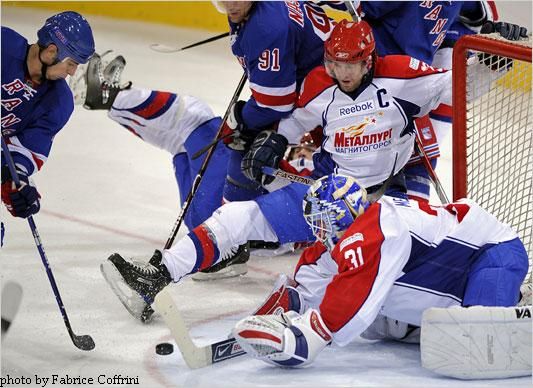
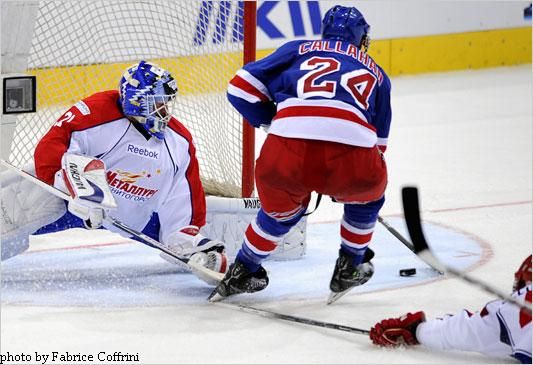
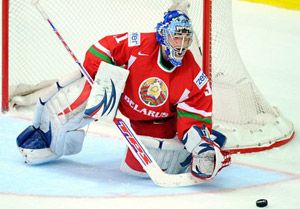
This image to the left probably won't be a memorable moment from the 2010 Vancouver Winter Olympics, but the man making the stop has himself a place in hockey lore. Andrei Mezin, the Belarussian goaltender, is best known for his 2002 Olympic performance against Sweden in the quarterfinals, but he has carved out a pretty good career over in Russia playing in the Russian Super League and the KHL. Today, I want to take a look at the highlights of Mr. Mezin's career after he was named as one of the KHL's Players of the Week for the last week.

Born in Chelyabinsk on July 8, 1974, Andrei Mezin bounced around North America from 1993 until 1998, playing in the ECHL, the Colonial Hockey League, the IHL, and the UHL in those six seasons.

In 1995-96, he starred with the Flint Generals of the Colonial Hockey League where he played 40 games with the team. He finished with a stellar 27-9-2 record despite having a 3.49 GAA and a .883 save percentage. He helped the team finish first in the East Division, and the Generals tore through the playoffs to win the Colonial Cup!

The following season saw Mezin star with the team again as he led them to first in the East Division again, this time with a 19-4-1 record, a 2.46 GAA, and a .902 save percentage. The Generals ploughed through the playoffs once more, but ran into an upstart Quad City Mallards team that had finished second overall in the CoHL. The Mallards downed the Generals in six games, but Mezin shone all season long.

The Generals finished second overall in the inaugural season of the UHL in 1997-98 on the strength of Mezin's 21-5-0 record. He regressed in his stats, posting a 3.47 GAA and a .885 save percentage, but the Generals marches their way to the UHL Final to face the Quad City Mallards once again. This series was much closer than the previous year as the series went back and forth. Quad City won all of the odd-numbered games, while Flint took all the even-numbered games. In Game Seven, it took overtime, but the Mallards finally prevailed by a 3-2 score. Bryan McMullen logged the majority of games in the playoffs, but the Generals had finished strong once again.

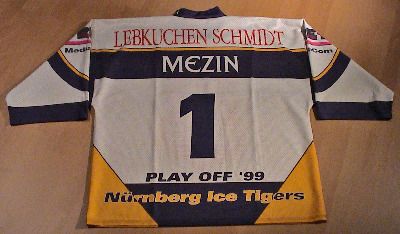
The 1998-99 season saw Mezin jump to a new locale as he began a career in the Deutsche Eishockey Liga with the Nürnberg Ice Tigers. He backstopped the Ice Tigers to first overall in the DEL, and carried them into the playoffs where they were stopped in the final by Adler Mannheim. The 1998-99 Ice Tigers still hold the best record for a Nürnberg DEL team.

After playing one season with Nürnberg, Mezin moved to the Berlin Capitals for three seasons. While he never experienced the same success as he did with Nürnberg, Mezin played no less than 54 games in each of his three seasons with the Capitals. However, with the Capitals experiencing financial problems in 2002, the team dropped to a lower-tiered German league as they worked to re-establish itself. With that, Mezin moved closer to home.

Of course, 2002 was Mezin's shining moment as he led the the winless Belarus team into the quarterfinals against the 3-0 Swedish team at the Salt Lake City Olympic Games. Mezin was brilliant in the game, stopping 44 shots, and he provided the Belarussians with a chance to win. And that's exactly what they did when a Vladimir Kopat shot from 70-feet away was misplayed by Sweden's Tommy Salo, landing in the back of the net for a 4-3 Belarus lead with 2:24 to play.

"For sure, it is a miracle for us," Belarus goalie Andrei Mezin said to CNNSI.com at the time. "But sometimes a gun without bullets can shoot, and that was us. We've made our place in history."

Belarus would lose their next game to Canada, but Mezin's heroics made him the darling of the 2002 Winter Olympic men's hockey tournament.

Mezin's next stop after the Berlin season ended was for Russian superpower Ak Bars Kazan. Kazan, however, used him as a backup only, and he appeared in only one game with Kazan. Kazan finished fourth in the RSL, meaning they had no chance of winning the championship as the top team through the season was awarded the trophy. After spending one year watching from the bench, Mezin was on the move again.

HC České Budějovice in the Czech Extraliga was where Mezin landed for the 2003-04 season, but his record suffered. Some of this may be attributed to his lack of playing time in Russia, but a 4-9-2 record didn't reflect his 2.98 GAA and .904 save percentage. Mezin didn't find many opportunities to play in the Czech Republic, and he was on the move again for the next season.

The Russian Super League would be where Mezin established his career over the next few seasons. He started with SKA St. Petersburg in 2004-05, but the team finished in the bottom half of the standings. Salavat Yulaev Ufa would be Mezin's next stop in 2005-06, and he would stick around Ufa for two seasons. Ufa increased its standing between the two seasons, but Mezin would play a smaller role in the second season than in his first season. Once again, Mezin would be on the move in 2007-08.

2007 saw Mezin move to the northern reaches of the Russia as he joined Metallurg Magnitogorsk. Through this season, Magnitogorsk would battle with Mezin's former team in Ufa for top spot in the RSL. At the end of the season, though, Metallurg Magnitogorsk would fall six points short of Ufa as they finished in second-place in the RSL. Mezin's record wasn't kept, but he did finish with a 1.84 GAA through 35 games - a clear indication that he wasn't done being an elite goaltender.

The 2008-09 season saw a major transformation as the Russian Super League transformed into the Kontinental Hockey League. Mezin stuck with Metallurg Magnitogorsk, and faced the NHL's New York Rangers in the inaugural Victoria Cup on October 1, 2008. Mezin showed he was certainly a very capable goaltender as he stopped 44 shots in a 4-3 loss to the Rangers. However, he would only play 26 games for Metallurg Magnitogorsk that season, posting a 2.82 GAA. He would appear in six games in the KHL Playoffs as well.

In 2009-10, Mezin jumped to Minsk Dynamo, but he joined a fairly weak KHL team. Mezin appeared in 41 games, posting a record of 10-20-5, but his 2.67 GAA and .902 save percentage are evidence that the Belarussian goalie hasn't lost his moxie. Minsk Dynamo finished seventeenth in the 24-team league, though.

Thus far, Minsk Dynamo has seen a major push to start the 2010-11 season. Mezin has posted a respectable 5-2-0 record with a 2.21 GAA and a .922 save percentage. Last week, Mezin was named as the KHL's best goaltender for the week. In three games, Mezin posted three wins, a .917 save percentage, and allowed an average of two goals per game.

Congratulations go out to Andrei Mezin for his work this past week! He's still one of the biggest stories I've witnessed in my time thanks to his heroics at the 2002 Olympics, and he is the only reason I own a Belarus hockey jersey. Thanks to Mezin, hockey in Belarus saw a huge spike, and we could see more Belarussians in the NHL in the upcoming years!

Until next time, keep your sticks on the ice!

Thursday, 8 October 2009

The Firsts Key

The "Firsts" Contest has ended. We have ourselves a winner. However, it's time that we examine the answers to the "Firsts" Contest in detail. There were a number of answers put forth. Some were right. Some were not so right. And some were... well, I'm not sure where they came from, but they were answers. In any case, I'll present the correct answers to the contest questions, and then I'll reveal who is eligible for prizes. Sound good? Well, that's how it is, so let's check the answers.

  1. The first professional goaltender to be credited with a goal was Michel Plasse of the CHL's Kansas City Blues. Plasse intercepted a pass against Oklahoma City on February 21, 1971 and lofted the puck down the ice into the yawning cage to seal a Kansas City 3-1 win. Plasse turned the trick nearly eight years before Billy Smith was credited as the first NHL goaltender to score a goal.
  2. The first goaltender to wear a trapper was Emile "The Cat" Francis. Francis, the Chicago Blackhawks' goaltender, wore a specially-designed first baseman's mitt with additional protection in a 1947 game against the Detroit Red Wings.
  3. The first goaltender to play 100 games without recording a shutout was Eldon "Pokey" Reddick. Reddick never recorded a shutout in the NHL during his 132-game career.
  4. Ron Stackhouse was the only OHL defenceman to ever stop a penalty shot. Roger Neilson, the coach of the Peterborough Petes, chose Stackhouse to stop the shot after Stackhouse hauled down a forward on a breakaway. The OHL put a stop to this practice shortly after Stackhouse's historic stop.
  5. The first North American-trained player to lace up the skates in the Russian Super League was Tod Hartje, a native of Anoka, Minnesota. Hartje, a Harvard graduate, was drafted by the Winnipeg Jets. GM Mike Smith sent Hartje to play in Russia with Sokol Kiev as an experiment in the early 1990s, nearly five years before Vincent Riendeau suited up for Lada Togliatti.
  6. The first female goaltender to win a professional game was Erin Whitten. Whitten was called into action on October 30, 1993 for the ECHL's Toledo Storm midway through their game against the Dayton Bombers. Whitten backstopped the Storm to a 6-5 win, earning her first win in professional hockey. She appeared in four games that season, recording a 2-0-0 record.
  7. Maple Leaf Gardens was the first arena to remove the chain-link fence, replacing it with Plexiglass to protect the fans. It was installed shortly after the Christmas break in 1946.
  8. March 10, 1955 saw the Montreal Forum use a zamboni for the first time between periods to lay down new sheets of ice for the players to skate on.
  9. The first player to suit up for all six Original Six teams was Vic Lynn. Many historians doubted his claim, but Brian MacFarlane contacted Lynn, and Lynn confirmed that he indeed appeared in one game for the New York Rangers in his career in 1942-43. Following that, he played for the Red Wings in 1943-44, the Montreal Canadiens in 1945-46, the Toronto Maple Leafs from 1946-50, the Boston Bruins from 1950-52, and the Chicago Blackhawks in 1953-54.
  10. Current Detroit Red Wing Kris Draper holds the honour of scoring an NHL goal before scoring a goal in junior hockey. Draper signed as a free agent with the Winnipeg Jets in the summer of 1990. He appeared in his first game with the Jets on October 4, 1990 against the Toronto Maple Leafs, netting his first NHL goal in his first game. After three games, Draper was sent to the Ottawa 67's where he scored his first goal in junior hockey.
  11. The first coach to sign himself to a professional player's contract was Jacques Demers. Due to injuries and illness, Demers found himself short of the minimum 15 players required to fill out a WHA roster as his Quebec Nordiques arrived in Edmonton to play the Oilers on March 18, 1979. Demers, who was also the Nordiques' General Manager, signed himself to a five-day tryout contract in order to meet the minimum requirement for the game. He never took a shift, and wasn't needed as a player in the game as the Nordiques blew out the Oilers in the game by a 7-2 score.
  12. The Calgary Flames have had Harvey the Hound entertaining their crowds since 1984. Harvey was the first furry entertainer in NHL history.
  13. The first NHL player to make a cameo in a soap opera was Ron Greschner of the New York Rangers. He appeared on an episode of Ryan's Hope in July 1980.
  14. The first puck to not become a souvenir is in the Hockey Hall of Fame. The two teams who prevented any fans from going home that night with a game-used puck were the visiting Minnesota North Stars and the hometown Los Angeles Kings. The game occurred on November 10, 1979 between these two teams.
  15. The first goaltender to win 300 games in the NHL without winning a Stanley Cup is John Vanbiesbrouck. The Beezer amassed 374 wins in his career, and went to the Stanley Cup Finals twice, but never earned the right to hoist to the Stanley Cup.
Your winner is Brian aka "Captain Canuck". Brian successfully earned the right to select a copy of Hockey's Book of Firsts or a copy of Beyond The Crease as the winner in what might have been the hardest contest yet on HBIC. Michael Jaworski finished slightly behind Brian, and he will receive whichever book is not chosen by Brian. Well done, gentlemen, in an extremely difficult contest!

That's all for today, but there are a number of contests planned for this hockey season, so keep your eye on HBIC for the next chance to win some free gear!

Until next time, keep your sticks on the ice!

Sunday, 4 October 2009

"Firsts" Contest

There are a lot of phrases in the English language that contain the word "first": first name, first lady, first place, first things first, First Nations, first aid, first class. You get the idea. Well, this is the first contest of the new hockey season, and it's going to focus on hockey "firsts". As seen yesterday in the TBC review of Hockey's Book of Firsts, there are a lot of "firsts" that have happened in and around the game of hockey. Our contest today is offering you a chance to win the book, as well as checking out how much you know about hockey "firsts". There are a number of questions, so read them carefully. Make sure to answer all the questions as best as you can!

First off, let's work through some of the fine print. The contest will run from Sunday, October 4 until Wednesday, October 7. The contest will close at 11:59pm on October 7. The winners will be announced and contacted on Thursday, October 8. The way the prizes will be handed out will be on the number of correct answers AND the fastest entry. Whoever is fastest with the highest number correct will win. TBC will award the winner a copy of Hockey's Book of Firsts or a copy of Beyond The Crease to the winner. Second-place will get whichever book is not selected by the winner. Sound good? Ok.

Please email your answers to me no later than Wednesday, October 7, 2009 at 11:59pm. Please have the subject line as "TBC Contest". Any entries mailed after that time will not be processed, and deleted from consideration. And with that made clear, let's start the questions. I won't lie about these questions, either: they are tougher than they appear. I didn't even know the answers to some.

  1. Officially, Billy Smith of the New York Islanders was the first goaltender to be credited with scoring a goal in the National Hockey League. However, he was not the first masked man to officially be crowned as the first goaltender to score a goal. Who was the goaltender, and what team did he play for? (2 points)
  2. Who was the first goaltender to wear a trapper on his hand to catch pucks? What team did he play for? (2 points)
  3. Who was the first goaltender to play 100 games in the NHL without registering a shutout in any of those games? (1 point)
  4. Who is the only defenceman to ever stop a penalty shot in the OHL? Who was his coach, and what team did he play for? (3 points)
  5. While it is believed in hockey circles that Vincent Riendeau was the first North American-trained player to play in the Russian Super League, there actually was someone before him. Who is the forgotten player, and what NHL team was he drafted by? (2 points)
  6. Manon Rheaume was the first female to break the gender barrier by suiting up for the Tampa Bay Lightning. There have been other female goaltenders who have played in the pro ranks as they followed Rheaume's lead. Who was the first woman to win a professional game while tending to the nets, and what team recorded the win? (2 points)
  7. Which NHL arena was the first to remove the chain-link fencing from around the boards and replace it with Plexiglass? (1 point)
  8. Which NHL arena was the first to use a zamboni to repair and lay down a new sheet of ice between periods? (1 point)
  9. Who was the first NHL player to play for all six Original Six teams at some point in his career? (1 point)
  10. What current NHL player is the only player in history to have an NHL goal before he scored a goal in junior hockey? (1 point)
  11. Which coach was the first coach to have signed himself to a contract as a player? What team did he suit up for, and who did they play against that night? (3 points)
  12. Which mascot was the first to entertain NHL crowds? (1 point)
  13. NHL players have made cameos on a number of TV shows throughout the years. Which NHL player was the first to appear on a soap opera, and what was the name of the soap opera? (2 points)
  14. The very first puck to last an entire game without being shot out of play is sitting in the Hockey Hall of Fame. Who were the two teams that only needed one puck to play the entire 60 minutes of action? (2 points)
  15. Who is the first goaltender to win 300 games in the NHL and not win the Stanley Cup? (1 point)
There's your test, kids. Have at it. You have until Wednesday night to complete as many of the questions as possible. Remember, the most right in the fastest time will win one of the two books. The next person with the most correct in the fastest time will earn the second book.

Until next time, keep your sticks on the ice!