Showing posts with label history. Show all posts

Saturday, 19 September 2026

The Tournament That Didn't Happen

I'm sure there are a few people who question my sanity when it comes to some of the things I find in the online newspaper archives I use simply because it looks like I spend a lot of time there. What normally happens is that I go searching for something, and a story will catch my eye that needs more thorough investigation because of a claim or conjecture made. That's exactly what happened today as one newspaper published an interesting "sports quickie" that absolutely needed context and examination.

First off, let's start off with what caught my attention in the archive.
According to the Austin Herald of Austin, Minnesota, the NHL was planning an "invitational tournament" for all fourteen NHL teams in 1970 that would be played in Winnipeg. Being that my parents and I are all from Winnipeg and had never heard about this tournament, this left me scratching my head. How did the NHL begin plannning a big tournament in a hockey-mad city that never materialized?

With my interest piqued, it was time to start hunting for more information on this tournament that never happened. The internet held no information on this tournament, so the newspaper archive was going to be my source for all the information for something that never happened. The next article that came up was from the Albert Lea Tribune as The Associated Press confirmed the "sports quickie" from the Austin Herald. The good news is there was more information as the NHL seemingly was planning to have the tournament in the fall of 1970 after the proposed World Hockey Tournament was cancelled for host cities Montreal and Winnipeg as Canada disputed the use of professional players at the championship.

There's a bold statement from Maitland Steinkopf, chairman of the Manitoba Centennial Corporation, about this tournament, claiming that, after talking to NHL President Clarence Campbell, there was a "75 per cent chance that it will come off." The former Progressive Conservative politician and longtime businessman made it sound like there was a better than good chance that the tournament would happen for the Manitoba capital. But did it happen, though?

Dozens of newspapers ran The Associated Press's report on between January 30 to February 5, 1970, but an article from MacGregor, Manitoba's The MacGregor Herald gave even more details on what was planned as Steinkopf was aiming for late September or early October for dates, adding "Right now we've just got to clear the dates." All fourteen teams would be able to attend using their players under contract to compete in the one-loss-and-out tournament over the planned week of games. In short, it sounded like a preseason tournament that would have brought the best professional players on the planet together for games. This could have been the start of something that the NHL could build on to spark interest for the coming season.

It appeared that Steinkopf was planning this massive hockey tournament to align with Manitoba's centennial celebration in 1970. He was instrumental in bringing all sorts of projects and events forward that year including the Centennial Concert Hall in downtown Winnipeg and a concert called "Man-Pop" that saw all of Led Zeppelin, Iron Butterfly, the Youngbloods, Chilliwack, the Ides Of March, Dianne Heatherington and the Merry-Go-Round, the Mongrels, and Sugar & Spice perform in Winnipeg for one day. That lineup is insane!

For whatever reason, nothing else was published about this NHL invitational tournament following those early reports in 1970, and it could be because Steinkopf shifted his focus to music as Man-Pop took place on August 29, 1970. My guess is that the dates proposed by Steinkopf didn't work for either the arenas in and around Winnipeg or the NHL clubs themselves, but the tournament evaporated as fast as it seemed to materialize. Winnipeg was not an NHL city in 1970.

There is a bit of a sad note to this story as Maitland Steinkopf passed away on Sunday, November 22, 1970 from a heart attack. Had the tournament happened, his passing would have been just weeks after watching NHL teams compete in the Manitoba capital. It also meant that he missed out on the WHA setting up shop in Winnipeg after luring NHL superstar Bobby Hull to the league which, I believe, would have tickled his showman's heart. Rest peacefully, Mr. Steinkopf.

There's a quick bit of history about what could have been the start of an annual event for the NHL had everything gone to plan with the league-wide invitational tournament. Maitland Steinkopf nearly put Manitoba on the map as a hockey destination with his efforts, but that event simply wasn't in the cards for the city of Winnipeg in 1970.

Until next time, keep your sticks on the ice!

Tuesday, 15 September 2026

It Was Always One Name

I had a chuckle today as a co-worker lamented over Connor Hellebuyck's situation in my office. His proposal was that the Jets are now the laughing stock of the NHL thanks to Kevin Cheveldayoff's inability to facilitate a trade with any number of teams, and this poor asset management will lead to more heartbreak for Jets fans like him. I can't say he's wrong, but his proposal that the Jets should apply for a new team name as the "Jokes" made me laugh before it got the old gray matter churning as we almost had a minor-league version of the Jets before the Atlanta Thrashers headed north.

Back in the summer of 1996, the IHL approved the relocation of the Minnesota Moose to Winnipeg as current Jets' owner Mark Chipman had bought the IHL franchise. Of course, a new league and team in town generates excitement, and one of the ways to get fans involved early is to run a "Name the Team" contest. We already knew the Moose were coming to Winnipeg with that name, so did Chipman need to run this contest? Apparently, the correct answer is yes.

On Friday, March 1, 1996, the newly-relocated IHL franchise in Winnipeg took out a half-page advertisement in the Winnipeg Free Press to run their "Name the Team" contest. This is that ad.
There was a pretty cool grand prize for whoever had their entry selected as flying to Chicago to see the Wolves and Moose play on Air Canada with a friend would be pretty fun despite the game being played in Rosemont as opposed to Chicago. Nevertheless, a free trip is awesome and getting to watch live hockey always makes it better.

However, I want to point your attention to the actual "Name the Team" entry portion of the advertisement where two of the names seem very familiar if you're a Winnipeg hockey fan of any kind.
The team went ahead and proposed two names that they didn't own nor held the trademarks for by printing "Winnipeg Jets" and "Winnipeg Warriors" as two of their more popular names. The Jets had just moved to the Arizona desert to become the Coyotes while the Warriors left Winnipeg in 1984 to become the Moose Jaw Warriors. As far as I can tell, neither the Coyotes nor the Moose Jaw Warriors had given permission to Chipman et al. to use those names for his team.

Had one of those names been selected by fans, it's likely that Mark Chipman would have had to negotiate the rights for those names since they belonged to those franchises, but history tells us that the team went with "Manitoba Moose" which seems like the name that requires the least amount of work to trademark. After all, the team once was the Minnesota Moose, and the original Moose logo literally was just modified to say "Manitoba" rather than "Minnesota".

What makes this rather unbelievable to me, however, is that Mark Chipman, current owner of the Jets, proposed that name for the Moose who were the first professional hockey franchise he owned in Winnipeg. It feels like the name "Jets" was always going to be the name of a pro hockey team if one returned to Winnipeg, and, in 2011, we found out that the NHL team that moved from Atlanta would indeed be called "Winnipeg Jets". It's almost like Chipman wanted that name and wasn't going to let anyone else have it!

I want to be clear that "Jets" isn't a bad name in any way, but it seems like, with the advertisement above, that Mark Chipman would someday own a professional hockey franchise called "Winnipeg Jets". He may have missed out on having that dream achieved in the IHL in 1996, but he certainly didn't miss again in 2011 when he bought and relocated the Atlanta Thrashers franchise. And had the fans opted for that name and the NHL had given up rights to that name, we may now be talking about the fourth iteration of the Jets after they played in the WHA, the NHL, the IHL, and back again in the NHL.

Until next time, keep your sticks on the ice!

Saturday, 12 September 2026

Some Good From A Lot Of Bad

It isn't often that professional hockey teams fold in the middle of a season, but the team with the jersey to the left - the UHL's Mohawk Valley Prowlers - were one of the few pro teams who did fold midway through their campaign. The team only lasted in Utica, New York from 1998 to 2001, so it's not like they had a massive impact on the community in their short existence. However, there are a few notes to examine when it comes to the Prowlers calling Utica home for parts of three seasons. Let's look at the Prowlers announcing their financial issues and what happened from there.

According to a report from The Associated Press on February 8, 2001, the Prowlers sought bankruptcy protection, depending on who you believe, sometime between Friday, February 2 through Tuesday, February 6 after telling a judge that the team was "spending more than 40 percent than it takes in". Citing total assets of $1.7 million and liabilities of $3.94 million, it's not hard to see why the team was suffering as it was spending $1.40 for every dollar made.

With the announcement, the players on the Prowlers' roster voted to strike in knowing that they likely weren't going to be paid until the bankruptcy matter was resolved. Rumours of missed salary payments totalling $40,000 and missed rent payments forcing players to be evicted from their apartments gave the players all the necessary motivation they needed not to play, and the team had no way of borrowing money to make their payroll while under bankruptcy protection despite owner Jack Tompkins saying that the players were owed only $5667 due to creditor protection. As a result of the team being unable to honour their contractual obligations to the players, the entire roster was declared as creditors owed money. Would ever get the money owed?

As the headline from the Syracuse Herald American stated, the Prowlers were forced to use replacement players for their scheduled game on February 11, 2001 against the BC Icemen. For those wondering, the "BC" stands for Broome County as the Icemen called Binghamton, New York home, but they took the ice against a Prowlers team that literally was made up of whoever the Prowlers could find who wasn't under contract. The end result was an 18-4 blowout by the Icemen, and Prowlers' management vowed that Wednesday's game against the Icemen would also see replacement players take the ice in Prowlers uniforms. Based on those results from Sunday, it would appear that their Prowlers needed professional players back.

It seems that Mohawk Valley wasn't done dealing their contracted players, though, as the Prowlers traded 12-goal, 35-point centerman Harold Hersh to Quad City on Monday, February 12. That's one way to satisfy one creditor as Hersh would finish the season in Quad City where he'd score 16 points in 19 games before adding six points in 11 games en route to a UHL championship!

The AHL's Lowell Lock Monsters would pick up a player from the Prowlers as well as they added noted bruiser Andre Payette from Mohawk Valley. Tye 6'2", 205-pound Payette had already made a name for himself in the UHL, scoring nine goals and 18 assists while racking up 244 PIMs in 45 games. Lowell added Payette to their lineup to replace noted pugilist Kip Brennan who returned to the OHL's Sudbury Wolves after it was discovered he still had junior hockey eligibility.

Apparently, business continued as if nothing ever changed for the Prowlers as they waived Quintin Brickley who never even played for them while claiming John Dowd from New Haven. On the other side, former leading scorer Jay Mazur, who was delcared a free agent following the bankruptcy filing, signed with New Haven to strengthen their lineup. Clearly, things were starting to crumble in Mohawk Valley, so it seemed like the inevitable was on the horizon.

On February 22, the final nail in the coffin was hammered as the Mohawk Valley Prowlers closed their doors on the season and on the franchise. With the team officially in bankruptcy proceedings, trustee Michael Balanoff oversaw the proceedings of how the team would repay its creditors which, as the article states, included over 1000 season-ticket holders. Of course, players were also included in the list of creditors, but any players still under contract and on the Prowlers payroll were officially made free agents by the UHL and were able to sign with any team of their choosing. Most players went on to find a new team by the start of the following season, but there was one replacement player whose statistics caught my attention as I was researching another story. Depending on when, he may have been part of the 18-4 loss against the BC Icemen back on February 11.

This young man is Terry Craven. In this picture taken on February 21 as the Prowlers cleared out their lockers following the announcement of the team folding, the 24 year-old had played a total of seven professional minutes of UHL hockey - one with the Asheville Smoke and six with the Mohawk Valley Prowlers. He had 24 NCAA games to his name with the Massachusetts College of Liberal Arts where his GAA and save percentage weren't going to get him scouted by NHL personnel, but he could be a decent goalie with a little seasoning in the UHL.

I'm not here to bring down Terry Craven in any way because he clearly got stuck in an untenable situation. Playing for the Prowlers while the franchise crumbles is not one that any player would want, but Craven's numbers are hard to ignore. Consider the following:
In his six minutes of standing in the blue paint for the Prowlers, he surrendered five goals on 11 shots and suffered his only professional loss at the UHL level or above in terms of his professional career. That is heartbreaking to read for a kid just trying to find his way into pro hockey, but Craven's record will show his Prowlers time with an 0-1-0 record, a 46.75 GAA, and a .545 save percentage. Just brutal!

There is a bright spot, though: Craven did get picked up as a goaltender for the ECHL's Lexington Men O'War in 2003. He spent two minutes on the ice in the ECHL with Lexington and made one save, but the Men O'War clearly saw something in Craven by bringing him in as an EBUG after spending nearly two years out of hockey!

Terry Craven's story won't be a 30-For-30 on ESPN or a Netflix special, but he did get nine minutes of professional hockey under his belt. Two-thirds of that time came in a Prowlers jersey where he was thrown to the wolves, but Craven did spend two minutes in an ECHL game where he officially made one save and finished with a 0.00 GAA and a 1.000 save percentage. The Prowlers franchise may have died in 2001, gone for good, but Terry Craven wasn't quite done.

Sometimes, out of the worst situations, good things happen. While Terry Craven never had a long or propserous professional hockey career, he did stop one puck in the ECHL with the Lexington Man O'War which is more than a lot of other good goaltenders can say they did. Who knows if that would have happened had it not been for the UHL's Mohawk Valley Prowlers franchise hemorrhaging money.

Until next time, keep your sticks on the ice!

Wednesday, 9 September 2026

The First EBUG?

As we know, the NHL has mandated that every team has to have an Emergency Back-Up Goaltender, EBUG, available this season. We've already seen fun stories about Peter Thome getting his shot and the return of the first NHL EBUG to win a game, but there was an EBUG sighting on another team long before David Ayles stepped onto the ice for the Hurricanes. Pictured to the left is that EBUG, and his name is Joe Franke who was pressed into action on December 14, 2002 as the Fort Wayne Komets and Elmira Jackals battled in the ECHL! How did this happen? Who is Joe Franke? Is he officially the first EBUG in modern hockey? Let's find out as we look at this awesome hockey history!

Franke wasn't on the Fort Wayne roster that night or any other night as an everyday goaltender. Instead, Franke was hired in 1978 by the team as their full-time equipment manager, but that didn't stop him from getting his name on the line-up sheet as a netminder more than 30 times in his illustrious career before he stepped away from the organization in 2020! And that leads us to December of 2002.

Again, the Komets put out an incredible video about this significant moment in their history and in hockey history, so I'd be remiss if I didn't post it here. Here is the video about Joe Franke's big night!
Pretty incredible video, right? Franke went in with eleven minutes remaining in the third period with Fort Wayne and Elmira tied 1-1. But how did Franke even get the chance to head out onto the ice?

As mentioned in the video, Komets starting goaltender Tom Lawson was called up to Milwaukee by the AHL's Admirals as they were battling a rough stretch with injuries and recalls by the Predators. As such, that left Pokey Reddick as the lone netminder for Fort Wayne despite him struggling with a virus. Cory Campbell, Scott Rideout, and Parris Duffus were the only other goalies used by the Komets that season, and none were available for their game against Elmira, forcing Franke into stand-by mode in case anything happened.

With Reddick cramping up in the third period and unable to play, Franke was sent to the dressing room to get ready as he would be needed to stop pucks. Minutes later, Franke would emerge down the tunnel wearing #35 in full gear as he stepped onto the ice. Shortly after he took his spot in the crease, Colin Chaulk scored for the Komets and Franke, unbelievably, earned an assist on his goal!

With Fort Wayne leading 3-1 after scoring a second time in the final frame, all the Komets had to do was shut down the Jackals for the win. However, the Jackals would rally for two goals late to tie the game at 3-3, and this UHL contest needed a shootout to determine the winner. Could Franke shut the door in the skills competition?

After both shooters failed to score in the first round of the shootout, Fort Wayne scored three times - Dustin Virag, Colin Chaulk, and Kelly Perrault - while Franke stopped Aaron Phillips in Round Five to give Fort Wayne the 3-1 shootout win for the 4-3 victory in the game! As such, Franke earned the win, picked up an assist, and stopped four of six shots plus four more in the shootout! How awesome is that debut?

While he's not the first EBUG in hockey history, Joe Franke might be the first EBUG to win a game at any professional level in modern hockey. Picking up an assist is also pretty cool for any goalie, but imagine getting an assist in your only game as a professional goalie! Well done, Joe, in crossing off two major stats in one fell swoop!

Just for fun, the Komets, as mentioned in the video, won the UHL championship that season, and that would add a second championship ring to Franke's jewelry box as he had also won a Stanley Cup with the 1991 Pittsburgh Penguins! He'd also add three Turner Cup rings from the IHL and a Central Hocley Lague championship ring during his time with the Komets, but his eleven minutes in net will never be forgotten in Fort Wayne, Indiana!

I know it won't happen, but maybe the Komets should retire #35 in honour of Joe Franke's tenure and his one big win in a Komets net!

Until next time, keep your sticks on the ice!

Saturday, 22 August 2026

Back To Their Roots

The Atlanta Gladiators have an interesting history when one considers that they became Atlanta's ECHL team in 2015. Previously named for the northeast county that reaches into Atlanta, the Gwinnett Gladiators were the original Mobile Mysticks franchise that played in Alabama from 1995 until 2003. The move to Gwinett County saw them go on a solid playoff run each season with no less than 40 wins in any of their first five seasons, but it's been a long, long time since Atlanta saw any hockey success since those early days of Gladiators hockey.

Since adopting Atlanta's name, the Gladiators have made the playoffs three times in nine seasons and have never advanced pas the first round. Twice in those three seasons have the Gadiators reached the 43-win mark, but it hasn't translated to postseason success. The last time that the Gladiators won a playoff series was back in 2013 under head coach John Wroblewski when they fell in the second round.

It should be noted that the team switched their colours from garnet and black to navy blue and gold as shown above to "create a unique identity and attract fans throughout the highly diverse landscape in metro Atlanta." There was hope from Atlanta fans that an affiliation with the Nashville Predators organization would soon follow based on these changes, but that affiliation wouldn't happen until 2023. The Gladiators instead remained as the Boston Bruins' ECHL affiliate.

Of course, that brings us to Friday where the Gladiators unveiled this.
The Gladiators will return to their original garnet-and-black scheme that they used when they moved to Gwinnett County! These new jerseys will be worn in the 2026-27 season, and they look pretty good! I'm not sure about that script on the left with the stripe so low, but the colours look fine on these new Gladiators threads!

These jerseys aren't replications of the original jerseys worn in 2003 when the team arrived from Mobile, and I'm glad they didn't bring back the diagonal-name jersey worn in 2012-13. The white jersey could use a maroon shoulder yoke with a black outline as an improvement, but, overall, these jerseys and colours work nicely.

With the Fort Wayne Komets throwing back to a number of eras in their history this season and, now, with Atlanta going back to their original colour scheme, it looks like two ECHL franchises see the value in embracing their roots. That's the thing about bringing back old jerseys: perople identify with them and have memories from the eras in which they were worn while teams can tell those stories again. It never hurts to turn back the clock when doing a rebranding!

If you want to read more about the Gladiators' history, please visit the Georgia Hockey Museum's website where they have an incredible article all about the Gladiators' history among the 15 teams featured! Huge shout-out to Jay Jarvis for putting this site together!

Until next time, keep your sticks on the ice!

Friday, 21 August 2026

The Least Amount Of Risk

The New York Islanders have an interesting franchise history, but their fans have always been partial to the original logo which the team wore in establishing its dynasty from 1979-1983. We know they rallied hard against the Fisherman logo in the 1990s before it was replaced with the original logo, and we've seen other logos land with thuds as Islanders fans made it clear as to which logo they prefer. When the third jersey contest was announced for the 2027-28 season, every option was back in play for fans to choose, and the hope was that the Islanders would see an awesome winner.

The results of the eight-jersey, bracket-style voting ended today, and the Islanders now have themselves a winner for that third jersey.

I'm not unhappy with how the vote ended, but this was literally the best of the eight options and even it's not great. This jersey is the safest option of the eight presented when it comes to the design, and the lighthouse logo has been in demand for a third jersey for quite some time by Islanders fans. The New York Islanders took zero risks.

Am I against this jersey? Not at all. That lighthouse logo is a great logo, and it should look good on the chests of players as a fully-embroidered mark for the New York Islanders. It's infintely better than the "NY" logo, and it certainly has as much charm and fun as the Fisherman. Everyone thinks of islands when one sees a lighthouse.

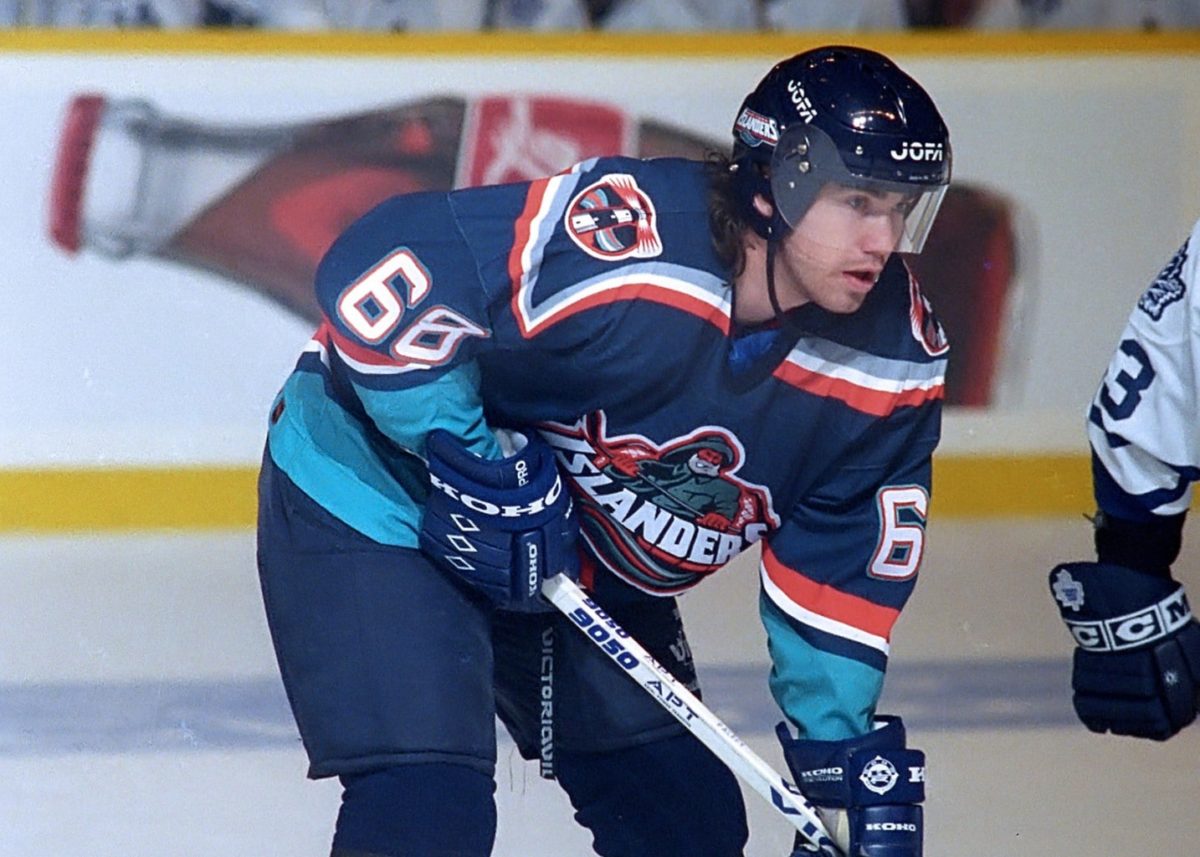
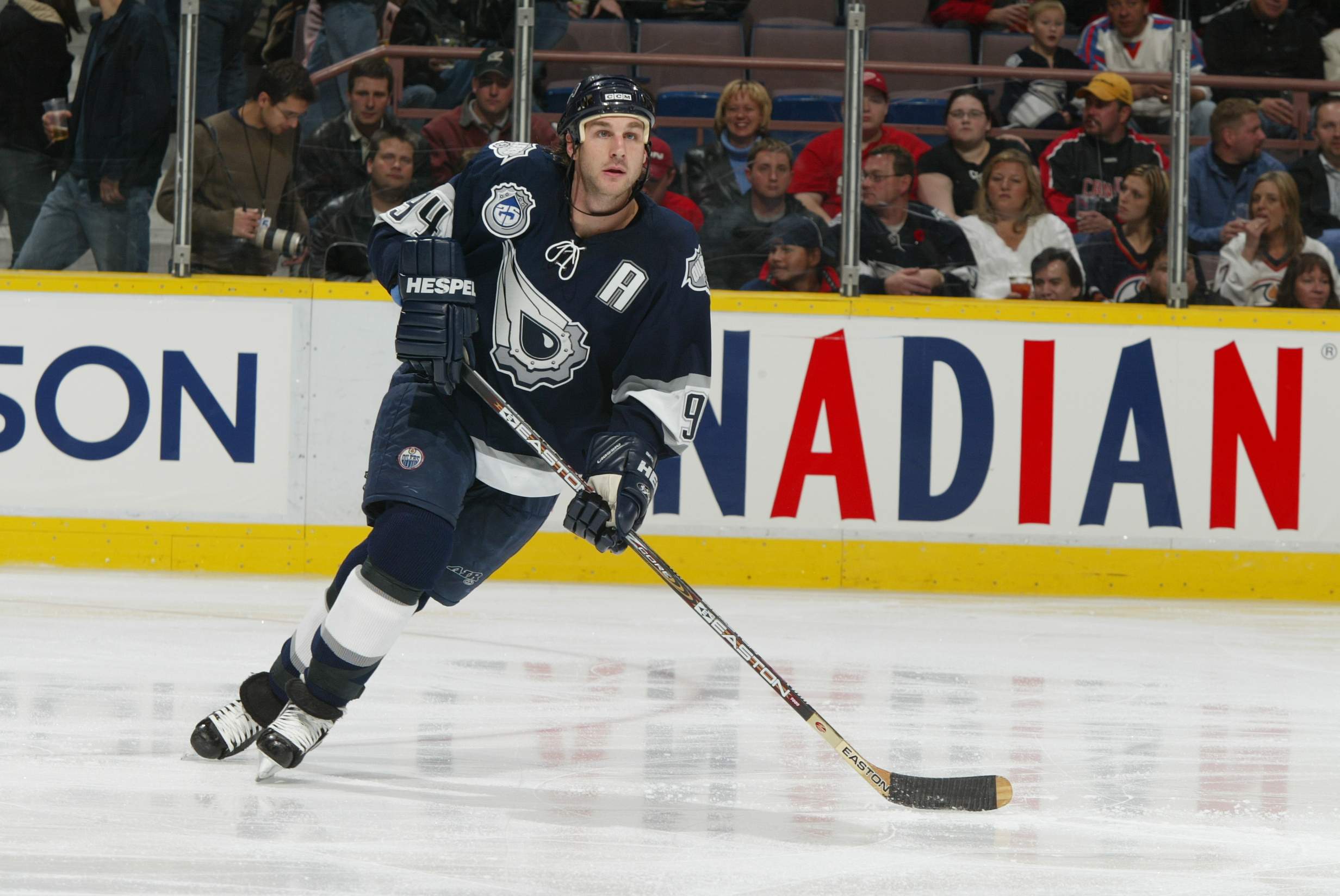
As you can see on Zigmund Palffy, this lighthouse logo was the shoulder patch on the original Fisherman jerseys, and it has always stood out as one of the better secondary logos, in my opinion, in NHL history. It's colourful, it catches the eye, and it needed to be used again by the Islanders. Whether it works as a long-term primary logo will be a question answwered in 2027-28 when they don these new third jerseys, but it certainly has a shot at warming fans' hearts.

Perhaps this was the jersey that the Islanders needed, though, after taking a big swing with the Fisherman in the 1990s. As was written by Nicholas Hirshon in We Want Fish Sticks, "the logo quickly became a scapegoat for the Islanders' poor play," so the Islanders are going to want to win in the Lighthouse jersey. Otherwise, this new third jersey could establish its own legacy of poor results which the Islanders don't want. Nothing hurts sales more than having a losing team.

I look at the uniqueness of this jersey compared to others in my collection, and there simply isn't enough for me to consider it as one that needs to be added. It's certainly not the Fisherman, it doesn't have that cool factor like the Oilers' alternate jersey did, it doesn't have that eye-catching quality that the Pooh Bear did, and it's not quite as bizarre as the Stars' alternate jersey was. It's solid, but it's going to take something special for the Islanders to see this jersey celebrated as much as their traditional home and road jerseys are.

The popular saying of "no risk, no reward" means that one has to step out of one's comfort zone if one wants to be successful. The Islanders didn't do that here as they stayed safe with colour, stripes, and logos. Yes, they can still make changes to these jerseys before they debut in 2027, but the Lighthouse jerseys feel safe which fits the overall brand of the New York Islanders. Former GM and noted alternate jersey hater Lou Lamoriello would be proud of the effort here.

Until next time, keep your sticks on the ice!

Monday, 17 August 2026

Doing It Right In Indiana

Imagine it's 1952 and you're heading to the local arena to catch the new professional team in action. If you're a man, you're wearing your best fedora, a snazzy suit and overcoat, and you're looking forward to the spectacle of hockey as you find your seats behind the chicken wire protecting the fans. Women would have been dressed in long dresses with perhaps a fur coat and a scarf to stay warm as the action unfolded on the ice in front of them. Hockey looked different back in 1950 when the ECHL's Fort Wayne Komets got their start in the International Hockey League, and it will look different on opening night as the team honours its storied history once again!

I had mentioned before on this blog that the Komets were going to wear three jerseys this season from different championship eras, but I never really examined each of those jerseys so I'll do that here today before we get to what the Komets will wear on opening night. After all, if they're going to honour their history in a classy way, they deserve a little credit for making that effort! Let's check them out!

As per the Komets' blurb about these 1962-63 jerseys, "Following setbacks in 1959 and 1960, the Komets secured their first Turner Cup championship in 1963" and "[t]he team defeated Minneapolis in five games to win the cup on April 23, 1963." I removed the dozen players who were named in the blurb, but, frankly, anytime a team can do horizontal stripes is a win for me. Of the names I omitted from the Turner Cup-winning team, Reggie Primeau played eight seasons with the Komets, Winnipegger Len Thornson spent 12 seasons with the Komets including five as team captain, and John Goodwin spent parts of eight seasons in Fort Wayne. The Komets went 35-30-5 in '62-63 to finish atop the six-team IHL standings, one point better than the Minneapolis Millers and two better than the Muskegon Zephyrs!

From the Komets' site, "Under head coach Marc Boileau, and with strong performances from Terry Pembroke, Terry Thomson, Cal Purinton, and goaltenders Robbie Irons and Don Atchison, the Komets allowed the fewest goals in the IHL that season. They defeated Flint in the first playoff round and swept Port Huron in the finals to win the cup on April 15, 1973." I'm not overly convinced that this jersey couldn't use a splash of white, but that orange jersey is beacon on the ice. What should be noted is that the Komets were first-overall in the nine-team IHL that season with a 48-23-3 record, finishing ten points ahead of the Flint Generals en route to a Turner Cup championship! Wayne Ego led the team with 94 points!

Again, from the Komets' site, "Few outside their locker room gave Fort Wayne a chance against San Diego in the 1993 Turner Cup Finals. After a sweep of Cleveland and Atlanta in the first two rounds of the playoffs, the Komets did the unthinkable. They swept the favored Gulls, completing one of the most dominant playoff performances in pro hockey history, going 12-0." This is the jersey I associate with the Komets after seeing them play the Manitoba Moose in the IHL, but it's pretty incredible to think that the 49-27-6 Komets were only the fourth-best team in the IHL that season, and only two points better than the Kansas City Blades in the twelve-team circuit! But, as the legend states, the Komets were perfect in the playoffs as the ousted Cleveland, 52-win Atlanta, and 62-win San Diego in series sweeps!

That leads us to opening night this season where Komets history will shine. The 1952-53 season would be Fort Wayne's first season in the International Hockey League. By all accounts, fans in Fort Wayne took to their new professional team quickly, filling the Fort Wayne Memorial Coliseum for each game. They battled some good teams from Cincinnati, Grand Rapids, and Toledo, but would ultimately finish in fifth-place of the six teams with a 20-38-2 record under head coach Alex Wood. George Drysdale led the way with 59 points while goaltender Jack Siemon appeared in 56 games that year. What's even cooler is that the Komets had five Winnipeg-born players on their roster for their inaugural season as all of defenceman Len Wharton, forwards Bob Daski, George Harrison, and Jack Kernahan, and goaltender Stan Fogg all were born in the Manitoba capital!

What's even cooler is that the Toledo Walleye, who Fort Wayne faces on October 17 in those 1952-53 jerseys, will bring their own heritage and history to the game by donning jerseys representing the '52-53 Toledo Mercurys that night! The Mercurys finished in third-place in the inaugural IHL season with a 32-25-3 record under player-coach/defenceman Doug McCaig. Roger Maisonneuve, who would soon become a Komet Hall-of-Famer, led the Mercurys in scoring with 38 goals and 85 points while six more Mercurys players had 19-or-more goals! Like Fort Wayne, Toledo brought in the Winnipeggers as defenceman Lou Kazowski and forwards Don Hart and Jerry Kruk were in the Mercurys' lineup!

All of these jerseys have some incredible historical significance in the Komets' franchise history, and seeing the Komets go all-out for their 75th anniversary is pretty awesome. If more teams paid attention to their histories with as much class and dignity as the Komets, the game would look a lot better and would allow teams to explore their histories a lot more. There have been a lot of great sweaters and jerseys worn by some incredible teams, and those teams should be known and celebrated in the modern era like the Komets are doing.

Once again, the Fort Wayne Komets are the head of the class in the ECHL when it comes to honouring their history, and this fourth throwback jersey to be worn on opening night along with Toledo's Mercurys throwback jersey should have the hockey gods smiling this season. No matter how things end this season the Fort Wayne Komets are doing hockey right. Two thumbs-up for all these jerseys!

Until next time, keep your sticks on the ice!

Sunday, 16 August 2026

From Blue Lines To Foul Lines

I have spent more than enough time at a ballpark this season to know that baseball can be a funny game. Whether it be hot streaks, cold streaks, wild pitches, or diving catches, baseball, like hockey, is a game of momentum. If one has it, usually good things happen while those that don't are often looking for a momentum change. Lots of hockey players play baseball in the summer as there are several skills that cross-over between the two sports, and we've seen good hockey players like Tom Glavine, Justin Morneau, and Larry Walker opt for the summer sport over the winter one. We can add another name to the former-hockey-player-turned-pro-baseball-player list as former Alberta Pandas forward Madison Willan is a full-time infielder for the New York Heights of the brand-new Women's Pro Baseball League!

Make no mistake that it was a treat to watch Madison torch defenders and victimize goalies on a regualr basis for the Pandas, but her first sports love was clearly baseball. I first caught wind of Madison's talents on the diamond back in 2019 when she helped Team Canada earn a spot at the COPABE Women's Baseball World Cup Qualifier in Aguascalientes, Mexico. Canada earned a bronze medal there, but Madison made a name for herself with her excellent defensive play with the glove while being lethal at the plate for Team Canada!

Of course, hearing about how good she is second-hand doesn't mean anything unless there's some sort of evidence to prove that hearsay, but I got to witness how good Madison is in-person when she made her way to the 2022 Women's Invitational Baseball Tournament in Stonewall, Manitoba with Team Alberta. Unexpectedly, Madison pitched in the game I saw between Alberta and Nova Scotia, and she tossed a two-hit, complete-game 5-0 shutout where she hit a ground rule double for an RBI. It's pretty clear that Willan has the tools.

With Madison being part of Team Canada every year since 2017, it was almost certain that she'd get some looks from the upstart WPBL during their draft that happened on November 20, 2025. New York would make her pro baseball dreams come true when she was selected with the 15th selection of the second round as the 35th-overall selection! Officially, Madison was now a professional baseball player, and she'd be moving to New York to play for the Heights!

The WPBL kicked off its season on August 1, 2026 with a game between the visiting Los Angeles Queens and the host New York Heights. It didn't take long for the scoring to get started as the Queens put up two runs in the top of the first inning. New York would answer in the bottom half of the inning with Willan playing a role!
Willan would hit the 0-2 offering to left field for the sacrifice fly, allowing Kylee Lahners to tag up from third base for Madison Willan's first professional RBI! That run would push New York ahead by a 3-2 score, but they would eventually fall to Los Angeles by a 10-8 score in the first-evr game for the WPBL, but Willan 0-for-1 on the day with a walk and that RBI shown above as she played third base in the game!

We\ll jump ahead to August 8, 2026 when the Boston Hunters were visitng New York. New York came in at 1-1 while Boston was 0-2 early in the season. With fellow Canadian Raine Padgham on the mound for Boston, Willan stepped into the batter's box in the second inning with New York leading 1-0 with baserunners on first and second base.
Willan goes up the middle with a parachute single for her first professional hit in the WPBL! Unfortunately, Boston would rally for a 9-6 win over New York after being down six runs on the day, but Willan went 1-for-4 with one strikeout on the day for the Heights!

Madison would be a pinch-runner on Sunday's game against the Hunters, helping the Heights defeat the Hunters by a 7-6 score. Boston would exact some revenge on Thursday, August 13 with a 6-1 win over New York where Willan went 0-for-3 with a walk while playing second base. They'd drop a second-straight game to San Francisco by an 11-6 score on August 15 that saw Willan go 0-for-0 with a walk after taking over at shortstop when Keira Izumi went into pitch. Boston would record another win over New York on today, but Willan wasn't in the lineup. As it stands, Willan is 1-for-9 on the season with a .111 average, but she has recorded three walks compared to one strikeout to push her on-base percentage to .308!

It's actually pretty awesome to see Willan doing her thing on the diamond, and you can watch her and her teammates over on YouTube as the New York Heights battle the Boston Hunters, the San Francisco Fireballs, and the Los Angeles Queens. It's honstly pretty good ball with lots of balls in play, so it makes for entertaining baseball! I'm hoping Willan catches fire, goes on a tear, and helps the New York Heights reach chanpionship heights in this inaugural season!

I have no idea what she plans to do this winter, but maybe she could be the first two-sport professional woman in the modern era if she tries out for the New York Sirens! Ok, that probably won't happen, but it's super cool to see Madison Willan playing professional baseball after her university hockey career. Keep up the great work, Madison!

Until next time, keep your sticks on the ice!

Friday, 14 August 2026

ਰੋਜਰਸ: ਕੈਨੇਡਾ ਵਿੱਚ ਹਾਕੀ ਦਾ ਖਾਤਮਾ

If you can read the title of today's article, you likely were a fan of Hockey Night In Canada's Punjabi broadcasts. The title is written in Punjabi, and it reads "Rogers: Killing Hockey In Canada" after they made the inexplicable decision to end the Hockey Night in Canada: Punjabi Edition broadcasts this season. After not renewing Kelly Hrudey's contract, selling off Wednesday nights to Amazon Prime, killing Hockey Night In Canada on CBC, and killing sports radio stations in both Vancouver and Calgary among a pile of job cuts, it's pretty clear that Rogers is only concerned about maximizing profits.

For those unaware, Harnarayan Singh, Randip Janda, and Bhupinder Hundal began planting the seeds for Punjabi hockey broadcasts back in 2008. They worked on demos they pitched to network executives for their broadcasts, but none of it took until CBC's Joel Darling invited Singh to broadcast from Hockey Day in Canada as CBC looked to add multiple language broadcasts to its programming that day. That opportunity turned into a chance to call the 2008 Stanley Cup Final, and CBC expanded the Punjabi broadcast to Saturday night doubleheaders the following season that saw Singh pay for his flights to Toronto from Calgary every weekend just to call games.

That led Janda and Hundal to push for more exposure at the 2010 Olympic Games in Vancouver after the Rogers-owned OMNI was named as part of the Olympic consortium. They were given the chance to call one preliminary-round game for the Canadian men's team. That stretched to two, and then three, then four before "we eventually got to the point where we did all the men’s games right through to the gold medal, and we did basically all the Team Canada women’s games all the way through to the gold medal," Hockey Night Punjabi producer Nathen Sekhon told Sportsnet's Sonny Sachdeva.

In 2012, Hundal and Sekhon recruited Singh to join the broadcast team on OMNI for the 2012 Summer Olympic Games, and it appeared that things were on the rise when Rogers Sportsnet acquired the Canadian broadcast rights for NHL hockey. The group pushed for more with NHL hockey being a Rogers' property, adn the stars would align shortly after when Sportsnet Pacific moved east to Toronto, leaving their studio vacant. Hundal and Sekhon convinced then-Sportnet president Scott Moore to allow them to launch Hockey Night Punjabi in that studio space, immeidately raising their profile and giving them a polished look for their broadcasts. They had a future!

For the Canadian Punjabi population that numbers just short of a million people, they make up 2.6% of the total population. The market is already small, so it's not like Rogers was looking at generating truckloads of cash with OMNI's broadcasts. Adding to the problems with getting national attention was the fact that OMNI, as a station, wasn't carried outside of specialty cable packages.

On May 15, 2017, the CRTC granted OMNI access to Canadian homes via basic cable packages, making it far more accessible. However, Shaw Communications applied to be exempt from that decision on June 29, 2017 for all households it serviced in Ontario, Alberta, and British Columbia where nearly half the Punjabi population in Canada lives. With OMNI based out of Vancouver originally, this decision had a massive effect on the availability of OMNI's broadcasts in those regions, but Hockey Night Punjabi pushed forward with its unique hockey broadcasts as expected thanks to Rogers' NHL rights.

There wouldn't be a change in Shaw's TV offerings until 2023 when Rogers bought Shaw Communications. With Shaw customers now under Rogers' umbrella, OMNI was introduced back to the channel options that had been not be available for years, but the damage had been done when it came to Hockey Night Punjabi's following as many Punjabi residents in western Canada simply had no access for years. As such, viewership was always lower than what could have been.

That brings us to today where Rogers Sportsnet announced that Hockey Night Punjabi would not be back for the 2026-27 season, citing that "the show's overall audience average was just 1,500 viewers, with more than half of all games averaging fewer than 1,000 viewers" as the reason for this decision. This is the end of years of hard work, dedication, passion, and a dream to bring hockey to the Punjabi community in their language after 18 years, snuffed out because Rogers likely saw it as red ink on their balance statement.

Forget that this was a hockey broadcast for a second and realize that this was a Rogers-created entity that had existed for nearly two decades on channels hardly available to anyone, and it still had a loyal following. Forget that it helped to promote Harnarayan Singh as a legitimate play-by-play hockey broadcaster who now finds himself calling games in English for Rogers Sportsnet. Forget that they had their own segments such as Meri Gal Sun ("Listen to me") - "basically, what your parents would say to you before they lecture you," Hundal explains - based on Punjabi culture. None of that mattered to Rogers when they looked at the books and saw that Hockey Night Punjabi simply wasn't a money-making property. Share prices matter, right?

It's amazing how Rogers can continue to be seen as a positive partner for hockey when it is doing irreparable damage to the game in Canada. There are no more over-the-air options nor streaming options on CBC with that network being removed as a broadcaster. There are no more Punjabi broadcasts to try and attract fans from that community. The quality of on-air talent is being diluted by letting accomplished analysts walk away in favour for cheaper, less talented analysts with some radio broadcasts no longer even existing in markets. When do we see Rogers actually INVEST in hockey?

The answer is likely "never" thanks to an $11 billion bill that will be amortized over the next twelve years. We've already seen them raise prices on their streaming services and sell off a day's worth of games to a competitor while raising prices on Blue Jays, Maple Leafs, and Raptors tickets, so don't expect the cuts to "extraneous expenses" to stop as Rogers tries to gets its financial house in order. Until this twelve-year anchor around their neck is gone, Rogers will simply cut, get rid of, and eliminate any property it doesn't see as profitable.

Rogers has done incredible damage to hockey since 2013, so maybe it should officially change its mission statement to "Killing Hockey In Canada". After all, that seems to be its intended goal with these cuts.

Until next time, keep your sticks on the ice!

Wednesday, 5 August 2026

It's Icy Again!

I usually don't spend a lot of time talking about mascots on HBIC simply because they don't generate many stories. I did spend a little time on July 24 talking about the mascot to the left in Icy D. Eagle after Friend of the Blog Fiona Quinn asked about Icy's appearance as the Winnipeg Jets' mascot back in 1995. In that article, I had mentioned that Icy was " a regular in the nominations for the annual ECHL Mascot of the Year award", and that voting happened this week for the 2026 award. Of course, you shouldn't be surprised that Icy D. Eagle won his third ECHL Mascot of the Year award as Komets fans put Icy on the map again, but you should be impressed with what else they did to celebrate Icy's third crown as the ECHL's best mascot!

You may have heard that the Fort Wayne Komets are celebrating their 75th anniversary this season, so they're really digging into their history. They'll wear three jerseys representing the championship teams from each of the eras in which they won the Turner Cup. Frankly, those jerseys look incredible, and I'm seriously giving those 1991-92 jerseys some thought about joining my collection.

Personal closets aside, the Komets also produced a video celebrating their long-time mascot's history of how Icy joined the Komets! Check out this great video of Icy, and note the Winnipeg clip in the footage!
How amazing is that? Full marks to the Fort Wayne Komets for creating this video! How many other teams have videos of their mascots from all different eras with an audio recap of the mascot's history? Hint: not many, if any, at all. This video is more evidence as to why the Komets are one of the classiest minor-pro teams, though!

I feel pretty proud that I contributed two seconds of footage to the video above thanks to finding that YouTube video of the Jets and Stars in 1995. Fiona gave me a shout-out on Twitter after the Komets posted the video, but I will gladly downplay my "work" because the other 80 seconds that the Komets provided is so darned good!

I clearly have no effect on how the Komets play or how they'll finish the 2026-27 season, but they are starting this season off by doing everything right. The three historical jerseys are replicas of the ones worn in each of the three championship seasons, they're honouring their past with reverence and resepct, and they're signing good players to make a run when the action on the ice starts. If the hockey gods are watching, everything they're doing since kicking into 75th anniversary mode should win the graces of said hockey gods!

Congratulations to Icy on being voted as the ECHL's best mascot for the third time, and keep up the great anniversary work, Komets!

Until next time, keep your sticks on the ice!

Tuesday, 4 August 2026

Coach Chevy?

Full marks to any hockey fan who can name the jersey to the left because I certainly could not when I first saw it. If you are old enough to remember Roller Hockey International as a hockey fan, you may remember the Denver Daredevils wearing these jerseys. I certainly did not, but we didn't get many roller hockey games broadcast in Canada and there was no local team in Winnipeg. The Daredevils lasted just one season in RHI where they weren't all that great, but we need to talk about the head coach in their lone season of wheeled hockey action because he's well-known in Winnipeg hockey circles.

Specifically, I want to bring to your attention this snippet of news.
You're reading that correctly as Winnipeg Jets general manager Kevin Cheveldayoff was the head coach of RHI's Denver Daredevils for one season! Can anyone picture Cheveldayoff behind the bench of a pro roller hockey team? I can't see him enjoying that experience at all.

It happened in the summer of 1996, though, and the Daredevils went 8-17-3 with those three games being losses in overtime. They only had two NHL players on their roster in Stephane Roy who played 12 total games with the Minnesota North Stars and Derek Laxdal who played 67 NHL games with the Leafs and Islanders. They mostly had players who found success in minor-pro hockey like Jay Neal, Kevin St. Jacques, and Darryl Olsen, but the Daredevils struggled.

Their first game was a 13-7 loss to the Vancouver Voodoo on June 1, 1996 which means that Brandon Sun snippet was filed two months after Cheveldayoff coached his first game and one week before he coached his last game on August 16, 1996 when Denver beat the Oakland Skates by an 11-10 score. With the Daredevils finishing at the bottom of the five-team Pacific Division standings, there wouldn't be a playoff run for the first-year, Mile-High roller hockey team.

Denver would finish as the third-worst team in the RHI that season, ahead of the 3-22-3 Ottawa Loggers and the 7-17-4 New Jersey Rockin' Rollers. The Long Island Jawz, who expanded into the RHI at the same time as Denver, finished with a 16-9-3 record, so it's pretty clear that whoever put together the Daredevils' roster didn't exactly build the most talented team. That may have included the 26 year-old head coach who had no roller hockey experience at that time.

Obviously, I have no access to the Winnipeg Jets nor any of their front-office staff, so I'm hoping that someone from those who have been granted access can sit down with Kevin Cheveldayoff and pick his brain about his one season in Denver coaching roller hockey. The Daredevils would cease to exist after their one summer in the Mile High City, but there's a fun connection to explore between the NHL's Winnipeg Jets and Roller Hockey International's Denver Daredevils!

Until next time, keep your sticks on the ice!

Monday, 27 July 2026

TBC: Cutting Edge

I'll be the first to admit that I've likely forgotten more about hockey than what I know. That's not to say that I should stop learning, but it does reinforce the importance to keep learning and reading about the game. I enjoy the history of the game when presented in a fun way, player biographies often bring insight, and I'm always looking for something that will give me better understanding of how the game is presented. Thanks to Arsenal Pulp Press, I was given an opportunity to read a book that has yet to hit bookstore shelves about a topic I admittedly have very little knowledge. Teebz's Book Club is proud to review Cutting Edge: Hockey as Queer Culture, written by Daniel Gawthrop and published by Arsenal Pulp Press. Gawthrop examines the game from every angle when it comes to LGBTQ+ culture in hockey, and I feel that this book could help the hockey world understand its own shortcomings with respect to the LGBTQ+ community that Gawthrop puts under the microscope with this book.

From the Arsenal Pulp Press website, "Daniel Gawthrop (he/him) is the author of six non-fiction books, including The Trial of Pope Benedict and The Rice Queen Diaries (both Arsenal Pulp Press), and one novel, Double Karma (Cormorant Books). A co-founder of the Cutting Edges, Vancouver's LGBTQ+ hockey association, he has written extensively about hockey for numerous publications. He lives in New Westminster, BC." Gawthrop also plays hockey with the Cutting Edges hockey team, worked as a reporter for the Hope Standard and Vancouver Sun, freelanced as a journalist, and served as a communications representative for the Canadian Union of Public Employees in his storied and illustrious career. He continues to advocate for LGBTQ+ causes and events.

Before I get into discussing Cutting Edge, I want to make it clear that I, as a cisgender, white, straight male, wasn't sure what I was going to read when I started flipping pages. My anger towards the NHL and their defence of players who spoke out about Pride Night festivities still burns when the NHL pumps its own tired about inclusivity while my exposure to women's hockey where same-sex relationships are often seen has allowed me to gain better understanding of some of the challenges that gay and lesbian hockey players face, but my depth of that understanding is barely surface deep as I haven't faced the same discrimination or had the same experiences as the LGBTQ+ community in hockey. My hope was that Cutting Edge would build on the admittedly little knowledge I had. That's where we'll begin.

Gawthrop doesn't waste any time in Cutting Edge by looking at one of the most well-known hockey figures in history in Hobey Baker by turning his story on its side by connecting the dots that could lead one to seeing Baker in a different light. While the evidence is there to possibly have one of hockey's best players as a gay man, no one has ever said that about Baker. Could Baker have been the first homosexual man in the sport's history? There's enough evidence to make one wonder based upon what's presented in Chapter One!

Gawthrop takes us through the history of hockey's whiter-than-white past, introducing the reader to where Gawthrop began to take an interest in the game. I won't give way which team's grace and beauty dazzled the young writer, but it would be two players who captured Gawthrop's attention for very different reasons, giving him enough thought-provoking material to fill early chapters in Cutting Edge!

Gawthrop does an excellent job in introducing readers to the Cutting Edges hockey team, exposing why many gay men move away from hockey while growing up, displaying the often-toxic hypermasculinity found in the game, examining the constant brutal ways masculinity is portrayed in the game, and providing enough evidence of each of these issues through the first hundred pages that you may question where else Gawthrop can go in his writing. From there, Gawthrop showed how he found his niche in the hockey world, how others navigated the hockey world despite numerous negative stereotypes shown towards the LGBTQ+ community, and how the NHL world struggled to accept the LGBTQ+ community when facing it.

I was often left amazed and, quite frankly, proud of how the LGBTQ+ community handled the gatekeeping and toxic masuclinity it faced throughout hockey's existence, particularly at the NHL level. Gawthrop himself faced a number of realizations as he also grew as a person and writer to have a better understanding of the game's nuances during this time, and his reflection upon himself is walked in-step with the reader as issues like sexual abuse, hazing, and mental health situations are better examined and understood.

Reading the chapters about women's hockey growing and having more BIPOC players in both men's and women's hockey, Gawthrop faded into the background, allowing others to have a more prominent voice. This was evident in Chapter 16: Breaking the Hockey Binary where Gawthrop shared the experiences and stories told by Harrison Browne and Jessica Platt, two transgender players, including what they had to overcome to be professional hockey players. It was here that Gawthrop realized the Cutting Edges had been describing itself as a "gay men's hockey team" despite being welcome to all, and trans player Sam Punzo didn't know if he'd be welcome, stating,
"'I think when you don't institutionalize [who the orgnaization is for] and you don't have language in it, it's left to interpretation, and it kind of creates a bit of ambiguity,' he explained. ''Gay men's hockey,' even though the intention behind it was to be inclusive, does send a message that it's not inclusive. In order to clarify, someone sould have to reach out or know somebody to be like, 'Oh, no, everyone's welcome.' Well, you'd have to know that. So, yeah, I think the [wording] change was huge, and times change. The description now, thirty years from now might not work too, right? But that's why we evolve and contonue to grow.'"
That comment from Punzo stuck with me as I finished reading Cutting Edge because Punzo is correct in that our language will change over the next thirty years as we become more knoweldgeable and have a better understanding of how to describe people who don't fit into a preconceived category. We should want to evolve, to change, and to be better so that everyone has a chance to be their best selves.

After all, aren't we told that hockey is supposed to be for everyone?

Overall, Cutting Edge: Hockey as Queer Culture is a book that doesn't shy away from the hard questions needed to be asked about sexuality, gender, and how they fit into the game of hockey. Daniel Gawthrop doesn't demand the reader abandon one's beliefs as much as he simply asks the reader to have an open mind about the discussions he generates. It took me about a week to get through Cutting Edge simply because I had to put the book down at points to process what I had read, but these moments allowed me reflect on the topics that Gawthrop framed. Because this book is another important step in understanding what hockey can do and where hockey can be better for everyone, Cutting Edge: Hockey as Queer Culture absolutely deserves the Teebz's Book Club Seal of Approval!

Cutting Edge: Hockey as Queer Culture will be released on September 8, 2026, and you can order a copy of the book from the linked Arsenal Pulp Press site above. It took me picking this book a few times to get through all the chapters that Daniel Gawthrop wrote, and the topics in those chapters are intended for a mature audience with the occasional unsavoury word used. In saying that, Cutting Edge should be read by everyone in the game of hockey in order gain a better understanding of how to be inclusive of the LGBTQ+ community!

Until next time, keep your sticks on the ice!

Friday, 24 July 2026

Benny, Mick E., and Icy?

Virtually every team on the planet has a mascot. They usually have the role of being an ambassador for the team while entertaining fans, but mascots are usually in a one-to-one relationship with a team. Rarely do we see mascots moving between teams, but there have been a handful who have made the transition from one team to another like Youppi! in Montreal and Sparky the Dragon on Long Island. There is one mascot in hockey, however, who has worked for a number of teams in his career, and one of those teams was the Winnipeg Jets despite him not being listed as an official mascot in the team's history nor being credited for his work!

The mascot pictured above is Icy D. Eagle who appears at the Allen County War Memorial Coliseum for every Fort Wayne Komets game. What's cool about Icy is that he didn't start out as the Komets' mascot, but moved to join the Komets after the Salt Lake Golden Eagles moved following the 1993-94 season to become the Detroit Vipers. It's reported that Icy made the trip to Fort Wayne for the 1994 IHL All-Star Game and fell in love with the Komets and the fans, but he officially became the Komets' mascot in the 1994-95 season!

I'll tip my cap to Friend of the Blog Fiona Quinn who is doing exemplary work in compiling the full history of the Fort Wayne Komets. Fiona's been working at this project for a few years now, and she reached out to me with an interesting question. It reads,
"Hi Teebz!!! I have a question. In 1994-95, Icy was in Winnipeg for a game and we were wondering if there was any way you could find a picture of him up in Winnipeg?"
At first, this question had me confused because the 1994-95 season would still be when the Winnipeg Jets were playing here before their move to Arizona. As we know, the Jets had a mascot in Benny, so having a second mascot in the arena who wasn't affiliated with the team didn't make much sense. However, I trust Fiona's research skills, so this sounded like something that needed a little investigating.

According to what she could find, she believed the games where Icy appeared in Winnipeg happened on March 10 and 11, 1995. After a quick check online, the Jets did indeed have back-to-back games that weekend against the Dallas Stars and the Los Angeles Kings, so the possibility of Icy being in Winnipeg became a little more real.

The next place I went to check for evidence of Icy's visit and appearance in Winnipeg was the newspaper archive. 1995 was long before the internet became what it is today, so the newspaper archive likely held the answer. As you can see to the right, Tim Campbell had documented Icy's visit to Winnipeg at the two games on Thursday, March 9, 1995, so we got one step closer to seeing some sort of visual evidence that Icy was at the Winnipeg Arena. 1995 was a tough era for images being online, so this is where I hit a wall.

Despite me looking for any and all newspapers who would have covered the Jets, Stars, and Kings, none of them seemingly had photographers who captured the work done by Icy in Winnipeg. I get that an opposing team's mascot wouldn't likely appeal to Stars fans or Kings fans, so I can understand why they wouldn't have made a big deal out of Icy being in Winnipeg. However, you'd think the Winnipeg newspapers would make some mention or grab a pciture of Icy being there outside of the small blurb above, right? Apparently not.

Not all hope was lost of finding an image of Icy, though, as I hit YouTube to see if the full games were posted to their site. The March 11 game against Los Angeles came up first, and it was produced by Prime Sports which covered the Los Angeles Kings. I had my doubts that a Kings-backed broadcast would show anything other than Kings content, and those doubts were confirmed as there was no mention nor video evidence of Icy on the Kings' broadcast that day.

My last hope was the January 10 game against the Dallas Stars, and this one gave me more hope as Winnipeg-based CKND produced this broadcast! I scrolled through the action as I watched for any sort of crowd shot that may include Icy, and my faith in local broadcasting was restored at the 19:06 mark as John Garrett was speaking!
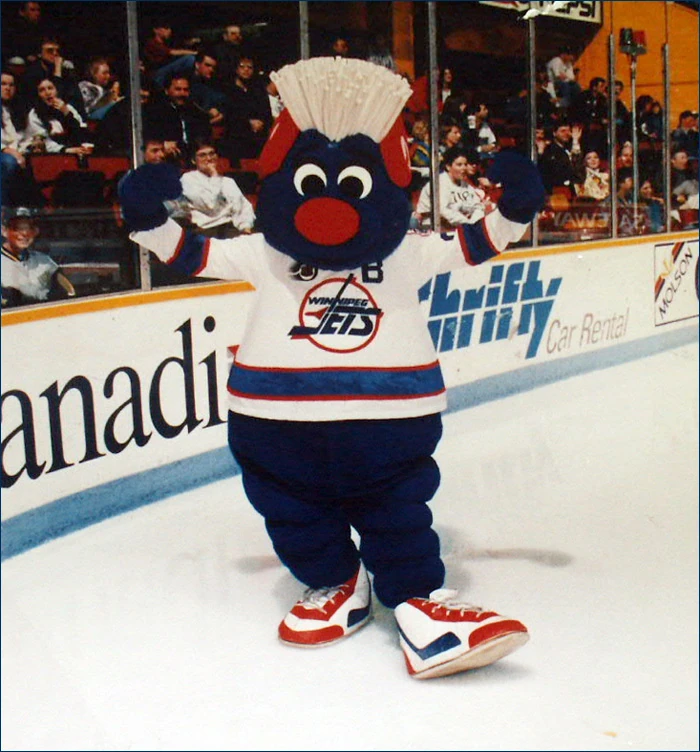
We now have visual evidence that Icy D. Eagle was in Winnipeg for the Jets-Stars game on March 10, 1995 while wearing a Winnipeg Jets jersey with #0 on it and working as a Jets mascot! Fiona is correct!

Honestly, I didn't even know this happened. Benny was the only mascot I ever associated with the Jets, and Mick E. Moose only came about thanks to the Manitoba Moose who played in the IHL and AHL. At no point was I aware that Icy D. Eagle had a two-game stint as a Winnipeg Jets mascot if it wasn't for Fiona's dedication to the Fort Wayne Komets' history. I'm not sure if the Jets are even aware about Icy's appearance as I can't find any information that links Icy and Winnipeg outside of that Winnipeg Free Press blurb posted above.

Major stick-tap to Fiona Quinn and her outstanding work as the Fort Wayne Komets' team historian for sending me down this path. Not only would I have not looked for this piece of hockey history had it not been for Fiona's prompt, but I wouldn't even have associated Icy with the Winnipeg Jets. Her effort in researching this led me to Icy being a Winnipeg Jets mascot which has blown my mind because I had no idea this even happened! Was Icy the only mascot who got this opportunity? Where was Benny in all of this? How many other mascots got this kind of opportunity with the Jets? These questions may go unanswered thanks to time, but we can officially say, thanks to Fiona's relentless research on all things Komets, that Icy D. Eagle was a Jets mascot for at least one game!

Don't be fooled by other ornithological mascots like Gulliver in San Diego or Swoop in Philadelphia when it comes to which bird mascot is the best. Icy D. Eagle holds that title, and is a regular in the nominations for the annual ECHL Mascot of the Year award. He's beloved for his antics at Komets games, he's an outstanding ambassador for the Komets' brand, and he's clearly good enough for an NHL team as the Winnipeg Jets wanted him for two games in 1995!

Because she is entirely responsible for me doing a deep dive into Icy's time in Winnipeg, please check out the Komets all-time record book edited by Fiona and Komets' radio play-by-play broadcaster Shane Albahrani. And when I say edited, I really mean "did all the research and compiled all the information". These two are vitally important cogs in the Komets organization considering all they do for the team and Komets fans, and I'm forever grateful to call Fiona a friend!

Until next time, keep your sticks on the ice!