


Showing posts with label WCHL. Show all posts

Wednesday, 23 November 2022

Once An Astro

This may be new information to some while other hockey fans might have known this for longer than I've been walking the planet, but the man to the left in the Houston Astros uniform is none other than former New York Islanders power forward Clark Gillies! The man who skated alongside Bryan Trottier and Mike Bossy for so many years in helping the Islanders capture four-straight Stanley Cups didn't start his professional sports career on the ice despite his skills on skates. Instead, he was a first baseman, a catcher, and an occasional outfielder for the Covington Astros in the Appalachian League where the Astros placed him in an effort to prepare him for Major League Baseball! Obviously, things worked out a little differently for Gillies, but let's take a look at his short baseball career!

At the age of 16 in 1970, Gillies landed in Covington, Virginia where the tyke suited up for the Astros' minor-league outfit for five games. Obviously, Gillies was far from being the physical presence he was on the ice at the age of 16, but the kid from Moose Jaw was still a man among boys at his age. Playing in the Appalachian League was a different story than senior men's baseball in Saskatchewan, though, and Gillies struggled in his three games as a positional player and one as a pitcher.

He had a solid showing in a pair of games at first base, committing just one error while recording 11 put-outs, two assists, and was part of one double-play. He played one game in the outfield where he made just one out without committing an error, and he also suited up as the Astros' pitcher for one game where he pitched six innings, giving up three hits and two runs while recording five strikeouts, three base-on-balls, and one hit-by-pitch. Defensively, the kid looked fine, but it was a different story at the plate as Gillies went 1-for-13 with a single while striking out ten times.

The Astros weren't willing to give up on Clark Gillies after he struggled in 1970 as they invited him back to Covington in 1971 after his hockey season ended. Gillies saw action in 35 games that season for a Covington team that ended up going 33-35 to finish 8.5 games back of the first-place Bluefield Orioles in the Appalachian League's North Division.

Gillies played 14 games at first base, and he looked the part as a 17 year-old. In 105 balls thrown his way, Gillies recorded 92 put-outs against eight errors while assisting on five outs and being part of seven double-plays. He also suited up for ten games as the Astros' catcher in 1971, and it was here that Gillies really excelled as he was part of 60 put-outs while committing no errors. He did give up 13 passed balls, but he also added three assists on outs from behind the plate. Defensively, Gillies was solid.

At the plate, Gillies was starting to find his groove as a pro ball player as well. In 92 at-bats, he recorded 22 hits and five walks while being hit-by-pitches three times and sacrificing twice. His .239 batting average doesn't look great, but he was playing against guys two years older than him in the Appalachian League so there may be a little slack given on this one. What should stand out is his 22 hits saw him hit five doubles, score eight runs, and drive in 11 more runs. Gillies was also caught stealing in his only attempt that season.

After heading home to join the WCHL's Regina Pats where he scored 31 goals and added 48 helpers in 68 games while posting 199 PIMs, Gillies began to look like a man carved out of the side of a mountain. He'd come back to Covington for the summer of 1972 where he played in 46 games with the Astros this summer as Covington finished in second-place in the one-division Appalachian League despite recording the most wins in the league with 41. The Bristol Tigers were 40-28 for a .588 win percentage while the Covington Astros were 41-29 for a .586 win percentage - a .002 difference in what has to be the slimmest of margins between the top-two teams in any league!

Gillies spent most of his 1972 season at first base where the big Saskatchewan kid showed an improvement over his previous season, recording 271 put-outs against just six errors made. His 29 assists matched the same number of double-plays he was involved in, and he looked like he may have a future at the corner for the Astros. It should be noted he played one game as catcher where an error and two passed balls overshadowed his two put-outs, and his four games as an outfielder saw him record six outs while making one error. He seemed to be destined to be a first baseman.

1972 also saw his work at the plate improve as well. In 156 at-bats, Gillies recorded 40 hits that included five doubles, two triples, and two balls that landed outside Casey Field. His average improved to .256 in this season, but he was still plagued by the whiff as he recorded 52 strikeouts against ten walks and two sacrifices. Gillies did score 23 runs that season while driving in 20 more, and he recorded his only stolen base of his professional career while being caught once.

Among Gillies' teammates with the Astros that year was another notable NHL star as Bob Bourne, a future teammate with the New York Islanders, was the other first baseman on the team! The 18 year-old Bourne played 33 games at first base in 1972, recording 250 put-outs against just four errors. He also assisted on 23 other outs and was part of 24 double-plays. At the plate, Bourne hit .257 with 28 hits in 109 at-bats. He had one double, one triple, scored 16 runs, and drove in 15 more. While he struck out 29 times, I'll also note he was hit by a pitch once, sacrificed four times, and stole six bases out of the seven times he tried to swipe a bag.

Gillies would head back to Regina for the 1972-73 hockey season where he'd once again find all sorts of success in scoring 40 goals and 52 assists in just 68 games as the Pats looked dangerous once again, but they were swept from the playoffs by the second-seeded Flin Flon Bombers in the opening round of the WCHL playoffs. Gillies made the decision to focus on hockey after being homesick every summer he was in Virginia, and that would put an end to his baseball career before it every truly got started.

It may have been for the best, though, because Gillies and the Pats went off in a big way in 1973-74. Gillies scored 46 goals and added 66 assists in 68 games to end up as the tenth-best scorer in the WCHL as he helped Regina to a 43-14-11 record as the top team in the WCHL. Regina downed Saskatoon in six games in the opening round of the playoffs, eliminated New Westminster in five games, and claimed the WCHL championship after sweeping the Calgary Centennials in the final. Gillies was named a WCHL all-star for his efforts, and the Pats would go on to play at the 1974 Memorial Cup tournament in Calgary.

The Pats defeated St. Catharines in their opening game by a 4-0 score after St. Catharines had defeated Quebec the day before. If the Pats defeated Quebec, they'd be the home team in the final against St. Catharines once more. Instead, the Remparts downed the Pats by a 5-3 score, and the two finalists were determined by goal differential. The 1-1 Regina Pats were the top team at +2, and they awaited the winner of the semifinal between Quebec and St. Catharines. Quebec downed St. Catharines in their rematch by an 11-3 drubbing, but they couldn't pull off a second win against Regina as the Pats claimed the Memorial Cup with a 7-4 victory over the Remparts!

The summer saw Clark Gillies' name become very popular as he was drafted in the WHA's secret draft for players younger than 20 at seventh-overall by the Edmonton Oilers before the New York Islanders called his name as the fourth-overall pick at the 1974 NHL Entry Draft in Montreal. Gillies would sign with the Islanders that summer, make the 1974-75 team as a rookie, and would hoist the Stanley Cup for the first of four times six seasons later.

Playing on the LILCO line with Billy Harris and Bryan Trottier before landing on the famous Trio Grande line with Trottier and Mike Bossy, Clark Gillies was the epitome of toughness and skill for the Islanders - a guy who could finish off a passing play, set up a teammate, or battle the opposition's toughest hombres. After a Hall-of-Fame career in the NHL, it's hard to imagine Clark Gillies having the same impact on baseball as he did on hockey, but it almost happened 53 years ago when a 16 year-old kid from Moose Jaw arrived in Covington, Virginia.

He was once an Astro, but Clark Gillies was destined to be a star.

Until next time, keep your sticks on the ice!

Monday, 14 March 2022

Complete Disrespect

This smiling woman to the left is Joy Tottman. Her name likely doesn't ring any bells for hockey fans, but she did something that no one else had done in her home country of England. Joy, you see, was the first woman to referee a men's professional hockey game in the EIHL there! Joy's list of accomplishments also includes working in a few Olympiads as she was in the stripes in both Torino in 2006 and in Vancouver in 2010, and at a number of IIHF Women's World Championship tournaments. She's been refereeing since she was 12, so her work as an ice zebra is well-documented and should be celebrated. But Joy Tottman isn't specifically why we're here today because there was a bigger crime committed by the very league that's supposed to be ushering in a new era of diversity in hockey.

Today on Twitter, the NHL decided it was going to do a little celebrating of Gender Equality Month. I have no real quarrel with the NHL celebrating gender equality except when they decide to post completely false information for the world to digest. Case in point?

It's true that Katie Guay did make history when she dropped the puck in an AHL game on October 16, 2021 as she became the first woman to referee an AHL contest. It's the remaining portion of the statement that completely disrespects all of Katie's accomplishments - plus a handful of other accomplishments by women in the hockey officiating realm - because Katie, unfortunately, wasn't "the first woman to referee in a professional men's hockey league" on that day. As shown above, Joy Tottman would like a word, NHL.

If the NHL doesn't consider the EIHL a professional league (hint: it very much is) where Tottman worked, perhaps it would like to explain how both the Central Hockey League and the West Coast Hockey League aren't professional hockey leagues. I ask that because Heather McDaniel worked in both leagues in 1995 and 1996 as she became the actual first woman to officiate a men's professional hockey league game. Her refereeing days carried into 1999 when she got pregnant and decided to hang up the stripes, but the historical records are very much still in existence.

Maybe the NHL forgot about McDaniel. It has been nearly 20 years since she worked her first professional men's game, so it may have slipped the NHL's collective mind. However, Erin Blair is a name that should be pretty recognizable to the league considering how many hockey games she's worked as a referee in the NCAA, for the IIHF, and at various clinics across the USA. She was also Katie Guay's referee partner in 2014 when Guay and Blair suited up to become the first women to officiate an SPHL game between the Fayetteville FireAntz and the Columbus Cottonmouths! Does that mean the SPHL isn't a professional league (hint: it very much is) either? It's shocking how little respect the NHL is showing here.

As I just mentioned, Katie Guay also worked that game between the FireAntz and Cottonmouths, so she definitely worked a professional men's hockey game long before 2021 as the NHL would lead you to believe. It should also be pointed out that Guay worked as a referee at the NHL Prospect Tournament at Great Park Ice in Irvine, California from September 7-10, 2019 which just happened to be hosted by the Anaheim Ducks and featured all sorts of men competing for NHL roster spots in games. Do those prospects games not count as a "professional men's hockey game" because they're exhibition games (hint: they very much do) and not regular season games? Heck, the linked article from NHL.com even states, "something never done before in the history of the league"!

Look, I respect the fact that NHL is trying to emphasize Gender Equality Month, but doing so by pushing false narratives and completely erroneous history isn't helping the cause whatsoever. Further to this, the disrespect they're showing other professional leagues is rather baffling, and I don't understand why the NHL would make a statement such as this without doing a rudimentary Google search first. As of 12:00pm CT, the tweet was still up on their Twitter account, so it seems the NHL is quite content with their Gender Equality Month effort despite singlehandedly ignoring all of the ceilings smashed prior to Katie Guay reaching the AHL as a referee.

I know the NHL likes to celebrate its own accomplishments in most cases, but this one is covered in disresepct to the women who have been forging the path to the AHL and NHL levels along with the leagues who have helped those women break through those barriers. As curators of the game, the NHL is pretty awful at recognizing that they rarely ever lead, and, in most cases, they're always a step or two behind minor-pro hockey leagues where cutting-edge innovation and off-the-wall ideas are the only way to survive. It's time for the NHL to stop taking credit for things that are patently false and far behind where others have dared to venture.

Katie Guay's accomplishment in being the first woman to referee in the AHL should be celebrated, but to erase decades of women knocking down barriers and leagues opening doors long before Katie set foot on AHL ice is yet another reason the NHL shouldn't be entrusted with looking after the long-term success of hockey.

Until next time, keep your sticks on the ice!

Saturday, 2 June 2018

Road Trip Saturday

I'm not sure the veracity of the claim posted on the billboard, but I am out and about in rural Manitoba on a visit to the lovely town of Gretna, Manitoba! Gretna is a small community of just under 600 people that sits about a kilometer north of the Canada-US border and it about seven kilometers north of Neche, North Dakota which is my destination to pick up a UPS package today. While Neche is the goal, Gretna is the focus of today's article thanks to the town having one NHL player ever call the town home.

The man pictured to the right is Hal Winkler, and he was born on March 20, 1892 in the bustling village of Gretna, Manitoba. Winkler started his career in Manitoba in 1913 with the Winnipeg Winnipegs of the Manitoba Senior Hockey League where he played eight games, posting a 2-6-0 record. It wasn't the most auspicious of starts for the netminder, but it would be the first recorded history of Hal Winkler standing in the crease for any team.

Winkler would play five seasons in the Manitoba Senior League for three teams including the Winnipeg Ypres who make an appearance in the 1917-18 Allan Cup. Winkler played extremely well in the Allan Cup, going 3-1-0 with a 2.25 GAA, but it was the one loss that stung the most as the Ypres fell to the Kitchener Greenshirts in the Allan Cup Final.

Winkler would move to the Brandon Elks in the Manitoba Senior League for the next season before moving west to Moose Jaw, Saskatchewan to join the Maple Leafs of the Western Canadian Hockey League in 1919-20. After that season, he'd move north to Saskatoon to join the Crescents. One season of rather poor Crescents hockey led him to being traded to the WCHL's Edmonton Eskimos following the 1920-21 season.

It was in Edmonton that Winkler would get his first taste of big-time hockey as the Eskimos were a solid team. In his first season with the team, the Eskimos would be backstopped by a 10-4-0 Hal Winkler with a 2.38 GAA en route to a first-place 15-9-0 season. The Eskimos would actually finish tied with the Regina Capitals at 14-9-1 atop the standings, so it was decided that the tie game between the two teams from the season would be replayed to determine who finished in first-place. Edmonton handily won the game by an 11-2 score, and they claimed the top spot in the WCHL. One week later, the Capitals exacted revenge in the WCHL final by winning the two-game total-goals series 3-2 after the teams played to a 1-1 tie in Game One and Regina won Game Two 2-1.

The 1922-23 WCHL season would see no tie-breakers needed as Edmonton was the class of the league once again with a 19-10-1 record that included Winkler's 17-10-1 season. The Eskimos would easily dispatch the Regina Capitals in this season to advance directly to the Stanley Cup Championship after the WCHL-PCHL playoff format was abandoned. The NHL champion would play the PCHL champion, pitting the NHL's Ottawa Senators against the PCHL's Vancouver Maroons, and it would the Ottawa Senators who advanced to meet the Edmonton Eskimos.

In a rather strange twist, the series between the Eskimos and Senators was played in Vancouver, marking this series as the last series in Stanley Cup history to be played entirely in a neutral site. Winkler would get the start for Edmonton across from Ottawa's Clint Benedict on March 29, 1923, and it appeared that this series was all about goaltending and defence. John Morrison put the Eskimos up 1-0 midway through the second period before Ottawa's Lionel Hitchman tied the game with seven minutes to play in the third period. In Game One of the Stanley Cup Championship, we'd need overtime, but it didn't last long as Cy Denneny found room past Winkler just two minutes into the extra period for the 2-1 Ottawa overtime win.

Game Two would be another low-scoring affair as just a single goal was scored. Harry "Punch" Broadbent notched a power-play marker 11:23 into the first period, and Clint Benedict and the Ottawa defence did the rest as the Senators withstood 68 shots to post the 1-0 shutout victory! Ottawa would win the Stanley Cup 2-0 in the best-of-three series, and they set a little history along the way as King Clancy became the only player to play all six positions on the ice in a Stanley Cup Championship after relieving netminder Clint Benedict in the second period after Benedict was whistled for a minor penalty and served it.

Despite falling the in the Stanley Cup Championship in 1923, the 1923-24 WCHL season was one to forget for the Edmonton Eskimos as they fell to the bottom of the standings with an 11-15-4 record. Hal Winkler was 9-13-4 on the season with a 2.50 GAA, but the Eskimos would miss the WCHL Championship.

The 1924-25 season saw the PCHL and WCHL merge after the PCHL collapsed, and the six-team league saw some movement as Hal Winkler was dealt to the Calgary Tigers on August 28, 1924 for cash. The Tigers roared through the six-team league to a 17-11-0 season with Winkler playing all 28 games. However, things would unravel in the WCHL Playoffs as the Tigers met the Victoria Cougars in the final, and the Tigers fell in the two-game total-goals series 1-1 and 2-0 to lose 3-1 on total goals. Once again, Winkler came up just short of going back to the Stanley Cup Championship.

The 1925-26 season saw the WCHL renamed as the Western Hockey League after the Regina Capitals relocated to Portland, Oregon to become the Portland Rosebuds. The Calgary Tigers, unfortunately, would be a non-factor in the WHL in this season as they and Hal Winkler posted 10-17-3 records to finish in fifth-place. That wouldn't be good enough to make the WHL Playoffs, but Winkler had a solid season in between the pipes. He finished fourth with a 2.70 GAA, but led the league in shutouts with six! And it would be that kind of solid goaltending that attracted the attention from one team in particular.

On October 27, 1926, Hal Winkler would be traded east as Calgary traded the netminder to the New York Rangers for cash, meaning that Winkler would now be an NHL goalie! His first game was against the Montreal Maroons on November 16, 1926 where he would post a 1-0 shutout! How about that for playing your first game in the show? Unfortunately, his career with the Rangers would be a very short one, however, as Winkler only appeared in eight games, posting a 3-4-1 record with a 1.87 GAA. The reason it was short? He was on the move again.

January 27, 1927 saw the New York Rangers trade the Gretna-born goalie to the Boston Bruins for $5000. It would be in Boston where Hal Winkler posted the best numbers of his short NHL career. For the remainder of the 1927 season, Winkler would go 12-9-2 with four shutouts and a 1.66 GAA, good enough to help the Bruins finish in second-place in the American Division with a 21-20-3 record.

Prior to the 1927 NHL Playoffs starting, news hit the NHL that the WHL had collapsed and folded, so the Stanley Cup Championship had no challenger from the west. Instead, the NHL Final would now be the Stanley Cup Final for the first time in history. Thanks to the ten-team divisional alignment that featured all the American teams in one division, it also meant that an American team would be guaranteed to play for the Stanley Cup in the final for the first time in history.

The division winners advanced to the semifinal series while the second-place and third-place teams played a two-game total goals series to advance to play the division winners. The Bruins and Winkler would meet the Chicago Blackhawks in this two-game series, and the Bruins won Game One 6-1 on March 29 before the two teams tied 4-4 on March 31. As a result of the 10-5 total of goals scored, the Bruins advanced to meet the New York Rangers in a two-game total-goals series with the winner advancing to the Stanley Cup Final.

The April 2 game saw Hal Winkler and Lorne Chabot match one another save for save through four periods as the game ended in a 0-0 tie. As obvious as that is, it would be Winkler's first shutout in the NHL playoffs. Game Two went on April 4, and the Bruins fell behind five minutes into the game when Bill Cook beat Winkler to put the Rangers up 1-0. However, three second-period goals by Jimmy "Sailor" Herbert, Lionel Hitchman, and Harry Oliver put the Bruins up 3-1, and that would be the final score as the Bruins advanced to the Stanley Cup Final with the 3-1 total-goals series victory!

The best-of-three Stanley Cup Final started in Boston on April 7, and both teams did their best in what can only be described as less-than-ideal ice conditions. The game would finish in a 0-0 tie after Frank Calder called the game with ice conditions in the second ten-minute overtime period basically resembling slush. Calder also determined that the series would be a best-of-five after this tie game, and if the two teams were tied in wins they'd share the Stanley Cup.

April 9 saw Game Two played in Boston again, and the Senators went on the offensive as King Clancy and Cy Denneny beat Winkler in the first period. Harry Oliver would make it a 2-1 game after poking the puck home with a mob of players on the doorstep with just over three minutes to play in the third period, but Denneny would score with seconds to play to ice the 3-1 win for the Ottawa Senators, giving them 1-0-1 series lead.

The series would shift to Ottawa for Game Three on April 11, and it appeared that the teams had shifted back into defensive-minded hockey. However, Jimmy Herbert sniped a goal past Alec Connell seven minutes into the game to give the Bruins the early 1-0 lead. Cy Denneny would find the equalizer with five minutes to play in the second period, and we'd have a scoreless third period to set up overtime! Neither team, though, would solve the goaltenders as this game ended 1-1 to push the series to 1-0-2 in favour of Ottawa. With the two ties, this series essentially became a best-of-three!

Game Four took place on April 13, and Ottawa head coach Dave Gill decided to make changes to his lineup as he inserted Frank Finnigan and Hec Kilrea into the starting lineup. Those moves proved wise as Finnigan and Cy Denneny both scored in the first period with Kilrea running general havoc all over the ice. Denneny would find the back of the net again in the third period, and things began to get out of control. Fights broke out all over the ice, the Ottawa police were called onto the ice to help keep the peace, and things began to settle down. Harry Oliver would put Boston on the board with two minutes to play, but an ugly butt-end to the face from Hooley Smith on Oliver ended Oliver's night, and Eddie Shore and Smith fought and were ejected.

In the end, Ottawa won the game 3-1 to win the Stanley Cup with a 2-0-2 record in the best-of-five series, but this game was marred by the late violence that included Boston's Billy Coutu attacking referee Jerry Laflamme before tackling alternate referee Billy Bell and setting off a bench-clearing brawl. Hal Winkler lost for the second time in a Stanley Cup Championship, but the fallout from the fisticuffs and brawling saw Coutu banned from the league for life, Hooley Smith was suspended for one-month from the start of the 1927-28 season, and Lionel Hitchman, George Boucher, and Jimmy Herbert were all fined for their parts in the melee.

The 1927-28 season saw that crazy downturn in scoring in the NHL where fifteen goalies posting eleven shutouts or more in the 44-game NHL season. One of those goalies? None other than Hal Winkler of the Boston Bruins who posted a 20-13-11 record with a 1.51 GAA and fifteen shutouts! That's a Boston Bruins record that still stands today, so Hal Winkler still has his name in the record books!

Boston finished atop the American Division with that 20-13-11 record, earning the very first Prince of Wales Trophy and a spot in the semifinals to await the winner of the New York Rangers-Pittsburgh Pirates two-game total-goals series. New York would advance, and the series between Boston and New York started on March 31 in New York where the two teams battled to a 1-1 tie. Game Two was played on April 3 in Boston with the winner of this game advancing thanks to the total-goals rule. Things did not go well for the Bruins as they dropped a 4-1 decision to the Rangers, ending their playoffs after just two games.

The 1928-29 season saw things change in the Bruins' front office as Art Ross reduced his coaching and GM duties to just the general manager's duties. In doing so, he acquired Cy Denneny from the Ottawa Senators as player-coach, and promoted a new goaltender who was all sorts of good in Cecil "Tiny" Thompson. With the promotion of Thompson, Hal Winkler was sent to the American Hockey Association's Minneapolis Millers where he continued to play well for the Bruins' affiliate. They would finish second in the AHA in '28-29 with an 18-12-10 record, but fall 3-1 in a series against the third-place, crosstown rival St. Paul Saints that would see the Millers and Winkler start their summers early once again.

The PCHL's Seattle Eskimos would sign Winkler as a free agent on October 28, 1929, and he would help the team by posting a 15-13-8 record with nine shutouts and a 1.61 GAA. The Eskimos, however, would miss the playoffs, and Seattle would deal Winkler to the Boston Tigers of the Can-Am League on October 30, 1931 for cash. With Boston, Winkler would play just ten games, going 3-7-0 with a 3.15 GAA. The Tigers would miss the playoffs that season, and it would be the final time that Hal Winkler pulled on a jersey in a professional game as he would retire at the season's end.

Winkler would live out his days in Winnipeg, Manitoba until he passed away on May 29, 1956 at the age of 62. While he never actually got to win a Stanley Cup, the Boston Bruins did an incredible thing to honour Winkler. The Stanley Cup was redesigned in 1957, and Winkler's name was added to the 1929 Boston Bruins' Stanley Cup champion names despite him playing with Minneapolis for the whole season. While his name was added posthumously, Hal Winkler officially has his name on the Stanley Cup forever.

He's the only NHL player to have ever come from the small town of Gretna, but Hal Winkler holds a special place in hockey's rich history.

Until next time, keep your sticks on the ice!

Sunday, 19 July 2015

Righting A Wrong

It's not often I get an email from a player who wants to clear up some confusion that I have written or others have suggested, but I was going through my email and I figured I needed to write about this. The man to the left is Warren Skorodenski. He didn't have a long NHL career, but he has one distinction that puts him in the history books. The skull mask worn by Skorodenski was the first skull mask seen in hockey as he beat Gary "Bones" Bromley by a few years! While Skorodenski wasn't the first netminder in the NHL to wear it, Skorodenski debuted his skull mask in a different league, and may actually be responsible for the trend at that time!

According to Mr. Skorodenski's email,
"This photo [Teebz: photo is below] was taken in the mid 70's at the Calgary Corral while playing with the Calgary Wranglers. Bones did not wear the Bones Mask until later on when Harrison made his different style mask and the Bones mask was born. And if that doesn't do it for ya just ask Greg Harrison who made my Harrison Skull Mask as well as the one for Bones. George Light from Selkirk, Manitoba made my 1st masks and the Skull Xray was painted by Norm Guziak in Winnipeg, Manitoba. I hope that clears up any misconception about the 1st Skull Mask."
Clearly, there's a little fact-checking to do here, but I'm fairly certain Mr. Skorodenski is correct in his timeline. Adding to the awesomeness of Mr. Skorodenski's email is the fact that he's from Winnipeg, and it's always super-cool when a guy from my hometown is making hockey history.

The image referenced above by Mr. Skorodenski is on the right of him playing in Calgary. That timeline would have him with the Wranglers in the WCHL and WHL from 1977 through 1980. We now have a timeline as to when Mr. Skorodenski wore the skull mask, and we can start piecing together a timeline as to who was first to wear the skull. Let's take a look back into history as to when Gary Bromley started wearing it.

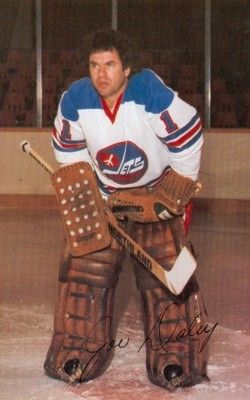
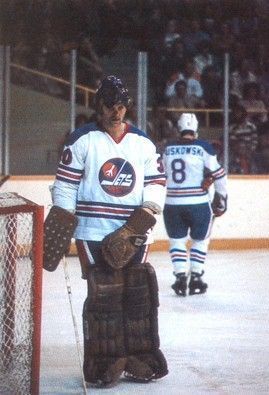
1977 saw Gary Bromley playing with the Winnipeg Jets in the WHA. Gary was fresh off a season with the WHA's Calgary Cowboys where he played 28 games behind Don McLeod. In Winnipeg, he split time with Joe Daley for the majority of the season, but his mask, as seen in the photo to the left, is completely white. The only problem? Mr. Skorodenski's photo of him in Calgary isn't dated. We must press on!

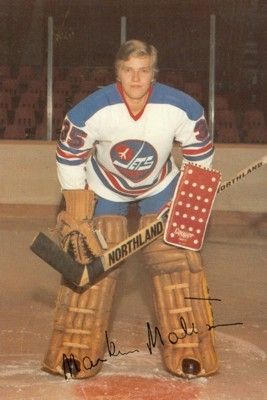
As an aside, the Jets logo in the Bromley picture above is a little off from what I remember. See the jet in the logo? I don't recall it ever being white. It's not shown on the 1977-78 image on whauniforms.com nor does it appear on any other year of the Jets' WHA existence. However, there are photos of Joe Daley and Markus Mattsson from the 1977 year that shows the white jet as well. Further to that, Gary Smith, who played for the Jets in the 1978-79 season, also wore a white jet in a game! Does anyone recall this white jet era for the Jets? How long did it last? And why was it changed when the Jets entered the NHL?

Anyway, back to the task at hand. In 1978, the Canucks signed Bromley and it was in Vancouver where "Bones" debuted his mask to the world. The problem? He didn't start off with the skull mask in Vancouver, instead wearing a plain white mask like he did in Winnipeg as seen to the right. That program, compliments of an eBay search, is from November 3, 1978 meaning that Bromley wore his all-white mask while backing up Glen Hanlon for at least part of the season. In other words, Mr. Skorodenski has a two-season head start on Bromley when it comes to wearing the skull mask, and Mr. Skorodenski has named names when it comes to having witnesses on this. I'm going to say that there's a better-than-good chance Mr. Skorodenski is right at this point.

Of course, Bromley was in the NHL two seasons before Mr. Skorodenski got there, and Bromley's hockey career ended in the AHL the season that Skorodenski played his first NHL game with the Blackhawks. It seems logical to suggest that Bromley was the first goaltender to wear the skull mask in the NHL, but it seems that Mr. Skorodenski is entirely right in saying that he was the first to wear the design in a documented hockey game. Skorodenski wore it while in junior while Bromley didn't have it for at least a year and a half later while playing with the Canucks.

According to one website, Mr. Skorodenski emailed a member of their forum about who created his mask, writing,
"George Light in Selkirk Manitoba. George worked in the casting department at the Selkirk Mental Hospital. He made Glen Hanlon and Karl Friesen's masks as well. I use to tell people that as a joke, as it turned out I asked him what Hospital he worked at the last time we spoke a few years ago and he told me the Mental Hospital. I had to laugh and tell him my story. He had a good laugh as well. My last mask was a Harrison. Not sure if Bones had his skull mask first or not. All I know is my skull was painted in the late seventies when I played for the Wranglers and I didn't know who bones was until we played against each other in the AHL in the eighties. Bones did not play in Vancouver until 78-79. I had the skull Mask in Calgary playing junior when Bones was with the Cowboys and he wasn't wearing the Bones Mask then."

There you have it, folks: Skorodenski should be credited with the first skull mask in history while Bromley should be credited with the first skull mask in the NHL. While some may say that this distinction matters little, I know it matters a lot to the man who played just 35 career NHL games. After all, it's his legacy and mark on the game!

Until next time, keep your sticks on the ice!

Friday, 15 April 2011

Concerns For The AHL Teams

With all the latest talk about the potential move of the Phoenix Coyotes back to Winnipeg for the Manitoba capital's second kick at the NHL, there seems to be one team that is continually being lost in the shuffle when it comes to this potential move. The AHL's Manitoba Moose is one of the flagship franchises in the AHL circuit, consistently putting up excellent attendance figures while being one of the most stable franchises in the league despite the long distance they are from most AHL outposts. What happens to this franchise if the Coyotes move to Winnipeg? Where do they end up in terms of a new city? Does Vancouver continue its affiliation with the Moose if they move further away?

Look, those of you who think the Coyotes should move back to Winnipeg, I applaud you. From everything we've seen happen in the desert, it sounds as though there really is only one option for the Coyotes once this season ends, and it starts and ends with moving vans. Until those vans hit the road, though, I am not going to be rushing out to slap down three years of cold, hard cash for season tickets if True North Sports and Entertainment asks me for it. Until the trucks are rolling north, I'm not putting the cart before the horse in this situation.

That being said, there must be plans in place to move the Moose if the NHL finally pulls the plug on Phoenix. AHL Commissioner David Andrews, who made news yesterday on this blog with his "reduced games" announcement, was answering questions on CKWX radio in Vancouver when the question about what to do about the Moose if Phoenix moves to Winnipeg came up. Andrews wasted little time in explaining the AHL's stance.

"We are preparing for the possibility that Phoenix could end up in Winnipeg," Andrews said. "We have contingency plans relative to our own divisional and conference alignments and schedule.

"The middle of May is kind of the drop-dead date for us in terms of preparations for the following year. We do have a couple of strong possibilities, couple of markets that really are interested in having an AHL franchise, so the potential is there to activate Manitoba's AHL club somewhere else if need be."
It sounds as though the AHL has been ready for some time when it comes to this Phoenix-Winnipeg saga coming to an end. I commend them for their preparedness, but it remains to be seen what happens if the Desert Dogs can survive the opening round against Detroit and move past that "middle of May" date that Mr. Andrews set as the drop-dead date.

The question really isn't about the Coyotes, though. If, or perhaps more appropriately "when", the Coyotes move back to Winnipeg, to where do the Moose relocate? What cities are represented by these "couple of markets" in Mr. Andrews' comments?

First, we should probably check out a map of AHL franchises. As you can see, Manitoba is kind of on its own way out in the middle of Canada. Milwaukee might be the closest team to them, and they play in a completely different division. If you look out on the west coast, you'll see the Abbotsford Heat all by their lonesome. Western Canada is a lonely place, it seems, but there may be a couple of places the Moose can relocate to above the 49th parallel.

Places that would make the Vancouver Canucks happy would have to include Chilliwack, Nanaimo, or even Tacoma, Washington. All three of those cities are in Vancouver's backyard, and each of them has their respective pros and cons. Chilliwack is, of course, a stone's throw from Abbotsford, so the rivalry between the Moose and Heat would ratchet up a few notches if the Moose were to relocate to Chilliwack. Nanaimo is on the island, but isn't very far away from Abbotsford either, so that's also an option.

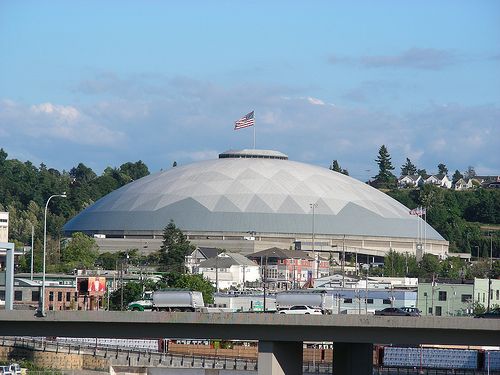
Tacoma, while not being a Canadian city, is a very attractive option as it finds itself just down the highway from both Seattle and Olympia. The Tacoma Dome is an interesting hockey venue as it is "the world's largest arena with a wooden dome in terms of total volume and seating capacity", according to Wikipedia. The WHL's Tacoma Rockets played there from 1991-95, and the WCHL's Tacoma Sabercats were the last hockey tenants as they played there from 1997-2002. The only question is whether the people of Tacoma want the AHL.

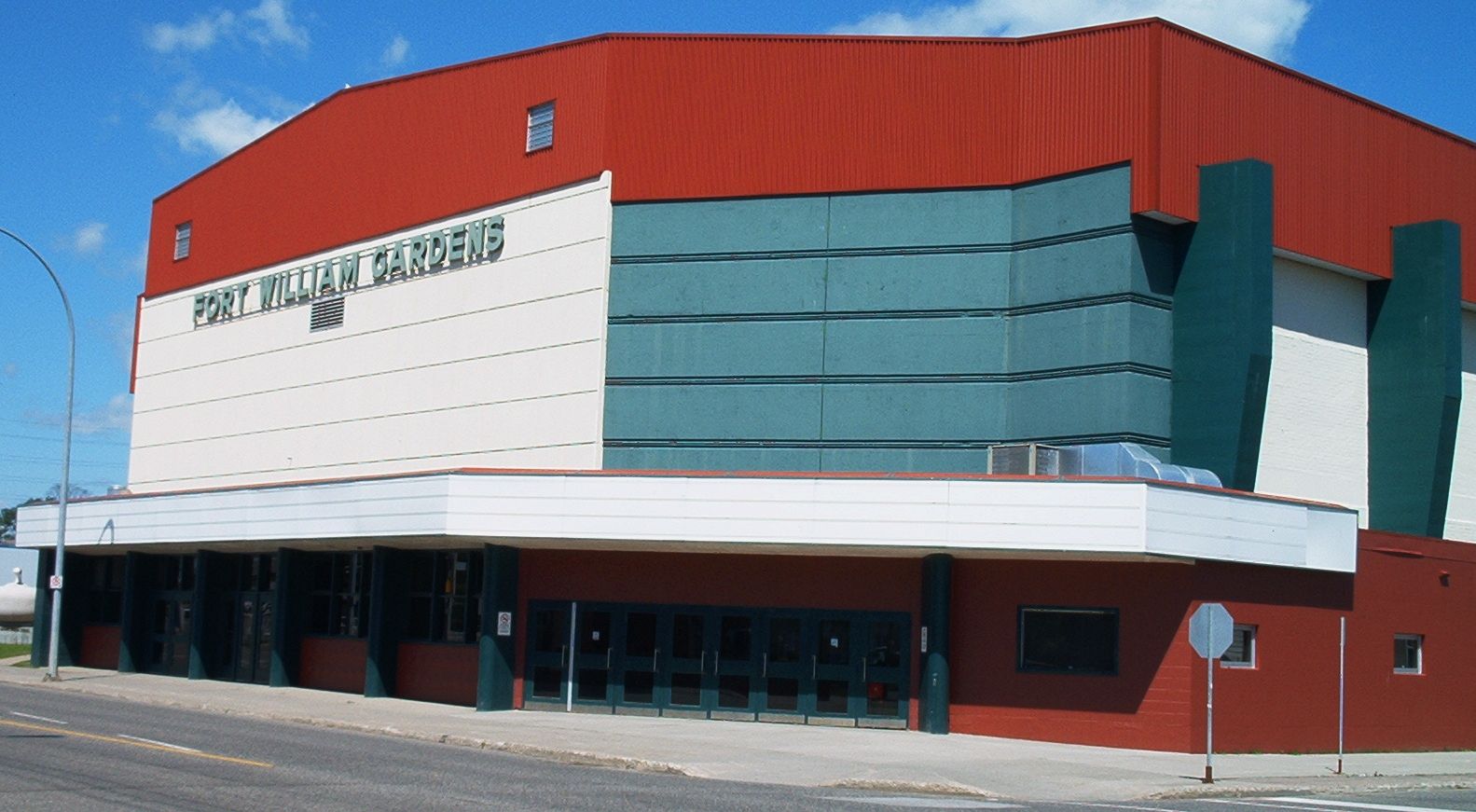
If moving to the west coast is too big of a leap for the Moose to make due to travel costs and logistics, perhaps they could look down the highway to the east. Thunder Bay has twice hosted the Manitoba Moose in preseason games: in 2002 against the St. John's Maple Leafs, and again in 2003 against the Toronto Roadrunners. While Fort William Gardens is quite small in terms of its maximum seating at 3351, the city of Thunder Bay has investigated getting a new state-of-the-art arena for its community, and there is talk of replacing the Fort William Gardens in 2013. Perhaps the arrival of the AHL can push that forward.

The biggest thing about Thunder Bay is that it wouldn't change the alignment in the AHL whatsoever, and the travel costs will remain about the same for the team as they were in Winnipeg. While the population of Thunder Bay is about 1/7th of Winnipeg, the city would probably outdraw some of the lower-ranked team in attendance by simply being the city's biggest pro sports team ever. Much in the same fashion that Hershey supports the Bears, Thunder Bay could take to their AHL franchise in much the same fashion.

Thunder Bay, Chilliwack, Nanaimo, and Tacoma are decent choice in my view. There are larger markets that the AHL could move into, though, and these have to be considered as well.

Kansas City and Vancouver already have had a relationship in the past when the Canucks were affiliated with the IHL's Kansas City Blades. Besides being a very large market, Kansas City also has that brand-new arena we keep hearing about whenever someone mentions the New York Islanders moving. While the Moose wouldn't be the first option when it comes to entertainment dollars, if the franchise was run properly, the AHL could work very nicely in Kansas City.

Omaha, Nebraska had a team as recently as 2007 when the Calgary Flames had their AHL affiliate playing out of Omaha. The Omaha Ak-Sar-Ben Knights weren't the greatest of draws in the AHL, and the Flames ultimately decided to move the team after the low attendance numbers forced their hand. Again, if the franchise was run properly and the community involvement from the team was there, I believe that the Moose could work very well in a city like Omaha.

If a team is leaving Phoenix, there is an open market there for another team to fill the void. Phoenix isn't a very far jump from Vancouver, so the affiliation might be good for both towns. Again, the issue is how this team is run and the support it would receive in Phoenix. If people aren't showing up in Phoenix for NHL games, why would they show up for AHL games? I'm sure the AHL would take this into consideration when looking at new homes for the Moose franchise. Could it work in Phoenix? In theory, yes. But that's all we're dealing with, and the evidence right now says it would not work in the long term.

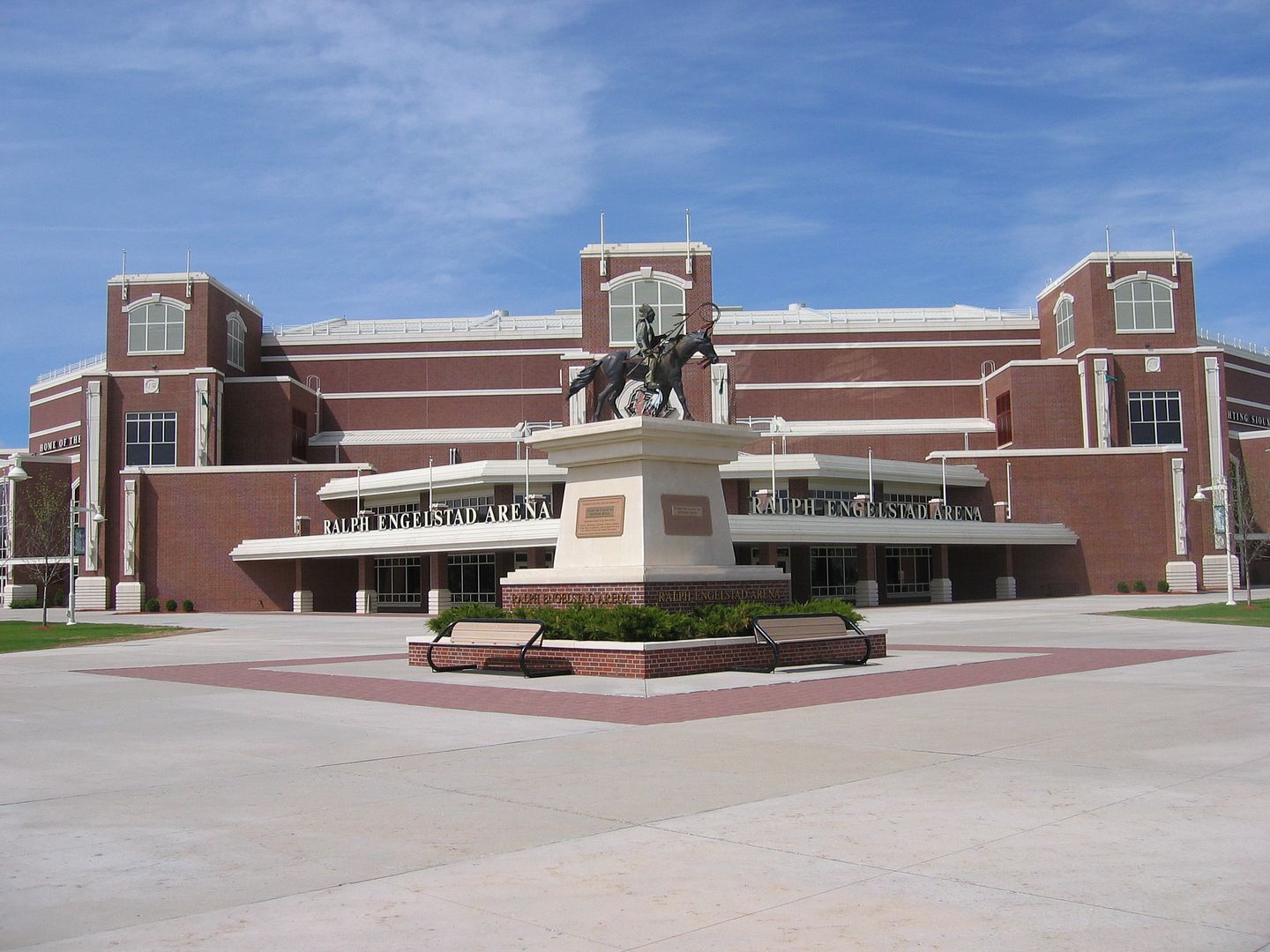
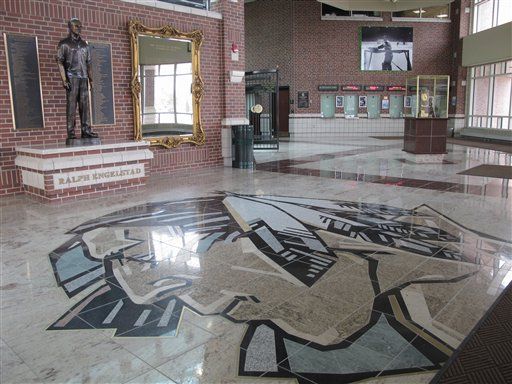
An interesting suggestion came from a co-worker when he suggested the cities of Grand Forks and Fargo, North Dakota. Fargo is double the population size of Thunder Bay, and they have a gorgeous hockey facility in the Ralph Engelstad Arena. Of course, Ralph Engelstad Arena is home to the NCAA's Sioux hockey team, so there might be some logistics to work out between the two teams, but Fargo's travel distance to other AHL markets would be comparable or less than what it is in Winnipeg. The fans in these cities support the Sioux very well, and I direct everyone to Nathan's comments!

The one thing that I think should be considered is that the USHL's Fargo Force play out of Fargo, so something will need to be done to reach an agreement for an AHL franchise to move. But for all the cross-border shopping that happens, I'm quite certain that a few Winnipeggers would attend a Fargo Moose game if they were in town for the weekend.

Overall, I believe there are some very good markets for the AHL to look at if the Moose are indeed on the move. I think a Canadian market would be best, but a northern US market would have no foreseeable faults either. What say you, readers? If the Moose were given the option to move, would one of the cities above be their best choice? Is there another place I should have considered? Have your say in the comments!

Until next time, keep your sticks on the ice!

Tuesday, 22 September 2009

TBC: They Don't Play Hockey In Heaven

Teebz's Book Club is making up for lost time. Considering I took the summer off, my summer reading is now being caught up, and I'm hoping to have a third book finished by the end of the week. We'll see how that goes, but let's get to this book. They Don't Play Hockey In Heaven, written by Ken Baker and published by The Lyons Press in 2003, is a story that is as inspirational as it is informative. Ken Baker's journey back to hockey after eight years away from the game is not only an inspiration story about following one's dreams, but how to live one's life. Mr. Baker's journey is filled with peaks and valleys, the support of his wife, Brooke, his friends, and teammates, but it is a story about one man following his dream, despite how impossible or unattainable it seems.

Ken Baker, a lad from Buffalo, New York, was a highly-touted goaltender by the age of 17. He played in the World Under-17 Championships with players like Jeremy Roenick and Mike Modano, and led the Americans to a gold medal victory over the Canadians who featured goaltender Stephane Fiset. All three of those men would go on to play in the NHL, while Baker received offers to suit up for NCAA Division One teams. Baker accepted an offer from Colgate to play net for the Red Raiders, and it appeared all was well.

That is, however, until Baker started to notice that he was having trouble building any sort of muscle mass on the top half of his body. Some other rather startling symptoms began showing themselves, giving Baker more cause for concern: impotence, a build-up of flab despite his athletic endeavours, lethargy, and the occasional milky discharge from his nipples. Something was wrong. Something was very wrong, and it prompted him to visit Dr. Joshua Trabulus about these symptoms.

"A few days later, a battery of blood tests came back showing that I had 150 times the normal level of prolactin, a hormone that women secrete to produce breast milk. Then an image from an MRI confirmed it: A prolactin-secreting tumor had taken up residence a few inches behind my eyes. Trabulus explained that the more prolactin I produced, the less testosterone I produced. A normal man has a level of about ten nanograms per milliliter; a woman breast-feeding her children has a level of two hundred. My prolactin level was 1,578."
Baker was suffering from a condition called hyperprolactinemia as a result of the tumor. Surgery was scheduled, and, nine months later in July 1998, the tumor was removed except for a tiny piece. Drugs would help control the tumor's growth, but they affected him when he did strenuous workouts. As a result of the tumor's growth and its affecting his life, Ken Baker's professional hockey career died after he graduated from Colgate in 1992.

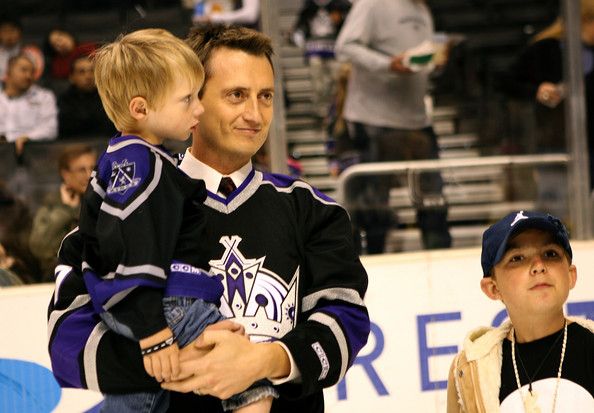
Now I could stop typing right here, and the man would still be a hero. He defeated cancer, and, albeit is still battling against it today, seems to have a pretty good hold on his life. Ken Baker is married to a wonderful woman named Brooke, has an amazing son named Jackson - seen here with dad at a Los Angeles Kings game in 2007 - and has his health. The story doesn't end there, though. We need to go back to 2001 where Ken Baker challenged himself and the institution of hockey, and proved that dreams can come true.

After deciding to go back to playing senior league hockey in Oakland, the fire was lit in Baker, and he wanted more. He was a successful writer for Us Weekly magazine, but "The Dream" had affected him. "The Dream" was a vivid scene that he had had while sleeping about playing professional hockey. At 30 years old, it was now or never, and, while it took some soul-searching and prodding from his closest friends and family, they convinced him to tryout with the WCHL's Bakersfield Condors.

He had nothing to lose if he didn't make the team. He just wanted to see if he was good enough to play in the professional ranks. After negotiating a deal with the Condors to be the third-string goaltender if he was good enough - including penning this book about his experience - Baker was kept as the third-string goaltender for the WCHL franchise. He had the support of the entire front office staff, but he still needed to prove that he belonged on the ice, and convincing the coach would be no easy task.

I'm not about to tell Ken Baker's story here. He tells it far better than I do as it is. I will say this: the cast of characters that he is around provide a number of laughs along with some frustration and anger. For anyone who has played the game, this will probably give you an idea of what it means to be good enough to make the team, but not good enough to play regularly. For anyone who hasn't played hockey, this will give you a real picture of what back-up goalies go through in a season.

Ken Baker has penned a brilliant story about life in minor-league hockey. His thoughts, his efforts, and his inspirational tale of fighting against the odds to realize his dream are chronicled well in this book, a sign of his excellent writing skills. They Don't Play Hockey In Heaven is truly one of the best hockey stories I have read to date amongst all the hockey books I have had the pleasure in reading, and Ken Baker's heartfelt, inspirational story deserves Teebz's Book Club Seal of Approval.

There is one note I'd like to pass along about this book. Ken Baker doesn't censor anyone in this book. If a coach or player said it, it was added verbatim. Because of this, there are a number of instances where "locker room talk" is included in the story, so it may not be suitable for children or young teens. However, adults can probably relate directly to Mr. Baker's story, and I recommend They Don't Play Hockey In Heaven for anyone who has ever had what seems like an impossible dream.

Until next time, keep your sticks on the ice!

Tuesday, 4 August 2009

Clancy: Leader By Example

Hockey Blog In Canada continues to profile the trophies that the NHL awards to its teams and players. Today, we look at the King Clancy Memorial Trophy, which is annually awarded to the NHL player who "best exemplifies leadership qualities on and off the ice and who has made a significant humanitarian contribution to his community". As you know, HBIC did a long examination last summer of some of the charities started by members of the NHLPA, and it really goes to show how involved the NHL players are in their communities. To me, the King Clancy Memorial Trophy might be the most underrated trophy in the NHL because it normally goes to the player who has done outstanding work for others in his community each year. It's that kind of dedication that attracts fans to the game, and helps to forge a bond between athlete and fans unlike any other. How did this trophy come about? Who was King Clancy? What is significant about the winners of this trophy?

Francis Michael "King" Clancy was born on February 25, 1903 in Ottawa, Ontario. Clancy grew up playing hockey for local junior teams, and established himself as a high-scoring, offensive defenceman. He would routinely get into altercations with other players, but his talents were putting pucks in the net, not fighting. Thus, he was reported to have lost almost every fight in which he was involved.

Clancy's hockey talents allowed him to sign on with the Ottawa Senators in 1921 at the age of 18. The transfer to professional hockey was a jump that slowed Clancy down a bit as he only posted four goals and six assists in 24 games with the Senators in 1921-22. However, over the next couple of years, Clancy blossomed into a promising defenceman who could hit and score despite being significantly smaller than the other defencemen in that time period.

In 1923, Clancy made NHL history when he became the first man to play all six positions in a Stanley Cup Final game. During the 1920s, goaltenders would serve their penalties in the penalty box if assessed a penalty. When Clint Benedict was whistled for a penalty in Game Two of the best-of-three series on March 31, 1923 against the WCHL's Edmonton Eskimos, Clancy guarded the net while Benedict served his minor penalty. Having lined up in the other five positions on the ice in the game, Clancy became the first man in history to play all six in a Stanley Cup Final game. Ironically, the Senators won that game by a 1-0 score, allowing them to win the Stanley Cup by a 2-0 series win.

Clancy had established himself as one of the best rearguards in the game by 1930. The 1929-30 season saw Clancy score 17 goals and add 23 assists in 44 games. However, the team was bleeding money as the smallest market in the ten-team NHL, and had played in American cities as the home team in order to turn a profit from gate receipts at those games. With the Great Depression looming, the Senators began selling players to other teams. Scoring star Frank Nighbor was sold to the Toronto Maple Leafs early in the off-season of 1930. And Clancy was also a victim of the sell-off as he was sold to the rival Maple Leafs for $35,000 and two players before the start of the 1930-31 season.

Clancy's production was consistent in Toronto over the next few seasons, averaging approximately nine goals and 13 assists annually. He was still tenacious in his own zone, however, and improved Toronto's blueline immensely. Clancy helped the Maple Leafs to the 1932 Stanley Cup with his play in what some called the "Tennis Series". Toronto won Game One in New York by a 6-4 score, followed up with a win in Boston by a 6-2 score, and then finished off the best-of-five series with another 6-4 win. Game Two had to be moved to a neutral location due to the circus invading Madison Square Gardens. Clancy's play was steady but unspectacular as he had two goals and an assist in seven playoff games. However, he was voted to the second all-star team after the season for his solid play.

Clancy ended his playing career in Toronto just six games into the 1936-37 season. He had one goal at the time of his announcement, but he retired as the NHL's best goal-scoring defenceman at the time with 136 goals to his name. However, he wasn't done in hockey just yet.

Clancy was hired by the Montreal Maroons as their head coach in 1937. His stint behind the bench wasn't all that spectacular, however, as he was fired after just 18 games that season after going 6-11-1 in those 18 contests. Clancy still had the passion for hockey burning inside him, so he moved into officiating, and the NHL employed him as a referee. He spent 11 years in the referee sweater, working all sorts of games for the NHL, but his love of the game took him back behind another bench.

In 1949, the Montreal Canadiens hired Clancy to coach the Cincinnati Mohawks, their AHL franchise. Clancy accepted, but found his time with the Mohawks similar to his time with the Maroons. Clancy posted two losing seasons in Cincinnati, and the Canadiens relieved him of his coaching duties. The Maple Leafs welcomed him back to their family as they granted him the head coaching position for the Pittsburgh Hornets, their AHL affiliate, in 1951.

As the head coach of the Hornets, Clancy went on a tear. In his first season behind the bench, the Hornets finished first overall in the AHL with 46 wins and 95 points before capturing the Calder Cup in the AHL Playoffs. They defeated the Providence Reds in six games to capture their first AHL Championship. Clancy guided the Hornets back to the Calder Cup Final the next season, but the Cleveland Barons used all seven games to wrestle the Calder Cup away from the Hornets. Clancy's coaching didn't go unnoticed by the Maple Leafs, and they moved him from the AHL bench to the NHL bench for the next season.

Clancy coached the Maple Leafs for three years, from 1953 until 1956, but never found the same success he had in Pittsburgh. His first season saw him win the most games in those three seasons with 32, and the Maple Leafs never finished higher than third in the NHL standings. In all three seasons, they were dispatched in the first round of the NHL Playoffs. Conn Smythe moved Clancy upstairs to the Assistant General Manager position for the 1956-57 season, but Clancy was rarely involved in any personnel decisions. In 1958, Clancy was inducted into the Hockey Hall of Fame as a player.

Clancy worked under Punch Imlach as the assistant GM through the 1960s. When Imlach was let go by the Leafs, Clancy had stated that he would follow Imlach, but the Leafs sweetened the deal and made him Vice-President of the Maple Leafs. With Harold Ballard taking over the Leafs in 1971, Clancy and Ballard became good friends and often seemed inseparable. Clancy even stepped behind the bench for 15 games while head coach John McLellan recovered from a peptic ulcer - something an executive would almost never do in today's NHL.

In 1986, Clancy went into the hospital to have his gallbladder removed. However, complications from surgery allowed the infection from his gallbladder to spread into his body, causing septic shock. Clancy passed away on November 10, 1983 from this complication.

The NHL's Board of Governors presented the NHL with the King Clancy Memorial Trophy in Francis M. Clancy's honour in 1988.

Now you may be asking how he got the name "King" Clancy. Well, his dad was actually nicknamed "King" Clancy as he was a skilled football player for the Ottawa Rough Riders. The football, at the turn of the century, wasn't "snapped" like it is in today's football. Instead, it was "heeled" back from the line, and Clancy's father was an expert at this maneuver. He was nicknamed the "King of Heelers", or "King" colloquially. Growing up, Francis' friends began calling him "King" like his dad, and the name stuck with him through his life.

So there's the man behind the trophy. Clancy's PR work for the Maple Leafs was instrumental in bringing people to the arena through the 1960s and 1970s. The very first King Clancy Memorial Trophy was awarded in 1988 to Lanny McDonald of the Calgary Flames for his work with numerous charities in Toronto and Calgary. Since that time, there have been no repeat winners in the history of the trophy. Let's take a look at some of the interesting facts about the winners:

  • The Calgary Flames have had the most Clancy Trophy winners with three. Lanny McDonald was the first in 1988, Joe Nieuwendyk won in 1995, and Jarome Iginla won in 2004.
  • The Boston Bruins and Edmonton Oilers are second with two Clancy Trophy winners each. Ray Bourque won in 1992 and Dave Poulin won in 1993 for the Bruins. Kevin Lowe won in 1990 and Ethan Moreau won in 2009 for the Oilers.
  • The Bruins are the only team to have consecutive winners of the Clancy Trophy.
  • Players from six Canadian teams have won the Clancy Trophy. Of the teams still active in Canada, only the Ottawa Senators have not had a Clancy Trophy winner. Edmonton, Calgary, Vancouver, Montreal, Toronto, and Winnipeg all had Clancy Trophy winners.
  • 17 different teams are represented on the Clancy Trophy.
  • All the teams in the Northwest Division, except the Minnesota Wild, have won the Clancy Trophy since the switch to geographical divisions.
  • No teams in the Pacific Division have won a Clancy Trophy since the switch to geographical divisions.
  • Six of the winners founded or co-founded a charitable organization. They include Vincent Lecavalier, Saku Koivu, Olaf Kolzig, Shjon Podein, Curtis Joseph, and Trevor Linden.
  • Only two goaltenders - Kolzig and Joseph - have won the award.
  • Only two defencemen - Bourque and Lowe - have won the award.
So there's a little history on the King Clancy Memorial Trophy, the man behind the trophy, and the winners of the trophy. Again, I think this trophy should get a lot more recognition, along with the nominees, simply due to the outstanding work done in the community by NHL players. The NHLPA is proud of the work these men do, and it should be highlighted more than what it currently is. Please check out the NHLPA Charities section to the right for more information on a lot of excellent charities that NHL players work with and support.

Until next time, keep your sticks on the ice!

Monday, 22 June 2009

Georges Vézina: Gardien De But Extraordinaire

We've seen a number of trophies that are awarded to the best player based upon certain criteria. The Hart Trophy is given to the season's best player, the Art Ross Trophy is given to the league's top scorer, and the Norris Trophy is awarded to the season's best defenceman. Today, we look at the Vezina Trophy, awarded annually to the goaltender judged to be the best at his position as voted on by NHL General Managers. This trophy was named in honour of Georges Vézina, the legendary Montreal Canadiens goaltender, and is the first trophy to have had its definition changed. Originally, it was awarded to the goaltender who had the fewest goals-against during the regular season. However in 1981-82, the NHL opted to award the Vezina Trophy to the league's best goaltender in the regular season. Who was Georges Vézina? Why is this trophy named for him? What's so special about it anyway?

Joseph-Georges-Gonzague Vézina was the youngest of eight children. His parents, Jacques Vézina, a baker originally from St. Nicholas de Larchoelle in France, and Clara Vézina raised their family in Chicoutimi, Quebec. Georges Vézina regularly played street hockey, and didn't actually hit the ice until age 16 when he joined a local team in Chicoutimi.

The problem was that Chicoutimi, at the turn of the 20th century, was a long way from Quebec City and Montreal, so there was no league for the team in which they could participate. The team, instead, traveled across the province of Quebec and played where ever they could. They called themselves the "Saguenéens", or "people from the Saguenay". Chicoutimi is located in the Saguenay region in Quebec. Today, of course, there is a QMJHL team with that same name.

In 1908 and at the age of 21, Vézina married a beautiful Quebecois girl named Marie-Adélaïde-Stella Morin. Two years later, the Saguenéens, with Vézina in net, arrived in Montreal to play the Canadiens of the National Hockey Association. Chicoutimi stifled the Canadiens all night, and Vézina earned the shutout against the professional squad. This prompted Canadiens' goaltender Joseph Cattarinich to speak to Vézina in an effort to convince him to tryout for the Canadiens.

Vézina initially refused the tryout, opting to stick with the the Saguenéens. However, in December 1910, the Saguenéens returned to Montreal for a game against the Canadiens, and both Georges, and his brother Pierre, were convinced by the Canadiens to come to Montreal for the tryout. Georges stood out in the tryout, blocking shots with both his body and his stick. Stick saves were still relatively unheard of, and this impressed the Canadiens' coaching staff. While Pierre's tryout was unsuccessful, Georges was signed to a contract for $800 per season.

Georges made his professional debut in the NHA against the Ottawa Senators on December 31, 1910. He played all sixteen games for the Canadiens that season, posting a record of 8-8 while giving up the fewest goals in the league. The following season saw Vézina's record drop to 8-10, but he again had the league's lowest goals-against.

January 18, 1913 saw Vézina post his first shutout of his professional career as Montreal defeated the Ottawa Senators by a score of 6-0. Vézina had a solid year in 1912-13 as he posted a record of 11-9, leading the Canadiens to a share of first-place overall with the Toronto Blueshirts. The Blueshirts went on to compete for the Stanley Cup that season, however, as they defeated the Canadiens in a two-game, total-goals series. Vézina shutout the Blueshirts in Game One by a 2-0 score, but the Blueshirts ripped six goals past him in Game Two to take the series.

The Canadiens would finish last in the NHA the following season, but the 1915-16 season was Vézina's best in the NHA. He posted a record of 16-7-1, had the lowest goals-against, and the Canadiens finished first overall in the league. This earned them the right to represent the NHA in the Stanley Cup Final against the WCHL Champion Portland Rosebuds. The Canadiens won the series 3-2, and captured the Stanley Cup. During the deciding game, Vézina's second son was born. According to reports, Vézina considered the 1915-16 season as his best.

The 1916-17 saw Vézina lead the NHA in fewest goals-against again, the fourth time in seven years he had done so. The Canadiens advanced to the Stanley Cup Final again, but lost to the Seattle Millionaires in that series. He also had several nicknames given to him by this time: "le Concombre de Chicoutimi" - the "Chicoutimi Cucumber" for his cool demeanour; and "l'Habitant silencieux" - the "Silent Habitant" in reference to his quiet personality.

With the NHA having dissolved and the NHL formed, the Canadiens joined the new league with Vézina as their starting goaltender. On February 18, 1918, Vézina recorded the NHL's first shutout after closing the door in a 9-0 thrashing of the Toronto Arenas. He was credited with the first assist ever by a goalie on December 28, 1918 after Newsy Lalonde picked up a puck on off a Vézina save and scored. His first season in the NHL saw Vézina go 12-9, lead the league with the fewest goals-against with 84, and posted one shutout.

Vézina and the Canadiens would be a part of NHL history the following season as well. The Canadiens defeated the Ottawa Senators in the NHL Playoffs to advance to the Stanley Cup Final against the Pacific Coast Hockey Association Champion Seattle Metropolitans. However, the Spanish flu epidemic had serious effects on the Canadiens when they traveled to Seattle, and the team became infected. Unable to play, the Stanley Cup was not awarded that season due to the spreading of the flu, the first time in history that had happened.

Vézina was a part of the first Montreal Canadiens team to win the Stanley Cup as an NHL club in 1923-24. The Canadiens defeated the Calgary Tigers of the WCHL in their best-of-three series 2-0 with Vézina recording a shutout in the second game.

In the summer of 1925, Vézina signed a contract worth $6000 for the season - huge money for an individual player, but a sign of how important he was to the Canadiens' success. There was serious concern, however, over Vézina's health when he arrived for training camp at the start of the 1925-26 season. While Vézina said nothing about it, he was noticeably thinner and looked ill. By the team's first game of that season against the Pittsburgh Pirates, he had lost 35 pounds in six weeks and was running a fever over 100 degrees consistently. However, he skated out to the net for the game against the Pirates, and didn't allow a goal in the first 20 minutes. After vomiting blood during the intermission, Vézina collapsed on the ice in the second period and had to leave the game.

He was diagnosed with tuberculosis the next day, and the team sent him home to recover. The quiet, proud French goaltender wouldn't play another game for the Canadiens. He returned on December 3 to see his teammates one last time. Head coach Léo Dandurand commented that Vézina sat in the corner of the locker room with tears running down his cheeks as he stared at his old pads and skates that Canadiens' trainer Eddie Dufour had left out for him. Vézina didn't take his equipment with him, but he did ask for one thing: the jersey he wore in the 1924-25 Stanley Cup Final. After receiving the jersey, Vézina returned home to Chicoutimi with his wife, Marie, at his side.

Vézina's health continued to deteriorate, and, on March 27, 1926, Vézina died at l'Hôtel-Dieu in Chicoutimi. In his honour, the Canadiens paid his full salary for the year despite him only playing one game - a testament to how important to the team he truly was. Over 1500 people filled a church in Chicoutimi to honour their fallen hero, and the newspapers in Quebec ran stories about his life and accomplishments. In 1945, with the establishment of the Hockey Hall of Fame, Vézina was inducted as one of the first twelve members. In 1965, the city of Chicoutimi renamed their arena as the Centre Georges-Vézina in honour of their goaltending legend.

In an effort to remember his contributions to hockey, Léo Dandurand, Leo Letourneau and Joseph Cattarinich, owners of the Montreal Canadiens at the time, donated a trophy in Georges Vézina's honour to the NHL. The Vezina Trophy was to be awarded to the goaltender who allowed the fewest goals-against during the regular season - something Vézina had done seven times in his career. The first winner of the Vezina Trophy was actually the man who replaced Vézina in the Montreal net, Canadiens' goaltender George Hainsworth.

So that's how the Vezina Trophy became a part of NHL lore. There are some pretty interesing facts about this trophy. After 1981, the NHL awarded the Vezina Trophy to the best goaltender during the regular season, so some of these records may never be broken:

  • Jacques Plante has the most Vezina Trophy wins in his career, winning it seven times. Dominik Hasek and Bill Durnan sit second with six career Vezina Trophy wins. Ken Dryden sits in third-place all-time with five Vezina Trophy wins.
  • The first repeat winner was the man who earned the first Vezina Trophy: George Hainsworth. Hainsworth actually won it three consecutive times from 1926-1929.
  • Francis Charles "Mister Zero" Brimsek, goaltender for the 1938-39 Boston Bruins, was the first non-Canadian goaltender to win the award. Brimsek was born in Eveleth, Minnesota. It would take another 46 seasons before the first non-North American-born goaltender would win the Vezina Trophy. Philadelphia's Pelle Lindbergh was the first European goaltender to win the Vezina Trophy when he did it in 1984-85.
  • There have been twelve years where more than one goaltender has had their name etched on the side of the Vezina Trophy. This is due to teams that employed more than one goaltender during the regular season when the award went to the team with the lowest goals-against during the season. The 1964-65 Toronto Maple Leafs were the first team to have both goalies on the trophy when Johnny Bower and Terry Sawchuk earned the accolade.
  • In 1973-74, there was a tie between goaltenders from two different teams. Chicago's Tony Esposito and Philadelphia's Bernie Parent earned the Vezina Trophy that season. This is the only time in NHL history that two goaltenders from different teams won the Vezina Trophy.
  • Only once have three goaltenders shared the award in one year. The 1980-81 Montreal Canadiens had Michel Laroque, Denis Herron, and Richard Sevigny share the Vezina Trophy that year.
  • The first player to win the Vezina Trophy after the NHL changed how they award the trophy was New York Islanders' goaltender Billy Smith in 1981-82.
  • The first player to win the Vezina Trophy twice under the new format was Montreal Canadiens' goaltender Patrick Roy. Roy won his first award in 1988-89, and followed it up in 1989-90 to become the first goaltender to win consecutive Vezina Trophies under the new format.
  • Dominik Hasek has won the most consecutive Vezina Trophies under the new format. Hasek won back-to-back-to-back Vezina Trophies with the Sabres from 1996-99.
  • Montreal Canadiens' goaltender Jacques Plante holds the record for most consecutive Vezina Trophy wins in NHL history. Plante won five Vezina Trophies in a row from 1955-1960, breaking former Canadiens' goaltender Bill Durnan's record of four consecutive Vezina Trophies.
  • Montreal, as a team, has had the most Vezina Trophy winners with 27. The Chicago Blackhawks sit second with ten, and the Boston Bruins sit third with eight.
  • Interestingly, Buffalo sits fourth all-time win seven Vezina Trophy winners. Besides, Hasek's six Vezina Trophies, Don Edwards and Bob Sauvé shared the Vezina Trophy in 1979-80.
  • There have been only fourteen franchises who have won a Vezina Trophy in the history of the NHL.
So there is the history of the Vezina Trophy, and a look back on the man who the trophy was named for. While there may have been flashier stars in the early days of the NHL, none played as consistently as Vézina, and the Canadiens flourished because of his efforts.

Until next time, keep your sticks on the ice!

Monday, 15 June 2009

The Toughest Trophy To Win

When it comes to competing for the major prizes in North American professional sports, none are harder to win than the Stanley Cup. Players talk about the NHL Playoffs being "war" and how they play hurt in order to have their names engraved on the side of the trophy. There is no other trophy in professional sports that has the names of the players on the winning team engraved on the side of the award, making it a huge honour for those that are lucky and/or good enough to reach this accolade. Ring after ring of names show that only a select few reach the summit of the NHL mountain each year, proving that the journey is the hardest part. So how did Lord Stanley's Cup become the hardest trophy to win? Where did it come from? How did it become property of the NHL to award to its members? We'll answer these questions, and several others, below.

In 1892, Sir Frederick Arthur Stanley, Lord Stanley of Preston and son of the Earl of Derby, purchased a Cup-like trophy for the price of approximately $50. The trophy was to be awarded to the top hockey club in the Dominion of Canada starting in 1893. Of course, there were many teams who competed for the trophy over the years, and the Stanley Cup would change hands regularly throughout its early years. Some of the more notable non-NHL teams to win the Stanley Cup include the Winnipeg Victorias (1895-96), the Kenora Thistles (1906-07), the Quebec Bulldogs (1911-12), and the Seattle Metropolitans (1916-17). Seattle, incidentally, is the first US-based hockey team to have won Lord Stanley's Cup.

In 1910, after the formation of the National Hockey Association, possession of the Stanley Cup belonged to the NHA to be awarded to the best team each year at the conclusion of the season. The first team to win the Stanley Cup under the NHA was the 1910-11 Ottawa Senators. With the demise of the NHA in 1916, the NHL was formed in 1917 and the Stanley Cup became property of the NHL. There were four member franchises who competed in the first NHL season: the Montreal Canadiens, the Montreal Wanderers, the Ottawa Senators, and the Toronto Arenas. It would be the Toronto Arenas who claimed the Stanley Cup in 1917-18 in the NHL's first year of existence, defeating the Vancouver Millionaires three games-to-two in a series between the NHL Champions and the WCHL Champions. Essentially, this fulfilled Lord Stanley's wish of thr trophy being awarded to the top hockey club in Canada.

Teams came and went depending on the financial stability of the clubs. 1918-19 saw only three NHL clubs start the season as the Montreal Wanderers closed shop. Midway through the season, the Toronto Arenas shut down their operations as well. The Quebec Bulldogs and Toronto St. Pats joined the NHL the following year. Quebec moved their club to Hamilton for the start of the 1920-21 season. However, in 1924-25, the NHL accepted US-based clubs for the first time, and the league expanded to six teams. The odds of winning the O'Brien Cup, awarded to the NHL Champions, went down with the inclusion of the new teams. Obviously, this also meant a more difficult time in reaching the Stanley Cup Final against the winner of the WCHL. The Montreal Maroons and the Boston Bruins joined Hamilton, Toronto, Ottawa, and Montreal in the new NHL.

The Hamilton Tigers were the toast of the league that year, finishing with the best record in the NHL. The Tigers' players demanded additional money for playing a longer season, and owner Percy Thompson rejected that demand. League President Frank Calder met threatened suspension to any player who refused to take part in the NHL Final. After an unsuccessful meeting with Shorty Green, a Tigers' player, Calder suspended the Tigers from play and fined them $200, the amount they were to receive. Because of this, the Montreal Canadiens won the O'Brien Cup by default and advanced to the Stanley Cup Final. However, the Victoria Cougars, champions of the WCHL, defeated the Canadiens three-games-to-one. The Cougars would be the last non-NHL team to win the Stanley Cup.

The chance to win the Stanley Cup became a little more difficult in 1925-26 when the Tigers moved to New York City to become the New York Americans. The Pittsburgh Pirates also joined the NHL for that season, moving the number of clubs to seven. This season marked the last time the NHL and WCHL Champions met as the WCHL ran into financial problems and folded. The Montreal Maroons would defeat the defending champion Victoria Cougars three-games-to-one for the Stanley Cup.

1926-27 sees the NHL absorb the contracts of the WCHL players after the league folds, and take sole possession of the Stanley Cup. The Portland Rosebuds become the Chicago Blackhawks while the Victoria Cougars become the Detroit Cougars. Also added to the NHL were the expansion New York Rangers, making the league into an 10-team organization. The St. Pats, bought by Conn Smythe, were renamed nidway through the season as the Maple Leafs. As the only professional hockey league left in Canada, the Stanley Cup is awarded to the NHL's best team in the playoffs. 1926-27 sees the Ottawa Senators defeat the Boston Bruins two-games-to-none to win the Stanley Cup.

1927-28 sees the New York Rangers become the first US-based NHL team to win the Stanley Cup as they defeat the Montreal Maroons three-games-to-two. All ten teams remain as part of the league.

1931-32 sees the league drop to eight teams as the Ottawa Senators and the Philadelphia Quakers - formerly the Pittsburgh Pirates - suspend operations due to financial difficulties. The Maple Leafs win the Stanley Cup over the Rangers in a three-game sweep.

1932-33 sees the Ottawa Senators return to the league. The Detroit Falcons - formerly the Cougars - merge with the AHL Chicago Shamrocks to become the Detroit Red Wings. The league moves from eight teams to nine teams. The New York Rangers win the Stanley Cup with a three-games-to-one series win over Toronto.

1935-36 sees the St. Louis Eagles - formerly the Ottawa Senators - close shop for good. The Eagles suffered major financial losses in both Ottawa and St. Louis. With the NHL back to eight teams, the Detroit Red Wings win their first Stanley Cup by defeating the Toronto Maple Leafs three-games-to-one.

1938-39 sees the Montreal Maroons disbanded after their request to move to St. Louis is denied by the other owners. The league drops to seven teams for this season, and the Bruins take advantage. They defeat the Toronto Maple Leafs four-games-to-one in the first best-of-seven Stanley Cup Final.

1942-43 sees the end to the Brooklyn Americans - formerly the New York Americans. The NHL is down to a mere six teams. The last time that occurred was 1924-25, 17 years earlier when the first US-based club in the Bruins were accepted into the NHL. As fate would have it, the Detroit Red Wings swept the Bruins in the Stanley Cup Final that spring.

We have to jump all the way ahead to 1967-68 for the next change. The NHL remained at six teams for 25 years until the NHL decided to move west. Six new teams, dubbed the "Expansion Six", formed the Western Division. They were the Los Angeles Kings, the Minnesota North Stars, the Oakland Seals, the Philadelphia Flyers, the Pittsburgh Penguins, and the St. Louis Blues. With the Original Six in one division and the Expansion Six in another, it guaranteed that one of the new teams would make the Stanley Cup Final. Montreal swept the West Division Champion St. Louis Blues in the Final.

In 1970-71, the Buffalo Sabres and Vancouver Canucks join the NHL as expansion franchises. The Blackhawks are moved from the East Division to the West Division, while the two new franchises are placed in the East Division. Yeah, Vancouver in the East Division. I know it makes no sense. Oakland is renamed as the California Golden Seals after Chalie O. Finley buys the franchise. The NHL is now up to its highest total of teams ever with 14. The Montreal Canadiens defeat the Chicago Blackhawks in seven games to win the Stanley Cup.

1972-73 sees two more franchises added as the New York Islanders and Atlanta Flames join the NHL. In an effort to block the WHA from expanding into brand-new arenas, the NHL hastily awards franchises in these locales. Just like in previous expansion years, the Montreal Canadiens win the Stanley Cup by defeating the Chicago Blackhawks in six games.

1974-75 sees the NHL award two more expansion franchises to Kansas City and Washington, DC. The Scouts and Capitals put up numbers of futility that have not been rivaled by first-year teams. The NHL now has 18 teams divided into two conferences of two divisions each. The Philadelphia Flyers, having won the Stanley Cup in the previous year, defend their title by defeating the Buffalo Sabres in six games.

1978-79 sees the Cleveland Barons - formerly the California Golden Seals - merge with the Minnesota North Stars as both teams struggled financially. This would mark the first reduction in NHL teams since the Brooklyn Americans ceased operations in 1942, leaving the NHL with 17 teams. The Montreal Canadiens win the Stanley Cup in five games over the New York Rangers.

The following season saw the NHL grow to 21 teams as the WHA closed its doors after financial problems plagued the majority of the teams. Six WHA teams were considered for expansion into the NHL. Winnipeg, Edmonton, Quebec, and New England are granted expansion franchises while Cincinnati and Birmingham are paid handsomely by the NHL to close their doors. New England, at the request of the Boston Bruins, change their name to the Hartford Whalers. The New York Islanders, playing in their first Stanley Cup Final, defeat the heavily-favoured Philadelphia Flyers to win their first Stanley Cup.

1991-92 sees the NHL expand into California as the San Jose Sharks join the league as the 22nd NHL franchise. The Gunds re-establish hockey in the Bay Area after having moved the California Golden Seals to Cleveland in 1976. Pittsburgh wins their second Stanley Cup, defending the title they won in 1991, by defeating the Chicago Blackhawks in four straight games.

1992-93 sees two more teams dive into the NHL pond as the Tampa Bay Lightning and Ottawa Senators join the league. This is the first NHL team in Ottawa since 1934, and the NHL now has 24 teams. Once again, an expansion year sees the Montreal Canadiens win the Stanley Cup as they defeated the Los Angeles Kings in five games.

1993-94 sees two more teams join the NHL as the Mighty Ducks of Anaheim and the Florida Panthers push the total number of teams to 26. The Minnesota North Stars leave the Land of 10,000 Lakes for the Lone Star State as the Dallas Stars take to the ice. The New York Rangers, tossing aside 54 years of dashed hopes and historic losses, win the Stanley Cup in seven games over the Vancouver Canucks.

The Nashville Predators become the 27th NHL team in 1998-99. The major news out of the hockey world was the retirement of Wayne Gretzky after the New York Rangers missed the playoffs. The Dallas Stars, having settled into their new digs in Dallas, defeat the Buffalo Sabres in six games to win the Stanley Cup.

1999-2000 was a return to Atlanta as the Atlanta Thrashers took to the ice, pushing the number of NHL teams to 28. There hadn't been NHL hockey in Atlanta since the Flames packed up and headed north to Calgary in 1980. The New Jersey Devils used six games to dispatch the Stanley Cup Champion Dallas Stars in the Stanley Cup Final.

2000-01 sees the NHL expand into Columbus as the Blue Jackets take the ice. Minneapolis/St. Paul is also granted an expansion franchise as the Minnesota Wild are born. This pushes the NHL to its highest total of teams in league history with 30. The Colorado Avalanche - formerly the Quebec Nordiques - win the Stanley Cup over the defending champion New Jersey Devils in seven games.

Phew! Got all that?

Ok, so there are now 30 franchises in the NHL, and only one Stanley Cup. Of those 30 teams, there are 13 teams who have not hoisted the Silver Chalice as the NHL's best team. They are:

  • Atlanta Thrashers
  • Buffalo Sabres
  • Columbus Blue Jackets
  • Los Angeles Kings
  • Ottawa Senators*
  • Nashville Predators
  • Minnesota Wild
  • Phoenix Coyotes
  • Washington Capitals
  • St. Louis Blues
  • Vancouver Canucks
  • San Jose Sharks
  • Florida Panthers
Now obviously the Senators won the Stanley Cup a long time ago, but the new version of the Senators have not. Two different franchises means two different accolades.

With every team that wins, the players who appeared in the Stanley Cup Final are added to the Stanley Cup roster on the Cup. Again, it is the only trophy in professional sports that has the names of the players who won it inscribed on the trophy itself. As the rings fill up, new rings are added. The older Stanley Cup rings and the original Stanley Cup are housed in Lord Stanley's Vault at the Hockey Hall of Fame. The current Stanley Cup is comprised of a bowl, three tiered bands, a collar, and five barrel or uniform bands. It stands at 35 1/4" tall, and weighs a lofty 34 1/2 pounds. It truly is one of the most impressive trophies in all of sport.

So what does this mean?

Not much.

Aside from the fact that only one team can come out on top out of the 30 teams in the NHL, it means that each team has about a 3.3% chance to win the Stanley Cup at the start of each year. Those are pretty slim odds. When you factor in the grueling 82-game schedule and the "war" known as the post-season, the odds of surviving are based on a number of factors: talent, luck, and durability to name a few. Since those factors can strike good or bad at anytime, all you can do is roll the dice and hope it comes up favorably.

With the NHL schedule requiring teams to win approximately half of their 82 games to qualify for the playoffs, there is a huge demand on every player in every game. Combine that with the required 16 wins in the Stanley Cup Playoffs, an NHL player can play up to 110 games of hockey per year in an effort to win the Stanley Cup. That's a whole lot of hockey. And we haven't even factored in injuries, bumps, bruises, and trades.

What it comes down to is that the NHL's Stanley Cup is the hardest trophy to win in North American professional sports by far. But it's also, in this writer's opinion, the most beautiful trophy in sports. And when you're battling for something so beautiful, something so magnificent, doesn't it require a Herculean effort?

Until next time, keep your sticks on the ice!